
News
Samsung developing Aluminium OS-based laptops with One UI 9


A new leak has surfaced, revealing that Samsung is actively developing Galaxy Book laptops running Google’s Aluminium OS, Android 17 underneath, with One UI 9 sitting on top.
Three tiers are in the works: low-end, mid-range, and flagship. The flagship model is apparently quite sleek, but the report acknowledges that Apple’s MacBook Neo may have already forced Samsung to rethink some design choices.
Google’s Aluminium OS project isn’t exactly a secret. It’s a serious swing at putting Android on PCs, with Gemini baked in, targeting everything from budget boxes to premium detachables.
Samsung looks like one of the first major OEM partners coming along for the ride. The transition from Chrome OS to Aluminium OS would be a natural evolution.
One UI 9, Galaxy AI, and a smarter DeX
These laptops are expected to ship with Galaxy AI features baked in, which Samsung has been aggressively pushing across its entire portfolio this year.
An improved version of DeX is reportedly coming, one designed to work tightly alongside DeX on Galaxy phones and tablets. No launch date exists yet. Google I/O 2026, just weeks away, is the likely stage for a software announcement.
Samsung has spent a decade trying to make the PC category matter. Android might be the only card it hasn’t fully played.


AI boom is making memory semiconductors a luxury, which has already led to unexpected price hikes. A bold new claim suggests smartphone prices may rise again in November 2026, including Samsung phones.
India-based leaker AbhishekYadav reports on X that smartphone prices “will” rise across all brands in November 2026. The tipster gave a price hike window of 10 to 15 days, indicating a series of price hikes by the end of the month.
October started with a steep price hike on the Galaxy S26 series in the US. Samsung bumped base model prices by $100, making them the most expensive flagships in history.
In the meantime, Samsung’s entry-level, budget, and mid-range models have also faced regular price revisions. The company raised prices of select models more than once over the past couple of weeks across emerging markets.
The company’s latest foldable phones are safe so far, as they already landed with a price hike. However, the late-November price bump may target the foldable phone as well.
We will again see price hikes in the next 10-15 days across all smartphone brands. 📱
— Abhishek Yadav (@yabhishekhd) November 7, 2026
Notably, the tipster hasn’t specifically named Samsung for the potential price hike. Instead, he noted, “across all smartphone brands.” This is not just random speculation, but a data-driven claim from memory supply chain.
DRAM costs haven’t stopped at new highs; October witnessed the highest price. The situation with NAND flash costs have improved as the particular segment has showed signs of recovery, but not expected anytime soon.
Meanwhile, Samsung is offering some incredible promotions and discounts to its consumers in the US; visit our Deals archive for the latest offers.

Memory crunch has led the worldwide tablet market toward another slump in Q3 2026, with Apple and Samsung trapped in decline, while Lenovo finds a rare growth path.
According to Omdia, global tablet shipments dropped sharply by 23 percent year-on-year in the third quarter. It’s worth noting that the second-quarter shipments had also declined by 9.9 percent year-on-year.
The global tablet shipments in Q3 2026 stood at 32.19 million units, hitting a low point not seen in nearly three years. By region, the drop was particularly steep in the Middle East, China, and Western Europe.
Apple and Samsung sucked into Q3 tablet slump
Apple, which retained its tablet lead, saw its Q3 tablet (iPad) shipments plunge by 27.5% year-on-year to 11.58 million units. Its market share by shipment volume shrank from 38.2% in Q3 last year to 36.0% in Q3 this year.
Second-placed Samsung also flagged a 21.7% drop in Galaxy Tab shipments, down from 6.93 million units in 3Q25 to 5.43 million units in 3Q26; market share edged up slightly from 16.6% to 16.9% over the same period.
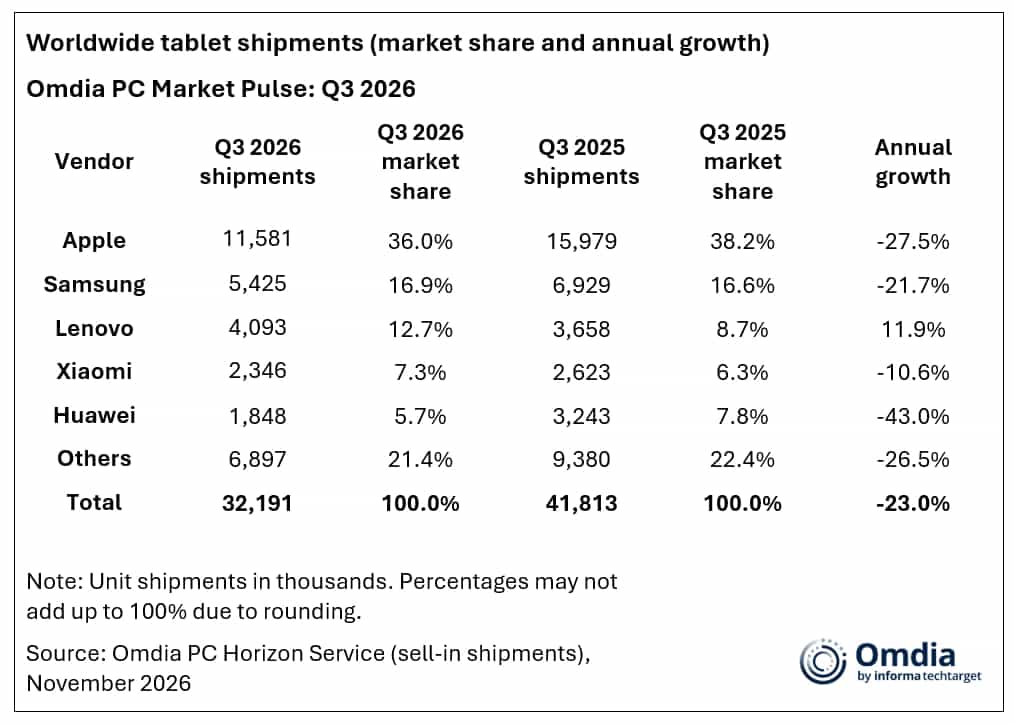
Among the top five tablet vendors in Q3, third-placed Lenovo was the only company to post year-on-year shipment growth. Omdia noted that Lenovo delivered stronger sell-in performance across all regions except Europe and Latin America.
Lenovo recorded 4.09 million tablet shipments in Q3, up 11.9% year-on-year. Its market share also rose from 8.7% to 12.7% during the same period.
Omdia projects, “As supply constraints intensify, tablets are increasingly taking a backseat in vendors’ strategic priorities for 2026 and 2027. With supply conditions expected to tighten further next year, a meaningful recovery in the tablet market is unlikely before 2028.”
The term “supply constraints” appears to refer to rising manufacturing costs driven by surging memory semiconductor prices, which in turn lead to higher end-product retail prices and a shrinking budget-to-mid-range market.
Xiaomi, ranked fourth, released its Pad 9 series in the second half of 2026; these releases had little impact on consumer demand. Huawei, Honor, OnePlus, and Realme have also launched new products recently.

Samsung has integrated Stripe’s Crypto Onramp into Samsung Wallet, allowing Galaxy device users in the US to purchase USD Coin (USDC) directly within the native wallet application.
The integration expands Samsung Pay’s footprint into digital asset infrastructure, bringing instant fiat-to-crypto conversions to an estimated 82 million active Galaxy smartphones nationwide.
Under the partnership, the newly launched Samsung Wallet Stablecoin Account enables users to buy Circle’s dollar-pegged stablecoin using linked credit cards, debit cards, bank transfers (ACH), and existing Samsung Pay balances.
Stripe handles the underlying infrastructure, including identity verification (KYC), regulatory compliance, and automated fraud mitigation during transactions. Concurrently, businesses using Stripe’s Crypto Onramp can now accept Samsung Pay as a checkout payment method.
By embedding a regulated stablecoin gateway directly into the operating system’s native wallet app, Samsung removes typical friction points such as third-party exchange registration and external wallet linking.
For Stripe, the integration significantly broadens the reach of its Web3 payment stack by attaching its processing engine to one of the largest mobile hardware footprints in North America.
Data shows stablecoin transaction volumes surpassed $1.5 trillion monthly earlier this year, driven by increasing adoption for cross-border settlements and yield-bearing digital cash equivalents.
Despite regulatory headwinds surrounding digital assets in the US market, hardware vendors are increasingly viewing stablecoins as a core layer for future peer-to-peer and micro-transaction features within modern mobile ecosystems.
Samsung’s deep integration signals growing confidence among tier-one hardware manufacturers that regulated stablecoins like USDC have matured sufficiently for mainstream consumer deployments.
As mobile wallets evolve beyond simple credit card virtualization into full-stack financial hubs, native access to dollar-backed digital assets is becoming a critical differentiator in premium smartphone platforms.


Samsung Electronics President Roh Tae-moon has bought another 3,000 shares of the company worth 630 million won, showing his confidence in the company at a time when investors are worried about its stock performance.
According to a disclosure filed with the Financial Supervisory Service on November 6, Roh bought the shares at 210,000 won each through an open-market transaction. The total value of the purchase was 630 million won.
After the latest purchase, Roh’s total shareholding in Samsung Electronics increased from 124,280 shares to 127,280 shares, marking a rise of around 2.4%.
This is not the first time Roh has invested in the company’s shares this year. In July, he bought 3,045 shares at 230,000 won per share. His latest purchase further increases his investment in Samsung Electronics.
The move comes as Samsung Electronics faces pressure in the stock market. It is raising concerns among shareholders about the company’s future performance.
Roh’s decision to buy more shares is being seen as a sign of his confidence in the company’s future. It may also help improve investor confidence, as the purchase shows that one of the company’s top leaders is willing to invest his own money in the business.
However, the purchase does not guarantee that the company’s share price will rise. Investors will continue to watch its business performance and future growth.

Apple is expanding its iPad tablet lineup in 2027, adding a new iPad Air, and Samsung Display is set to dominate the OLED display supply chain.
South Korean media outlet ZDNet reported that Apple is launching a new tablet model, iPad Air, in the second half of the next year, with Samsung Display expected to be one of the primary suppliers of the OLED panels.
Back in 2024, the Cupertino firm debuted the OLED iPad Pro in 11-inch and 13-inch sizes. The company added a new iPad Mini model this year, featuring an 8.5-inch OLED. Now, Apple is ready for another expansion with iPad Air in 2027.
Next year’s shipment forecasts for each OLED iPad model are as follows:
- Pro: 3 to 4 million units
- Mini: 4 to 5 million units
- Air: 4 to 5 million units
The panel suppliers for each model are:
- Pro: LG Display, Samsung Display
- Mini: Samsung Display
- Air: Samsung Display, BOE
For total iPad OLED volume next year, Samsung Display is widely expected to secure the largest share, while LG Display is expected to lead in panel volume for the top-tier iPad Pro OLED. BOE is aiming to supply OLED panels for one of the two Air models, though its technical capabilities remain a variable.
While expanding the OLED iPad lineup, Apple is maintaining clear specification differences between the Pro models and the Mini/Air models. A two-stack tandem OLED with two emitting layers is used for the Pro, whereas a single-stack OLED with a single emitting layer is used for the Mini and Air.
Thin-film transistor (TFT) also differs: Low-Temperature Polycrystalline Oxide (LTPO) is exclusive to the Pro, while the Mini and Air feature Low-Temperature Polycrystalline Silicon (LTPS), which has lower specifications than LTPO.
-
 Updates2 days ago
Samsung Galaxy Watch 9 and Ultra 2 grab October 2026 update
-
 Updates3 days ago
Galaxy phones get new GPSU as Samsung confirms 200+ patches in November 2026 SMR
-
 Issues3 days ago
One UI 9 update triggers Wi-Fi and network drops, SIM card issues
-
 One UI3 days ago
10 changes/features needed in One UI 9.5 to fight Android 17 and iOS 27 in 2027