
News
These are the 4 design upgrades for Samsung Galaxy S26 FE


Samsung Galaxy S26 FE is shaping its way to the launch event, and a recent live image leak has revealed 4 design upgrades that you should know about this Fan Edition smartphone.
Display
The display continues to be flat with round corners and uses a single hole punch to feature a selfie camera. It has slim bezels, but we have to see whether it surpasses the slimness of the S25 FE.

Frame
It is made of aluminum, and it might be better than the last generation. This perception is drawn from the dark color scheme, but we have yet to know its real color composition.
Round corners
Another thing to note is that the device has a slightly larger corner radius than the Galaxy S25 FE. The Galaxy S26 Ultra, released this year, also has this design tweak, which aligns it with the standard and the Plus models. It’s a sort of streamlined design approach from the company.
Rear camera design
Coming to the back, which has a new camera bump, it reflects the other Galaxy S26 models. Specifically, the company has connected the three rear cameras – wide, ultra-wide, and an optical telephoto- through a unified vertical camera island. Previously, these were separate crowns.
That’s pretty much it; these are the four design specs that leaked in the recent hands-on leak of the Galaxy S26 FE. The company announces the FE phones in the second half of the year, making them available with the latest software version and using the Exynos chipset, unlike the Snapdragon used in its higher-end siblings.






TSMC appears to have developed a glass-based CoPoS packaging technology for the next generation of AI chips. It’s a major breakthrough in the chip packaging segment after Samsung utilized its Heat Path Block (HPB) solution.
Ming Chi-Kuo reports that TSMC CoPoS is slated for mass production in H2 2026. The architecture targets ultra-large packages above the 9.5x reticle-size class. NVIDIA’s Feynman AI chip is already being floated as a potential first adopter.
Here’s where the glass story gets technical, and where a lot of coverage has gotten it wrong, via Ming Chi-Kuo:
Glass appears in CoPoS in two distinct roles.
- First, as temporary carriers measuring 310 by 310 mm during processing.
- Second, and more critically, as glass panels that are cut down into individual glass core substrates.
Those panels come in two sizes: 250 by 250 mm for pilot runs, scaling to 510 by 515 mm for full mass production. The substrate itself is a three-layer sandwich: a glass core in the middle, ABF build-up layers on both sides.
Glass is not acting as an interposer. Interconnect duty falls to the chip-side RDL combined with TGV and copper interconnects inside the glass core substrate stack. Glass is also not replacing ABF. They coexist in the same structure.
If CoPoS executes, TSMC’s advanced packaging lead could stay visible through roughly 2032.
Samsung, meanwhile, is pushing HPB for AI chips. It’s a real effort, but TSMC is building the architecture that the biggest customer in semiconductors, NVIDIA, is already circling.

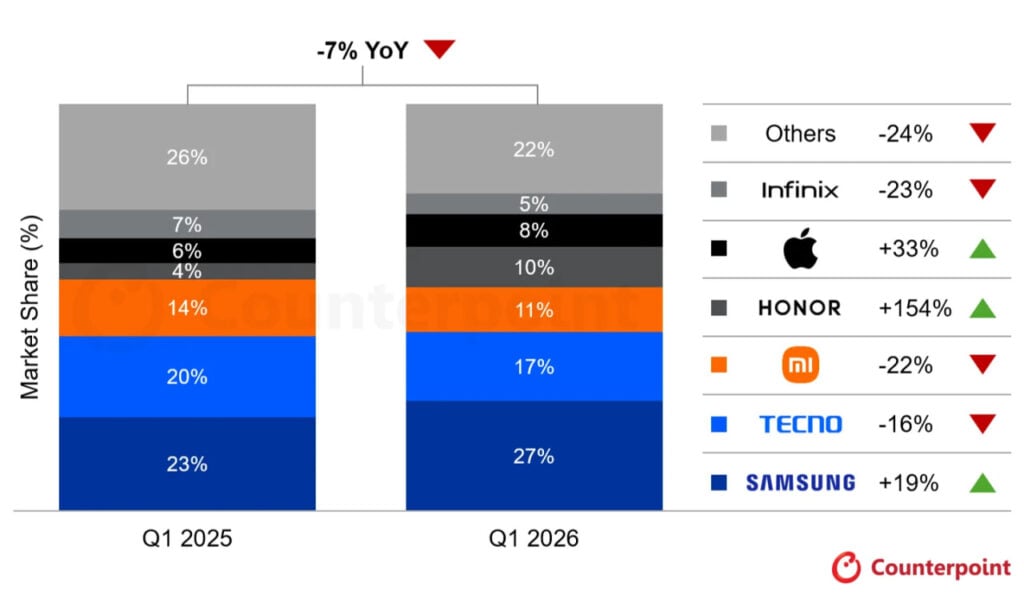
Samsung had a strong first quarter in the Middle East and Africa due to premium phones. The company has managed to grow its market share despite shrinking overall shipments triggered by the ongoing war in the region.
Counterpoint Research confirmed that Samsung Middle East and Africa shipments climbed 19% year-on-year, pushing its market share from 23% to 27%. The company grew by four percent, while the overall market slipped 7 percent.
Memory price spikes, logistics chaos, and active regional conflict dragged the whole industry down. Samsung’s premium lineup insulated it from the memory cost crunch.
Samsung grew 19% YoY, maintaining volume leadership in the region, supported by relatively stable prices and stronger inventories. Other Chinese OEMs, like Transsion and Xiaomi, have limited product availability and empty shelves in some cases.
Galaxy S26 series landed at exactly the right moment, feeding a market that kept reaching for high-end hardware even as budgets tightened everywhere else. Stable pricing and strong inventory management didn’t hurt either.
Apple also benefited from premium demand, shipping 33% more units and climbing to 8% market share.
Meanwhile, phones in the $50 to $99 bracket saw shipments fall 41%. Brands like Transsion and Xiaomi, which live in that territory, took the hit directly.
Related article:

Samsung Electronics convenes its Global Strategy Meeting next week, and the H2 2026 agenda includes AI, HBM, and the upcoming foldable phones.
The three-day session runs from June 16 through 18. The DX division meets first, under TM Roh, as per the fresh EToday report. DS division closes things out on the 18th, led by Vice Chairman Jun Young-hyun.
The MX unit is walking into that room with a real problem. Rising DRAM and NAND prices are squeezing smartphone margins, and Samsung is simultaneously trying to expand the Galaxy Z Fold and Flip lineup.
Middle East instability surfaces as a serious variable, too.
The DS division’s whole session circles one thing: where is the HBM and server DRAM market actually heading? Big Tech data center spending has been the story driving memory optimism, but those investment plans shift fast, and Samsung needs clarity.
AX, Samsung’s internal AI transformation push, also lands on the agenda. Starting June 12, employees can choose between ChatGPT, Claude, and Gemini for work tasks.
Related article:
The meeting won’t produce public fireworks, but the decisions made in those rooms this week will show up in the numbers by Q4.

On June 11, Samsung announced the start of Workspace AI Transformation (AX) and kick-started the rollout of ChatGPT, Claude, and Gemini.
With this move, Samsung handed its entire DX Division the keys to ChatGPT, Gemini, and Claude. The company is rolling out all three major generative AI platforms to executives and employees across its Device Experience division.
Samsung Electronics’ decision to use external generative AI is aimed at fundamentally innovating the way employees work to accelerate AI transformation. Based on this, the company intends to enhance the DX Division’s business competitiveness in the global market, ultimately providing customers with better product and service experiences.
Samsung ran a test group of roughly 2,500 employees before committing. They watched, measured, and then made a call that most companies are still debating in committee rooms.
“It is the starting point for fundamentally transforming the way we work and the speed of our execution.” – TM Roh
Meanwhile, the Korean tech giant will continue to offer its own Samsung Gauss AI model and chatbot to employees. The workspace now has the best compound of artificial intelligence tools available out there.
Related article:

Samsung officially launched an affordable model of its BESPOKE AI Steam robot vacuum cleaner in South Korea. The company has made it clear for a while that everyone should own a robot vacuum, and bringing a cheaper model is proof.
The South Korean giant has unveiled a standard (affordable) model in the expansive Samsung Bespoke AI Steam robot vacuum cleaner lineup, slotting below the Ultra and Plus variants it launched earlier this year.
What you actually get
- The Steam Clean Station: Provides hygienic mop maintenance through high-temperature washing, steam sterilization, and hot air drying.
- The EasyPass Wheel: Easily crosses single door thresholds up to 45mm high.
- The Pop-out Combo: Features an extended brush and mop to ensure thorough cleaning right up against walls.
- Samsung also baked in Knox security, earning a Diamond rating from UL Solutions.
Pricing lands between 1.41 million won (~ $920) and 1.59 million won (~ $1,040), depending on specs. It will be available through major online channels such as Samsung.com, Naver, and Gmarket.
The Bespoke AI Steam line crossed 20,000 units sold in May. It’s also the first robot vacuum chosen as a built-in option for a major Korean apartment complex, a 1,875-unit development in Uiwang-si scheduled for this July.
“By launching the standard ‘Bespoke AI Steam’ model, which offers both competitive pricing and performance, we will lead the popularization of K-robot vacuums and further strengthen our market competitiveness,” said Kim Yong-hoon, Vice President at Samsung Electronics Korea.
-

 One UI3 days ago
These Samsung Galaxy devices received One UI 8.5 official update
-

 Updates3 days ago
iOS 27 supports iPhones from 2019, Samsung’s 2022 flagship denied One UI 8.5
-
 Issues2 days ago
Samsung One UI 8.5 had a 5-month Beta, but battery life seems a mess
-
 Updates15 hours ago
Samsung releases June 2026 security enhancements for Galaxy S26, S25 (Edge/FE), Fold 7, Flip 7 and TriFold