
News
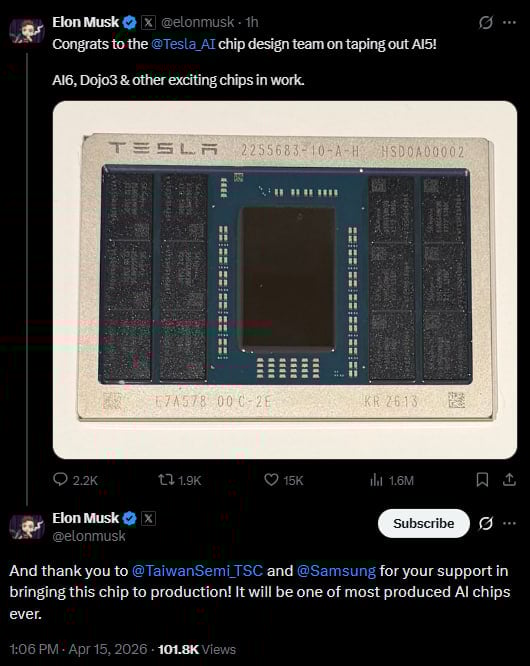
Samsung Taylor chip fab gears up for Tesla AI5 2nm production


Samsung is gearing up to commence mass production of the Tesla AI5 chip at its Taylor fab on the 2nm process. The company has reportedly completed “tape-out,” that is, finalizing the design for mass production.
Recently, a Samsung Foundry executive announced on LinkedIn that the 2nm chip design tape-out has been completed for Tesla AI5. However, the Samsung official removed the post shared on his LinkedIn account.
In his post, the Samsung Foundry principal engineer stated, “The AI5 is scheduled to be produced using Samsung’s 2nm process at the Taylor, Texas plant and will soon be equipped in Tesla’s latest products.”
The Taylor fab is expected to start initial operations later this year before taking on mass production for key customers, including Tesla, in 2027.
Why does Tesla AI5 matter for Samsung Foundry?
The AI5 program carries significance well beyond a single customer win. Samsung already manufactures Tesla’s current AI4 chip on its 7nm process at its Pyeongtaek campus, with an upgraded AI4 variant also expected to remain there.
AI5, however, represents the transition to Samsung’s cutting-edge 2nm technology and its brand-new Texas manufacturing base. Reports also suggest Tesla’s future AI chip roadmap will be divided between Samsung and TSMC.
Securing a large production program like Tesla AI5 could help improve factory utilization and demonstrate the competitiveness of Samsung’s advanced process technologies.
This project is likely to become the industry’s first real test of how well Samsung’s Taylor fab can execute leading-edge production at scale.


Consumer electronics price hike fear is looming across the world, and the same reason is now driving the demand for the Samsung Galaxy S26 series.
According to the Korean media, Samsung is producing 1.5 million additional units of the Galaxy S26, which has exceeded the previous forecast for July. Customers doubt that the Galaxy S27 series, releasing next year, could get a price hike due to the rising memory prices.
The new production plan adds up to 50% of what it originally decided for the current month for domestic and global markets. That’s not it; Samsung may add more volume to the production if the demand climbs.
On top of that, Samsung is also running special promo campaigns in the home ground to promote the latest devices. These are also contributing to this increased interest. Still, the price hike fear is real, and it’s showing effect among consumers.
DRAM crisis:
The semiconductor industry is cashing in on its resources during the generative AI era, and memory makers such as Samsung, SK Hynix and Micron have taken the central role in this price hike conversation.
These companies are putting more of their memory shipments to large AI firms, and reducing the DRAM production share for consumer devices. As a result, they not only created a supply issue but also increased the prices of the available memory chips.
Despite being part of the same group, Samsung’s mobile division isn’t getting any special offer on the memory prices. Therefore, it has to buy DRAM and NAND at the same prices as Apple and other memory makers.
To sustain its gross margin in each device, Samsung must increase the prices or bear the loss. The second option is very difficult. So, increasing the price remains the only way. For now, the Galaxy S26 series price remains unchanged, but there’s no certainty on what may come next.

Samsung has been offering an optional eSIM capability in smartphones for a while, and it is the right time to offer an eSIM-only version of the Galaxy S27, S27 Plus, S27 Pro, and S27 Ultra in limited markets.
The phone maker could adopt an iPhone-like strategy because there are no regulatory barriers. For example, Samsung, Apple, and any other smartphone maker in the US falls under the same framework from the FCC and carriers. So, rules are the same for each player, and it’s up to the company to decide when to sell such smartphones.
Can Samsung do it?
Yes, Samsung is already offering an eSIM feature that could pair with major carriers like AT&T, Verizon, and T-Mobile. The company has set up guides for a better user experience. Apple started doing this with the iPhone 14 and continues to do so with each new release.
Why should Samsung introduce eSIM?
Besides easy switching, the eSIM has its own benefits.
Security
The first thing thieves do when they steal the device is remove the physical SIM to stop the cellular connection. This move prevents the owner from tracking the device through services like Find My. This isn’t possible with the eSIM phone, which requires user authorization. Basically, the phone will remain online as long as it has power.
Better design
Removing the physical tray eliminates vulnerable points for moisture and micro-particles to enter the device. This would further strengthen its IP68 rating and increase the longevity of the phone.
Space
Even a small SIM tray takes notable space, and removing this entire structure could free up useful area. This could be utilized to increase the battery, improve the cooling system, or do anything that the smartphone maker may fancy.
Conclusion
Yes, this isn’t for every country, but markets like the US are perfect to sell eSIM-only devices. This cannot be done with the upcoming foldables, so Samsung can offer eSIM-only versions with the Galaxy S27 series next year.


A new leak suggests Samsung has downgraded the Galaxy S27 Pro model’s camera specs. Rather than offering an Ultra-like imaging system, the Pro model is now expected to sit between the base S27 and the S27 Ultra.
Naver blogger Lanzuk reports that Samsung has revised its plans for the Galaxy S27 Pro variant’s camera specs. Instead of delivering a near-Ultra experience, the company is now expected to position the device in the middle of the lineup.
That said, the Galaxy S27 Pro will no longer inherit most of the Galaxy S27 Ultra’s imaging hardware. Rather, it will share only selected camera specs with the Ultra while adopting others from the standard S27 and S27+.
Earlier rumors suggested the S27 Pro would replace the Edge concept with premium hardware in a slimmer form factor. If this leak proves accurate, Samsung appears to be creating clearer separation between the Pro and Ultra models.
Buyers wanting the absolute best camera experience may still need to step up to the Ultra, while the Pro could become a more balanced flagship focused on design, performance, and price.
Samsung has traditionally kept the Ultra as its photography showcase, and limiting the Pro’s camera hardware would preserve that distinction.
The source claims Samsung’s roadmap beyond the Galaxy S28 remains uncertain for this product line, with long-term plans still reportedly undecided.
As always, these details are based on early development information and should be treated with caution. Samsung is still many months away from unveiling the Galaxy S27 series, leaving plenty of time for changes before launch.


Samsung TV Plus just got a lot more interesting for anyone who’s ever wished they could catch a live musical without booking a flight to Seoul or fighting for a decent seat.
The company’s free ad-supported streaming service is now hosting full musical theater productions, and the first one out of the gate is Maybe Happy Ending.
It premieres Sunday at 7 PM on STN, the Samsung-exclusive channel baked into TV Plus, and it’ll keep airing weekly through mid-August. Samsung isn’t stopping there either, with Hero landing on Liberation Day, telling the story of independence fighter Ahn Jung-geun, and Crash Landing on You getting a Chuseok slot in late September.
Additionally, the K-drama is getting the musical treatment, and honestly, that alone might pull in viewers who’ve never sat through a stage production in their life.
Crash Landing on You will ship with Multi-Cam, letting viewers pick their own camera angle mid-scene instead of accepting whatever the director decided was important.
Samsung TV Plus – Eclipsa Spatial Audio
Then there’s Eclipsa Audio, built on the IAMF spatial audio standard, which is doing the heavier lifting here. It’s meant to separate dialogue and vocals cleanly while still rendering the room itself, crowd noise, hall acoustics, that sense of space you lose the second a performance gets flattened into a TV speaker.
“Eclipsa Audio” is a spatial audio technology based on IAMF (Immersive Audio Model and Formats); it delivers actors’ dialogue and vocals with exceptional clarity while three-dimensionally reproducing the atmosphere of the venue, such as the cheers of the audience.
It could be the more meaningful upgrade of the two, since audio is usually where streamed live performances fall apart.
Lee Gwi-ho, Vice President of the Visual Display Business at Samsung Electronics, stated, “Through Samsung TV Plus, we have brought the moving experience of the theater into the living room, putting the power of choice in the hands of the audience.”


Samsung Electronics and Samsung Display are jointly developing a next-generation glass interposer for AI semiconductors, with prototype production targeted for later this year.
According to TheElec (via SemiconductorsX), Samsung Display has already formed a dedicated R&D team focused on Redistribution Layer (RDL), while Samsung Electronics is working with external partners on manufacturing.
The initiative is intended to improve foundry competitiveness, reduce packaging costs, and build a stronger alternative to TSMC’s advanced packaging ecosystem.
Rather than manufacturing display panels, Samsung Display will focus on one of the most demanding parts of glass interposer production: forming high-precision Redistribution Layers through photolithography.
Samsung Display still has technical hurdles to overcome.
One of the biggest is the “SeWaRe” phenomenon, an interlayer delamination issue caused by differences in thermal expansion between glass and organic materials during the Redistribution Layer process.
Samsung Electronics reportedly plans to manufacture glass interposer prototypes before the end of the year. The company could outsource processes such as Through Glass Via formation and copper filling to specialized partners, including Soulbrain, Chemtronics, and Jungwoo M-Tech.
The South Korean tech giant is attempting to build an integrated platform that combines its foundry services with advanced packaging capabilities, creating a more complete manufacturing solution for AI chip customers.
-
 Phones3 days ago
Early adopter shares Galaxy Z Fold 8 Wide experience
-
 Samsung3 days ago
Samsung confirms re-shaped Instagram, Netflix, and YouTube
-

 News3 days ago
Galaxy Tab S12+ appears in new certifications with live design image
-

 Apps2 days ago
Samsung Voice Recorder gets 5 new features with One UI 9