
News
Right to Repair activist challenges Samsung’s warranty terms in a US court over SSD


Louis Rossman, a well-known Right to Repair activist, has filed suit against Samsung’s warranty terms in Texas, US, due to a 990 Pro SSD warranty dispute.
The activist purchased a 4TB Samsung 990 Pro SSD for $330. It failed within the warranty period. He did everything right: error logs, documentation, the full paper trail. Samsung’s support team reviewed those logs and confirmed the drive appeared dead.
Samsung tested the drive itself and suddenly declared it healthy. They shipped it back without explanation. Rossman tested it again (via Tom’s Hardware) on his own equipment and found it still wasn’t working correctly.
At that point, he gave Samsung an ultimatum: send a replacement 4TB 990 Pro within 60 days or face him in court in Austin, Texas.
Samsung’s response was to offer him $330 back, the original purchase price, citing a lack of available stock. The problem with that story is Rossman found the exact drive sitting on Samsung’s own Amazon storefront for $949.
It’s worth mentioning that Samsung’s own warranty language complicates their position. The agreement states the company will repair or replace the product, or refund the current market value if replacement isn’t possible.
Rossman has covered enough of these fights to know how they drag. The 60-day statutory window is up and the case is moving to court.


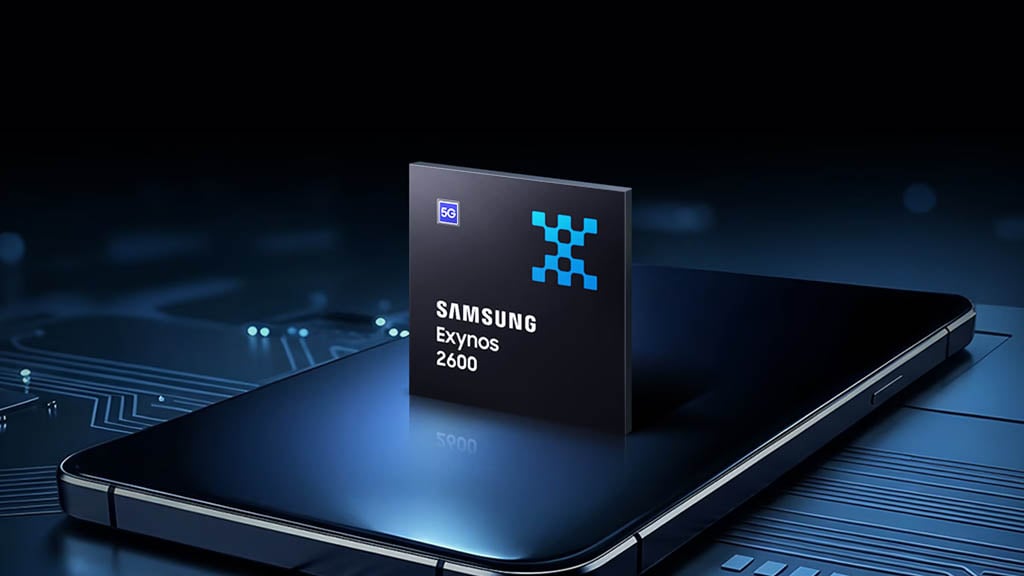
Samsung just dropped fresh MLPerf numbers on the Exynos 2600, and the result is quietly impressive. While everyone obsesses over flagship Snapdragon wins, Samsung’s in-house 2nm chip (already shipping in Galaxy S26 and S26+) is showing real progress on the one thing that actually matters for future phones: fast, local AI.
Key results from Samsung’s latest tests (via @SemiconductorsX):
- Mobile-BERT (NLP inference): 1199.57 QPS – 2.1x better than Exynos 2500
- Stable Diffusion (image gen): 0.53 QPS – 2.4x improvement
This lines up with Samsung’s earlier internal claim of 113% better generative AI performance on the NPU. It is built on the industry’s first mobile 2nm GAA process, aimed squarely at responsive on-device agentic AI and local generation instead of cloud round-trips.
These are real, public benchmarks (similar to industry-standard MLPerf tests). Samsung’s main point is clear: The Exynos 2600 isn’t just trying to match Snapdragon in regular speed and graphics. Instead, it’s heavily focused on making on-device AI fast, private, and feel instant – all running directly on your phone without needing the internet. Still, these results are encouraging.

Source – Samsung | Via – Yonhap
If you are tired of AI features that only work with a strong internet connection, this is worth watching. Can Samsung finally make Exynos the AI champion in 2026 phones, or will Snapdragon still dominate the flagship market?

Google is reportedly considering Samsung Foundry’s 2nm process for its future TPU (AI chips). If the deal materializes, it’s going to be one of the biggest client production opportunities for the company’s chip manufacturing business.
TheInformation (via SemiconductorsX) reports that Google is considering tapping Samsung to manufacture a portion of its next-generation Tensor Processing Unit (TPU), the in-house AI chip that powers everything from Gemini to its internal cloud infrastructure.
The chip in question carries the codename “Icefish,” and it’s the 10th generation of Google’s TPU lineage. Mass production isn’t expected until 2028, but the supply chain maneuvering is already happening now.
Google’s plan would split the manufacturing across two foundries. TSMC handles the core logic die on its 1.4nm process. Samsung takes the memory I/O die, the component that bridges the logic chip to High Bandwidth Memory, on its 2nm process.
Why Samsung, specifically?
Samsung is the only company on the planet that makes the memory, runs the foundry, and handles advanced packaging under one roof. Samsung recently locked in Tesla’s AI6 chip and is manufacturing components for Nvidia’s Vera Rubin platform.
TPUs are core Google infrastructure. Winning a role in Icefish production would signal to the entire industry that Samsung’s 2nm process is trustworthy for the most demanding AI workloads in existence.


Samsung Galaxy S26 FE is shaping its way to the launch event, and a recent live image leak has revealed 4 design upgrades that you should know about this Fan Edition smartphone.
Display
The display continues to be flat with round corners and uses a single hole punch to feature a selfie camera. It has slim bezels, but we have to see whether it surpasses the slimness of the S25 FE.

Frame
It is made of aluminum, and it might be better than the last generation. This perception is drawn from the dark color scheme, but we have yet to know its real color composition.
Round corners
Another thing to note is that the device has a slightly larger corner radius than the Galaxy S25 FE. The Galaxy S26 Ultra, released this year, also has this design tweak, which aligns it with the standard and the Plus models. It’s a sort of streamlined design approach from the company.
Rear camera design
Coming to the back, which has a new camera bump, it reflects the other Galaxy S26 models. Specifically, the company has connected the three rear cameras – wide, ultra-wide, and an optical telephoto- through a unified vertical camera island. Previously, these were separate crowns.
That’s pretty much it; these are the four design specs that leaked in the recent hands-on leak of the Galaxy S26 FE. The company announces the FE phones in the second half of the year, making them available with the latest software version and using the Exynos chipset, unlike the Snapdragon used in its higher-end siblings.

TSMC appears to have developed a glass-based CoPoS packaging technology for the next generation of AI chips. It’s a major breakthrough in the chip packaging segment after Samsung utilized its Heat Path Block (HPB) solution.
Ming Chi-Kuo reports that TSMC CoPoS is slated for mass production in H2 2026. The architecture targets ultra-large packages above the 9.5x reticle-size class. NVIDIA’s Feynman AI chip is already being floated as a potential first adopter.
Here’s where the glass story gets technical, and where a lot of coverage has gotten it wrong, via Ming Chi-Kuo:
Glass appears in CoPoS in two distinct roles.
- First, as temporary carriers measuring 310 by 310 mm during processing.
- Second, and more critically, as glass panels that are cut down into individual glass core substrates.
Those panels come in two sizes: 250 by 250 mm for pilot runs, scaling to 510 by 515 mm for full mass production. The substrate itself is a three-layer sandwich: a glass core in the middle, ABF build-up layers on both sides.
Glass is not acting as an interposer. Interconnect duty falls to the chip-side RDL combined with TGV and copper interconnects inside the glass core substrate stack. Glass is also not replacing ABF. They coexist in the same structure.
If CoPoS executes, TSMC’s advanced packaging lead could stay visible through roughly 2032.
Samsung, meanwhile, is pushing HPB for AI chips. It’s a real effort, but TSMC is building the architecture that the biggest customer in semiconductors, NVIDIA, is already circling.

Samsung had a strong first quarter in the Middle East and Africa due to premium phones. The company has managed to grow its market share despite shrinking overall shipments triggered by the ongoing war in the region.
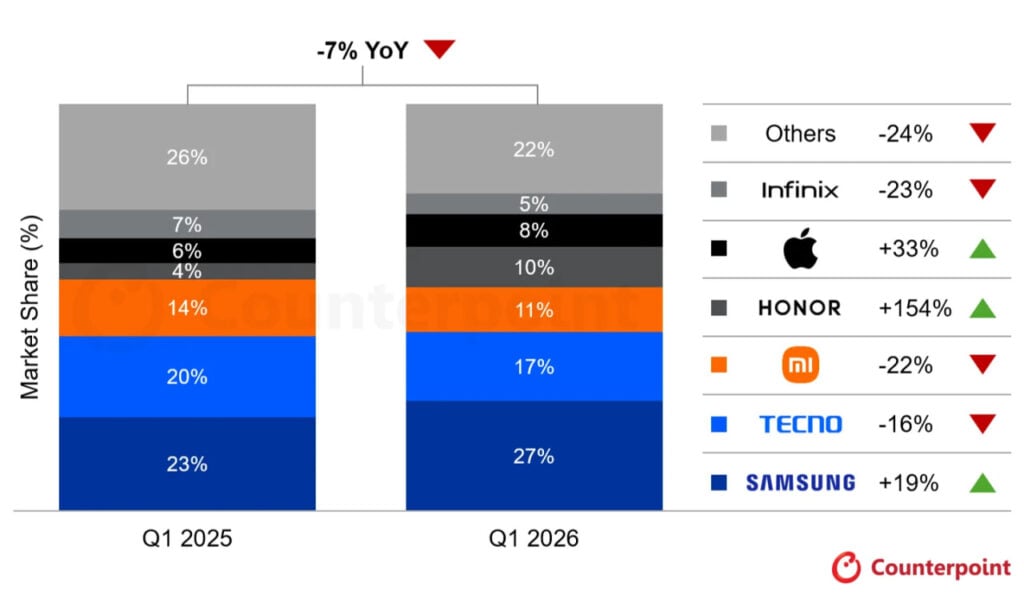
Counterpoint Research confirmed that Samsung Middle East and Africa shipments climbed 19% year-on-year, pushing its market share from 23% to 27%. The company grew by four percent, while the overall market slipped 7 percent.
Memory price spikes, logistics chaos, and active regional conflict dragged the whole industry down. Samsung’s premium lineup insulated it from the memory cost crunch.
Samsung grew 19% YoY, maintaining volume leadership in the region, supported by relatively stable prices and stronger inventories. Other Chinese OEMs, like Transsion and Xiaomi, have limited product availability and empty shelves in some cases.
Galaxy S26 series landed at exactly the right moment, feeding a market that kept reaching for high-end hardware even as budgets tightened everywhere else. Stable pricing and strong inventory management didn’t hurt either.
Apple also benefited from premium demand, shipping 33% more units and climbing to 8% market share.
Meanwhile, phones in the $50 to $99 bracket saw shipments fall 41%. Brands like Transsion and Xiaomi, which live in that territory, took the hit directly.
Related article:
-
 Updates1 day ago
Samsung releases June 2026 security enhancements for Galaxy S26, S25 (Edge/FE), Fold 7, Flip 7 and TriFold
-
 Issues3 days ago
Samsung One UI 8.5 had a 5-month Beta, but battery life seems a mess
-
 One UI2 days ago
Instead of waiting for One UI 9 Beta, try this awesome One UI 8.5 feature
-
 News3 days ago
Samsung TV Plus covers US sports for free across FIFA+, UFC, and more