
Technology
Apple could launch foldable display MacBook as soon as 2026


In the global smartphone market, various OEMs introduced foldable display devices to seize market share, but Apple has not launched any. Recently, a trusted Korean media outlet reported that the foldable display Apple MacBook laptop is expected to be launched in 2026 at the earliest.
South Korean companies are coordinating development and production plans for foldable OLED panels for laptops in line with the opening of the foldable panel market for IT devices.
Samsung Display has decided to invest $3.1 billion to produce 8.6-gen OLED panels from 2025 to 2026. LG Display is also investing in medium-sized OLED panels, including those for tablet PCs.
Follow our socials:
However, Korean manufacturers have released the first laptops with OLED panels, but not yet any with foldable OLED panels. Samsung Electronics has only secured trademark rights for foldable laptops.
The current leader in the foldable laptop market is Asus. In September 2022, the Taiwanese laptop maker launched the world’s first 17-inch foldable OLED laptop, the ZenBook 17 Fold OLED. The product is reportedly loaded with panels from China’s BOE.


Semiconductor
Samsung’s HBM5 with Heat Path Block (HPB) technology: A detailed technical explanation


Hey everyone, if you have been following the crazy growth in AI, you know memory isn’t just about speed anymore, it’s about keeping things from melting under insane workloads.
Samsung just dropped something pretty cool (well, it needs to be cool) at Computex 2026: the first physical mockup of its next-gen HBM5 memory, integrated with a new trick called the Heat Path Block, or HPB. I dug into the details from reliable reports, and it’s a smart move in the ongoing battle for AI dominance.
Why Heat is the New Bottleneck in AI Memory
High Bandwidth Memory (HBM) is the super-fast RAM that powers today’s AI GPUs and accelerators. It is like a skyscraper: multiple DRAM dies stacked vertically on top of a logic “base die” that talks directly to the processor. This setup gives massive bandwidth (terabytes per second), but it also generates a ton of heat, especially where the high-speed connections (called Die-to-Die or D2D interfaces) sit.
As stacks get taller and speeds climb (we are talking 14-16 Gbps now, with even more coming), that heat concentrates in the PHY area (the PHY area is basically the ‘communication zone’ on the base die where the super-fast data connections between the HBM memory and the GPU happen, and it’s also one of the hottest spots in the whole package).
Traditional cooling through the top of the stack or sides just isn’t cutting it anymore. Without better thermal management, performance throttles, systems become unstable, or you waste power on cooling.
Samsung’s rival SK hynix recently showed its iHBM (I will provide detailed information about iHBM very soon and link here) with built-in cooling elements. Samsung has an answer? HPB. It’s not copying, it’s a different but equally clever approach to the same problem.
What Exactly is Heat Path Block (HPB)?
If I want to explain “What is HPB?” easily, I will tell you to add a dedicated “chimney” right next to the memory stack. That’s basically HPB.
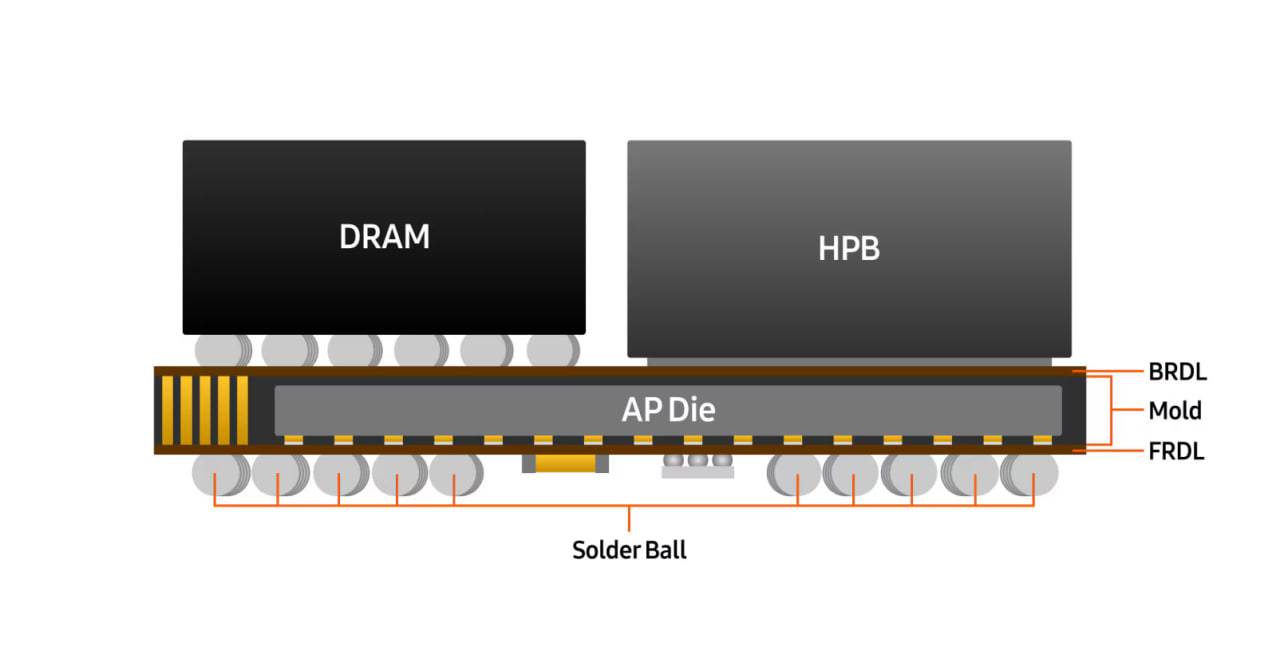 Instead of forcing all the heat to go through the DRAM dies (which aren’t great at conducting heat away quickly), HPB creates an independent thermal pathway. This structure (think thermal pillars or a block) sits on the same base die, pulls heat directly from the hot PHY region, and sends it to a heat spreader on top or the side of the package.
Samsung has already tested and verified this on its HBM4E samples (the 12-high stacks shipping now). It lowers thermal resistance, keeps temperatures more stable, and lets the memory run harder for longer without issues. Samsung first used a version of HPB in Exynos 2600 mobile processors, where it improved thermal performance noticeably, up to around 16% better resistance in some tests by optimizing the package layout.
 In the Computex HBM5 mockup, you can see the HPB structure alongside the core die stack. It’s a physical demonstration that this isn’t just a paper promise, it’s real hardware.

Via – @SemiconductorX/X
The 2nm Process Tech
The HPB isn’t the only upgrade. Samsung is going aggressive on manufacturing too. The Base Die for HBM5 will be built on Samsung’s own 2nm process node (using Gate-All-Around transistors). That’s a big jump from the 4nm used in HBM4 and HBM4E.
Why does this matter? A more advanced process means better power efficiency and higher performance in the logic part that handles all that high-speed data traffic. The core DRAM layers will use advanced 1c (6th-gen 10nm-class) technology, with potential for even denser stacks.
This is where Samsung’s unique position works. As an IDM (Integrated Device Manufacturer), the company designs both the memory and the foundry processes. Samsung’s CTO, Song Jae-hyuk, highlighted how this lets them optimize die placement and heat paths faster than competitors who might rely more on external partners. I am personally excited about this 2nm development. Good work, Sammy.
Samsung’s AI Memory Push
This HBM5 news is part of Samsung’s bigger push in AI. The company is speeding up its factory investments; for example, Samsung moved the groundbreaking for its new P5 Fab 2 in Pyeongtaek forward by 6 months to July 2026. The goal is clear: produce a lot more memory to meet the exploding demand for AI chips.
HBM5 is expected to target mass production around 2028, following samples and validation. For context, HBM4E already delivers impressive specs: up to 3.6 TB/s bandwidth per stack, 48GB capacity in higher configs, and it’s over 20% faster than previous generations in some cases. You will see HBM5 pushing those numbers further while staying cooler.
Better thermal performance lets AI systems run at full speed for longer without slowing down or using too much extra power. That’s a big deal for data centers handling huge AI training or inference jobs.
Competition and the Industry Benefits
The HBM race is really heating up. SK Hynix has been leading the market share (57-62%) for high-end HBM, but Samsung (17-22%) is fighting back strongly with new innovations. Samsung’s HPB uses a dedicated external heat path, while SK hynix’s iHBM puts cooling elements inside the package. Both solutions target the same hot spot, showing that good thermal management is now just as important as raw speed or stacking more layers.
For big customers like NVIDIA, who still rely heavily on SK hynix today but are starting to diversify. These improvements mean more reliable and power-efficient memory. Samsung is also preparing its full AI memory lineup for upcoming platforms like NVIDIA’s Vera Rubin.
Meanwhile, Micron is also competing strongly by ramping up its HBM4 with excellent power efficiency and is already sold out for 2026, while preparing its own solutions for the upcoming HBM5 generation to challenge Samsung and SK Hynix.
From a business side, stronger HBM products could help Samsung win back ground in this high-profit AI memory market. Memory prices go up and down, but the strong demand from AI continues to be a big advantage.
Challenges and Opportunities
Of course, nothing is guaranteed. Samsung still has to successfully scale up its 2nm production, maintain good yields on these complex stacked packages, and keep costs under control. But its vertical integration, controlling both memory and chip manufacturing, gives it some unique advantages that others don’t have (you are winning here, Sammy).
For chip enthusiasts and semiconductor professionals, this is really exciting. It shows how innovation in packaging and thermal management is keeping up with smaller chip processes. As AI models keep getting bigger, the hardware underneath needs to evolve too, not just faster, but also smarter about power and heat.
If you are into chips, keep watching HBM developments closely. What started as a special memory for graphics cards has now become a key part of the AI revolution.
Samsung’s HBM5 with HPB feels like a strong step toward making those giant GPU clusters more efficient and reliable.


Samsung’s new Exynos 2600 processor is gaining attention because of its advanced cooling system, Heat Pass Block (HPB). This new technology helps the chip stay cooler and work faster for a longer time, mainly during gaming and heavy tasks.
Today’s smartphones become hot quickly because powerful processors create a lot of heat. Most premium phones use vapor chambers to control temperature, but Samsung has added something extra. The company placed a copper cooling layer directly on top of the processor to move heat away more efficiently.
Most smartphone companies, including Apple, use a design where memory is placed on top of the processor to save space inside the phone. While this makes phones thinner, it also traps heat. As a result, processors slow down after some time to avoid overheating. This problem is thermal throttling.
According to tests by YouTuber Geekerwan, the Exynos 2600 performed better than Qualcomm’s Snapdragon 8 Elite Gen 5, even when the Snapdragon chip was cooled using liquid nitrogen. Surprisingly, the Snapdragon processor still could not maintain stable performance for long periods.
The Exynos 2600 is not completely free from heating issues. The Galaxy S26+ still showed some throttling during long gaming sessions because its cooling system is smaller than that of the Galaxy S26 Ultra. However, adding a small clip-on fan to the back of the phone helped improve cooling and performance.
Samsung’s new HPB cooling system could become very important for future smartphones. Other companies like Qualcomm, Apple, and MediaTek may also adopt similar cooling methods in upcoming processors.

Qualcomm has introduced a new chip, the Snapdragon C Platform. This chip is made for low-cost laptops. It is expected to be used in laptops made by companies like Samsung, Acer, HP, and Lenovo.
The main aim of Qualcomm’s Snapdragon C is to make cheap laptops faster, more efficient, and longer-lasting. These laptops are expected to start at around $300, which makes them more affordable for many people.
Snapdragon C chip is designed for daily use, like browsing the internet, watching videos, attending online classes, and doing office work. It also includes a special AI part, an NPU. This helps laptops do smart tasks faster, like improving video calls or helping apps run better.
The biggest benefit of Snapdragon C is better battery life. Laptops using this chip are expected to last all day on a single charge. They also run cooler and quieter, so fans will not make much noise.

Due to these improvements, the Snapdragon C chip could make laptops like the Samsung Galaxy Book series more powerful in the budget category. It may also help them compete better with Apple’s MacBook line, including models like the MacBook Neo.
However, the real performance will depend on how laptop companies use the chip and how well the software works with it. This chip could change the entry-level laptop market. The first Snapdragon C laptops are expected to come out later this year.

Samsung is getting ready to launch its first smart glasses and plans to offer more styles in the future. The company recently showed two designs made with fashion brands Gentle Monster and Warby Parker. Samsung said these are only the first models, and more designs will come later, so people can choose styles they like best.
The smart glasses are expected to launch in Fall 2026. Samsung has not shared the official price or final name yet. Right now, the company is calling them “Intelligent Eyewear.” The glasses are being made for everyday use and will also support prescription lenses. This means people who wear glasses for eyesight can use them easily.
Samsung’s smart glasses use Google’s Android XR system and are powered by Gemini AI. The glasses come with a front camera, microphones, speakers, and a touch control area on the side. There is also a small LED light that turns on when the camera is recording, helping people know when they are being filmed.
The glasses can connect with both Android phones and iPhones. Users can even control them using a Galaxy Watch. With Gemini AI, the glasses can help with directions, music, message replies, notifications, and internet searches. This allows users to get information quickly without using their phones all the time.
Samsung’s new smart glasses will compete with smart glasses from Meta and the expected glasses from Apple. The first version will not have a display screen inside the glasses.
However, future models planned for 2027 or 2028 may include built-in displays for a more advanced experience. Samsung hopes these smart glasses will combine fashion, comfort, and useful technology for daily life.
Technology
Why Samsung’s camera failed so badly in this Night Shot – Galaxy S26 Ultra vs Vivo X200 Ultra


Samsung makes beautiful phones with one of the best camera hardware. But this camera comparison picture shared by X user raises a big question. I am not criticizing Samsung for this comparison (as I can not verify the authenticity of this image), but this one is embarrassing.
Look at this side-by-side photo comparison, and you will be shocked. A user took the same picture of a nighttime construction crane using the Galaxy S26 Ultra and Vivo X200 Ultra. The Vivo X200 Ultra captured a clear, sharp image. You can read the word “JONES” on the crane and see every little detail on the metal and cables. But the Samsung Galaxy S26 Ultra? It looks terrible. The picture is dark and blurry. The text is unreadable. If this is an authentic image, then Samsung should be embarrassed by such poor quality. WHY?
Samsung is falling behind because its hardware is not strong enough for low-light zoom shots. The Vivo phone uses a giant 200-megapixel periscope lens with a big sensor and bright aperture. It catches lots of light naturally, so the photo stays sharp even at 10x zoom. Samsung’s S26 Ultra has only a 50-megapixel 5x periscope and a weak (not really, but yes) 10-megapixel 3x lens.
At 10x, Samsung has to use digital zoom and heavy AI tricks to fill in the gaps. In low light, you get less real detail and more noise. The phone simply cannot get enough light to begin with. Samsung is trying too hard with Nightography mode. It smooths everything out with AI, removes noise, and wipes fine textures. The result is a flat, blurry mess.
I have to praise Vivo’s processing. It keeps the natural sharpness because the hardware already did most of the work. Chinese brands like Vivo are winning the camera zoom war because the companies are adding huge sensors in the telephoto cameras.
Samsung is focusing more on video and everyday shots. That choice is now costing the company in this tough competition. Some fans are blaming the user. Some are saying, “You focused wrong” or “You didn’t use the right night mode.” Sure, user error is a possibility here. But a flagship phone like S26 Ultra should not be so easy to mess up.
I believe a phone with good cameras should help regular people get great results, not punish them for small mistakes. Samsung’s system is too picky, and its results vary too much.
If Samsung wants to stay on top in the camera world, it must stop relying so heavily on AI and start investing in better telephoto hardware. Samsung fans deserve much better than this.
-
 One UI1 day ago
One UI 9.0 (Android 17) testing on these 50 Samsung devices
-
 One UI3 days ago
Official Samsung One UI 9.0 and One UI 9 Watch release in the market starting today
-

 News2 days ago
After 7 years, Samsung finds a new Galaxy pre-order champion
-
 Phones3 days ago
New Galaxy S27 rumors signal massive display and performance upgrades