
News
Samsung Art Store crosses 5,000 works with new Art Basel collection


Samsung quietly crossed a milestone: the Art Store now carries more than 5000 artworks in 4K, pulled from over 800 artists and 80-plus partners, all sitting behind a single subscription.
The South Korean tech giant has dropped the news alongside the launch of its Art Basel in Basel 2026 Collection, a 24-piece digital exhibition built around Swiss and Switzerland-based artists.
Eight galleries contributed work, including Mai 36, von Bartha, and Blue Velvet from Switzerland, plus international names like Fanta MLN and Felix Gaudlitz. The whole thing lands on Art Store starting today, timed to the fair’s June 18-21 run in Basel.
Three artists anchor the collection with real weight.
Thomas Huber’s “16.7.2024” reflects his distinctive approach to painting, where image and text converge to explore picture space as both a visual and philosophical construction.
Tobias Kaspar’s “The Japan Collection” examines systems of value, taste and desire through a multidisciplinary practice that bridges art and fashion.
Athene Galiciadis’s “Stillleben (Reflection on longings and belongings)” presents a richly layered visual language, combining geometric and organic forms with references to craft, design, science and spirituality.
Samsung is running a gallery-style Art Wall in Basel built from The Frame Pro, OLED, and Micro RGB displays, pulling works based on what attendees respond to visually. Notably, Artist Daniel Arsham is now Samsung’s Art TV ambassador.
Art Store runs across Samsung’s 2026 Art TV lineup, covering The Frame, The Frame Pro, Neo QLED, OLED, and Micro RGB.








Huawei is on its journey to develop in-house or rely on Chinese national tech solutions after the United States cut crucial access. Meanwhile, the latest Huawei flagship phones still depend partly on Samsung-made memory solutions.
In a Kirin 9030 and 9030 Pro teardown, SemiAnalysis (via SemiconductorsX) discovered a mix of Samsung and CXMT memory chips, powering the Huawei Mate 80 series flagship phones.
The Pro variant carries 12 GB of Samsung DRAM, two stacks of four dies each, identified as the K4L2E165YD. That’s LPDDR5X-9600 built on Samsung’s 1a node, the fourth generation of its 10nm-class DRAM family after 1x, 1y, and 1z.
Irony doesn’t get much richer than this. Samsung’s 1a has shipped in volume since 2022, which means Huawei is buying current, competitive memory from the company whose country’s government is actively sanctioning them.
SemiAnalysis report pointed out:
China is not closing the gap with Intel, Samsung and TSMC. The teardown shows the opposite in several places: no EUV, no backside power, higher process complexity, and visible trade-offs.
Units surfaced with two different memory packages, depending on who built them, Samsung or China’s CXMT. The CXMT 16GB package, marked CXDD7JEDM and assembled in week 45 of 2025, is stacked the same way.
CXMT is closing the distance, but Huawei still needs Samsung to fill the top of its own lineup.


Chip foundry giant TSMC is reportedly building out a full supply chain for Panel-Level Packaging, the next-generation semiconductor packaging technology where Samsung Electronics has held a quiet, durable lead for years.
ETNews, via SemiconductorsX, reports that TSMC is in talks with equipment and materials suppliers to lock in a mass production system based on Panel-Level-Packaging technology, and the target is early next year.
After absorbing the PLP business from Samsung Electro-Mechanics in 2019, Samsung spent years quietly applying the technology to mobile application processors and power management chips.
TSMC didn’t need PLP when conventional wafer-level packaging was keeping customers happy. Meanwhile, the demand for bigger chips at higher volumes changed the prospect overnight.
What is Panel-Level Packaging
Conventional packaging happens on round wafers.
A 300mm wafer wastes the edges, all that curved geometry that can’t fit a complete chip.
PLP moves the process to a rectangular panel, roughly 600x600mm, offering five to six times the output from the same process.
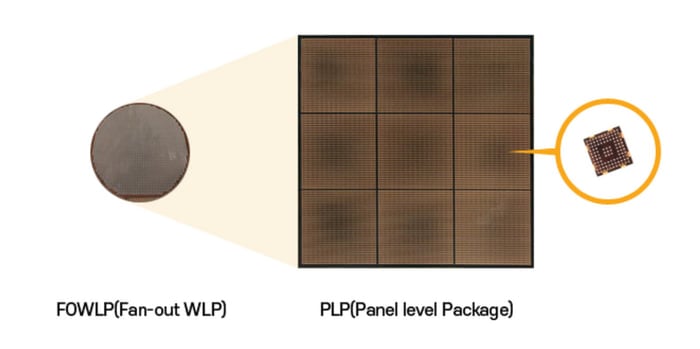
Notably, TSMC stood up a pilot line in 2025, evaluated it, and is now moving toward large-scale production. The company has reportedly already secured customers among global AI chip players.
Samsung isn’t standing still either. It’s pushing PLP into high-performance computing and AI semiconductors, and it’s eyeing glass substrates as the next packaging frontier.

Supply chain sources have surfaced a picture that should make Samsung’s product team sweat. Apple is reportedly aligning the reveal of its first foldable iPhone around the launch of Samsung Galaxy S27 series in early 2027.
MoneyUDN (via SemiconductorsX) reports that Apple is planning to drop the iPhone 18 family this autumn, then follow it with its first-ever foldable iPhone in early 2027.
The iPhone Ultra foldable phone lands almost directly on top of Mobile World Congress (MWC), the exact moment Samsung traditionally owns the conversation with its Galaxy S series.
Largan Precision CEO Lin En-ping didn’t exactly announce anything at a recent shareholders’ meeting, but he didn’t hide it either. He revealed that “Q4 will be busier than usual,” with some devices arriving in Q3 and others pushed to early 2027.
The “reveal first, ship later” strategy Apple appears to be running extends its peak season deep into Q1 2027. The iPhone maker is targeting the Lunar New Year in China as well as Samsung’s mainstream launch event.
Market research firms project Apple could capture nearly 30% of the global foldable market in year one, shipping up to 11 million units.
Samsung has launched Galaxy S phones in February for over a decade without ever competing directly against a simultaneous Apple flagship. Meanwhile, that’s going to end, starting in 2027, when the first foldable iPhone lands.
However, Samsung is also preparing to rival Apple’s first foldable by bringing the Galaxy Z Fold 8 Wide. This model would come with a different screen ratio than legacy foldables, directly rivaling the Apple iPhone Ultra.
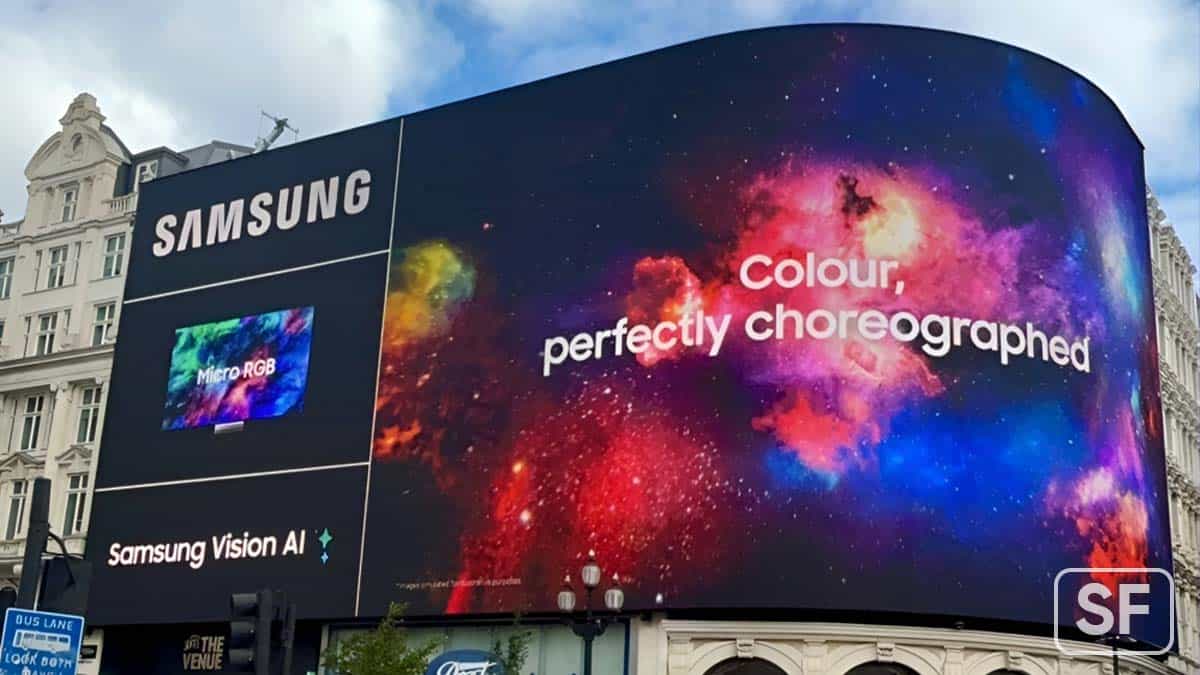
Samsung isn’t whispering about Micro RGB, but it’s screaming it from Times Square. The company has planted billboard campaigns at some of the most-watched intersections on the planet.
Times Square in New York, Piccadilly Circus in London, and The Entertainment Building in Hong Kong, aren’t subtle placements; Samsung picked the loudest rooms in the world and turned the volume up.
At the center of it all sits a hip-hop dance campaign built around choreographer Sergio Reis.
Centering on a large-scale hip-hop dance performance created in collaboration with renowned choreographer Sergio Reis, the advertisement visually brings Micro RGB’s extensive array of red, green and blue backlights to life, along with the precision AI engine that controls them.
The performance visually maps to what Micro RGB actually does: thousands of individual red, green, and blue backlights firing with precision, shaped by the Micro RGB AI Engine Pro.
AI Soccer Mode lets viewers mute commentators entirely, which, honestly, is the feature nobody knew they needed until right now. Vision AI Companion layers in real-time player stats while you watch.
The campaign runs through the end of the year across all locations.


Samsung Electronics’ Foundry chief threw cold water on recent optimism about the division’s financial recovery, saying a return to profit is unlikely before 2028.
Han Jin-man, president of Samsung’s foundry business, told employees (via KoreaHerald) at an internal briefing Thursday that turning the division profitable “does not look easy even next year [2027].”
“Turning the foundry business to a profit does not look easy even next year,” said Samsung Foundry chief, and added that “There is a high possibility of achieving profitability in 2028.”
His remarks landed just five days after industry sources told Chosun that the foundry unit could break even as early as the third quarter of 2026.
Han pointed to several structural problems beyond the usual cost complaints: a business mix still too dependent on mobile customers, weak technological competitiveness, orders won at margins too thin to matter, and a legacy process business he now wants to exit as the market turns into a “red ocean.”
A newly established employee bonus system, funded at 10.5% of semiconductor division profits, adds another recurring cost layer that analysts may not have fully accounted for.
The Taylor chip manufacturing factory, central to the turnaround thesis, won’t enter mass production until next year, Han indicated, later than some had assumed.
Related article:
-

 Updates2 days ago
Samsung gives two retired Galaxy S phones and a Note a fresh life, now in the US
-

 Updates2 days ago
Samsung Galaxy Watch 7, 8 and Ultra get new Wear OS update with security improvements [U: Live in USA]
-
 Updates21 minutes ago
Samsung releases June 2026 security enhancements for more Galaxy S26, S25 (Edge/FE), Fold 7, Flip 7 and TriFold
-
 News3 days ago
Galaxy Z Fold 8 Ultra looks massive next to the Z Fold 8 and Flip 8 in leak