
News
TSMC maintains 72.5% market share while SMIC gains ground on Samsung


The global chip manufacturing industry continued to grow strongly in the second quarter of 2026. According to TrendForce, the total revenue of the world’s top 10 chip foundries reached nearly $53.49 billion, up 11.5% from the previous quarter.
The main reason for this growth was the rising demand for chips used in AI, high-performance computers, smartphones, PCs, and other electronic devices.
TSMC remained the world’s biggest chipmaker. Its revenue reached nearly $40.2 billion, an increase of 12.1%. TSMC controlled 72.5% of the global foundry market. Strong demand for AI chips and advanced 3nm and 5/4nm chips helped the company maintain its lead. Its new 2nm technology also started generating revenue.
Samsung Foundry remained in second place, with revenue of $3.26 billion, up 1.8%. However, its market share fell to 5.9% because other companies grew faster. SMIC ranked third and showed the strongest growth among the top three. Its revenue increased 20% to more than $3 billion.
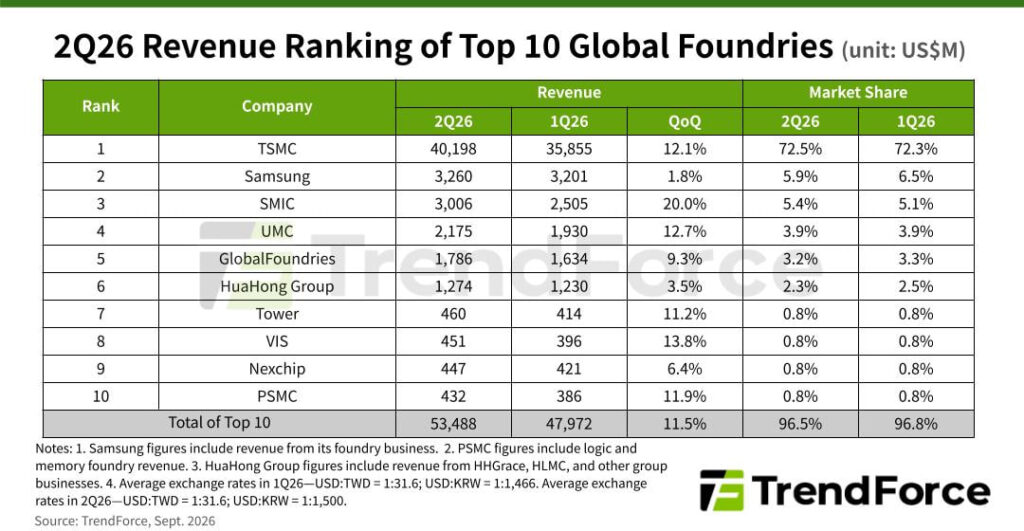
Image via TrendForce
SMIC’s market share rose to 5.4%, bringing it closer to Samsung. Strong demand for chips used in PCs, notebooks, AI systems, and networking products helped SMIC grow. UMC ranked fourth with revenue of nearly $2.18 billion, while GlobalFoundries ranked fifth with about US$1.79 billion.
Other major foundries, including HuaHong, Tower, VIS, Nexchip, and PSMC, also recorded growth. The industry to grow further in the third quarter due to strong demand for smartphones, AI, and advanced computer systems.






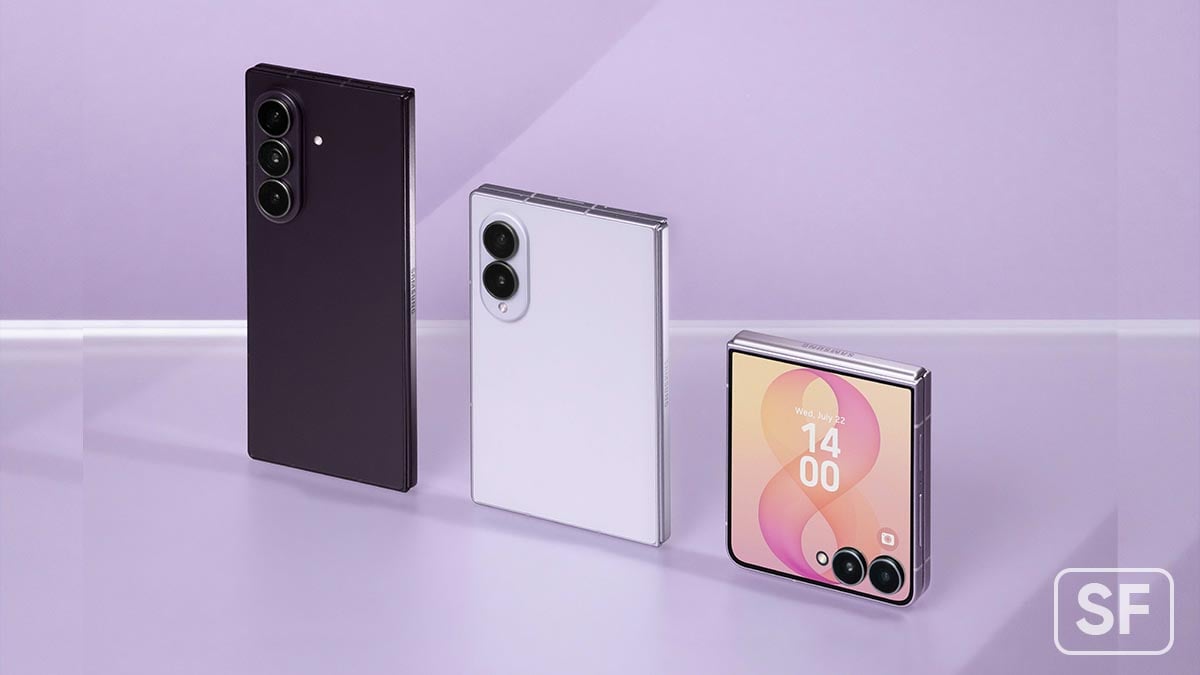


Samsung has now released refurbished Galaxy S26, S26+, and S26 Ultra in the UK as part of its Certified Re-Newed program. The company is making its latest Galaxy flagships a little easier to buy without paying full flagship prices.
In the UK, the refurbished Galaxy S26 lineup is available through Samsung.com in Black and Cobalt Violet, with storage options ranging from 256GB to 1TB depending on the model.
Samsung backs these Certified Re-Newed phones with a two-year warranty, matching the warranty period listed for new smartphones in the UK.
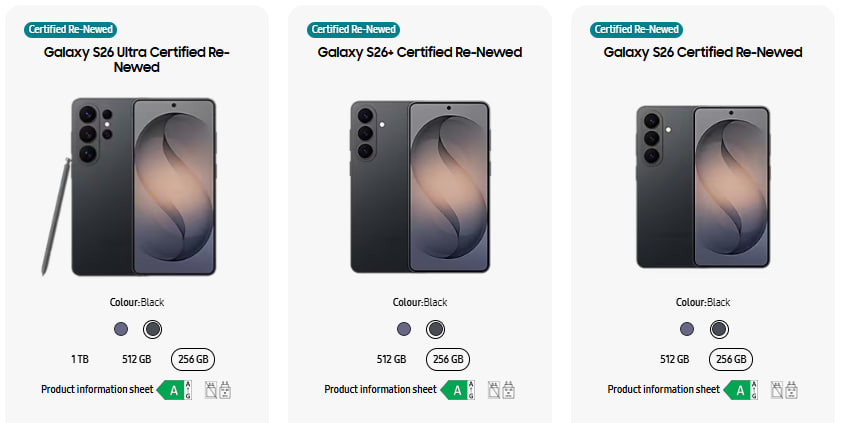
Certified Re-Newed devices go through Samsung’s own inspection and restoration process. Samsung says the phones are thoroughly cleaned and tested, while any required repairs use genuine Samsung components.
Galaxy S26, Galaxy S26+ and Galaxy S26 Ultra Certified Re-Newed undergo an in-house expert inspection and refurbishment process, which includes rigorous cleaning and quality tests. Each device is reconditioned to look and perform to Samsung’s high standards using genuine Samsung parts. During the restoration process, all devices are reset to delete personal data and ensure they are sold in a condition equivalent to that of a brand-new device.
The phones receive the latest available software, while Samsung’s certified batteries are tested to deliver performance comparable to a new device. Samsung also says minor cosmetic blemishes can remain, although they should not affect functionality.
The company expanded Certified Re-Newed to the UK, France, and Germany earlier this year, initially offering the Galaxy S25 series. The programme is also part of Samsung’s broader effort to extend the usable life of Galaxy smartphones.


OpenAI is taking its relationship with Samsung beyond memory supply and enterprise AI, with the two companies now working together on next-generation chip development.
OpenAI and Samsung expand chip collaboration
Harrison Kim, OpenAI Korea’s general manager, revealed the expanded cooperation during a press conference in Seoul, saying joint production and research on future chips is one of the areas where the two companies have made the most progress. He did not disclose which chips are being developed or what role Samsung will play.
The development is particularly interesting because OpenAI has already started building its own silicon. In June, the company introduced Jalapeno, its first custom AI inference processor, developed with Broadcom.
OpenAI designed the architecture around the requirements of large language models, while Broadcom is handling key silicon and networking technologies. The chip is planned for large-scale deployment starting later this year.
Samsung’s involvement could therefore extend beyond simply supplying memory for OpenAI’s AI infrastructure.
The two companies already have a substantial relationship through Stargate. Samsung agreed to supply advanced memory for the project, with OpenAI estimating demand could eventually reach 900,000 DRAM wafers per month across its memory partners.
Samsung also brings expertise in memory, foundry and advanced packaging, areas that could become increasingly important as OpenAI develops specialized accelerators.
Samsung is also becoming a major OpenAI customer
The partnership works both ways. OpenAI says Samsung has deployed ChatGPT and Codex among employees globally, making it one of its largest enterprise deployments.
Samsung has been expanding internal access to generative AI tools as it looks to apply AI across research, development and other business operations.
For Samsung, the timing is notable. AI demand is driving an unprecedented push for advanced memory and semiconductor capacity, while the company is simultaneously strengthening its position across the AI chip supply chain.
OpenAI’s deeper cooperation could give Samsung another important customer and technology partner as custom AI silicon becomes a bigger part of the industry.

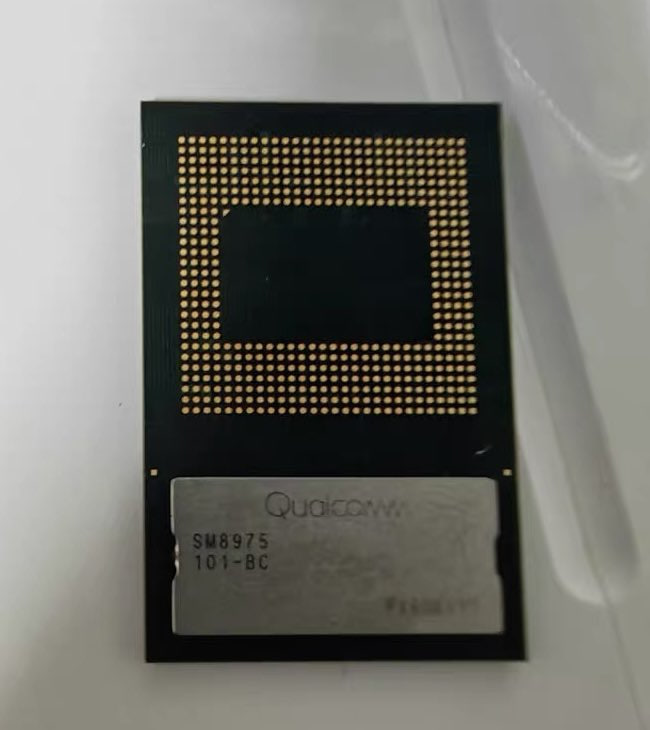
A newly leaked photo now gives us a better idea of what Qualcomm’s most powerful mobile chip, the Snapdragon 8 Elite Extreme Gen 6, could look like.
Qualcomm could be preparing a major change to its Snapdragon lineup this year. Instead of offering a single top-tier chip, the company is set to introduce standard and Pro variants, with the latter carrying Extreme branding.
Snapdragon 8 Elite Extreme Gen 6 appears unusually large
An image shared by LaidBackDeveloper on X appears to show the SM8975 package, which has previously been associated with Qualcomm’s higher-end Snapdragon 8 Elite Gen 6 variant.
Qualcomm appears to be placing the memory and thermal components alongside the processor. The new architecture could give manufacturers more room to manage heat when the chip is pushed hard during gaming or AI processing.
However, the package takes up considerably more physical space. Smartphone makers will therefore need to account for the larger footprint when designing their internal layouts.
Snapdragon 8 Elite Gen 6 Pro is also rumored to support newer LPDDR6 memory, while the standard model may stick with LPDDR5X. That could give vendors a choice between controlling costs and chasing maximum performance.
There are also claims of substantial GPU architectural changes aimed at improving gaming performance. If the leaked package is genuine, Qualcomm’s approach may influence phone thickness, cooling hardware and motherboard design.
With the first Snapdragon 8 Elite Gen 6 devices expected later this year, we shouldn’t have to wait too long to see how much of this leak actually makes it into commercial smartphones.

Samsung’s Privacy Display, which debuted on the Galaxy S26 Ultra, could be seen on two models in 2027: Galaxy S27 Pro and Galaxy S27 Ultra.
Galaxy S27 Pro and Ultra get Privacy Display
A new report suggests Samsung plans to equip Galaxy S27 Pro and Galaxy S27 Ultra with its Privacy Display technology. It will be a hefty privacy-focused hardware upgrade for the newly added Galaxy S27 Pro variant.
The company may have changed its plans for Privacy Display application. A previous report claimed that Samsung is considering bringing the new display technology to all four models of the Galaxy S27 series next year.
Meanwhile, ETNews now reports that Privacy Display will be used to differentiate the Galaxy S27 Pro and Ultra from the Galaxy S27 and Galaxy S27 Plus.

The past report came as a surprise, as Samsung doesn’t usually expand hardware-level upgrades to lower-tier flagship models this early. This could have also led to a cost increase, which would impact the final consumer pricing.
Privacy Display is backed by Samsung’s Flex Magic Pixel technology. It can be operated using a software interface within Settings. Samsung offers customization settings too, which you can use to set up the application of Privacy Display.
When enabled, Privacy Display dims the brightness significantly, making it can’t be seen from a side angle. Users can either apply it across the screen or hide a specific part of the screen, such as a notification pop-up or password entry.
Galaxy S27 Ultra is a natural beneficiary of Privacy Display. However, Galaxy S27 Pro is getting yet another Ultra-style perk from Samsung. This will further expand its appeal among consumers, while adopting a 6.47-inch OLED.
Looking ahead, Samsung plans to expand Privacy Display OLED beyond smartphones. Galaxy Book could be the next to adopt the FMP technology in the future, as Huawei already introduced it to its recent laptop in China.
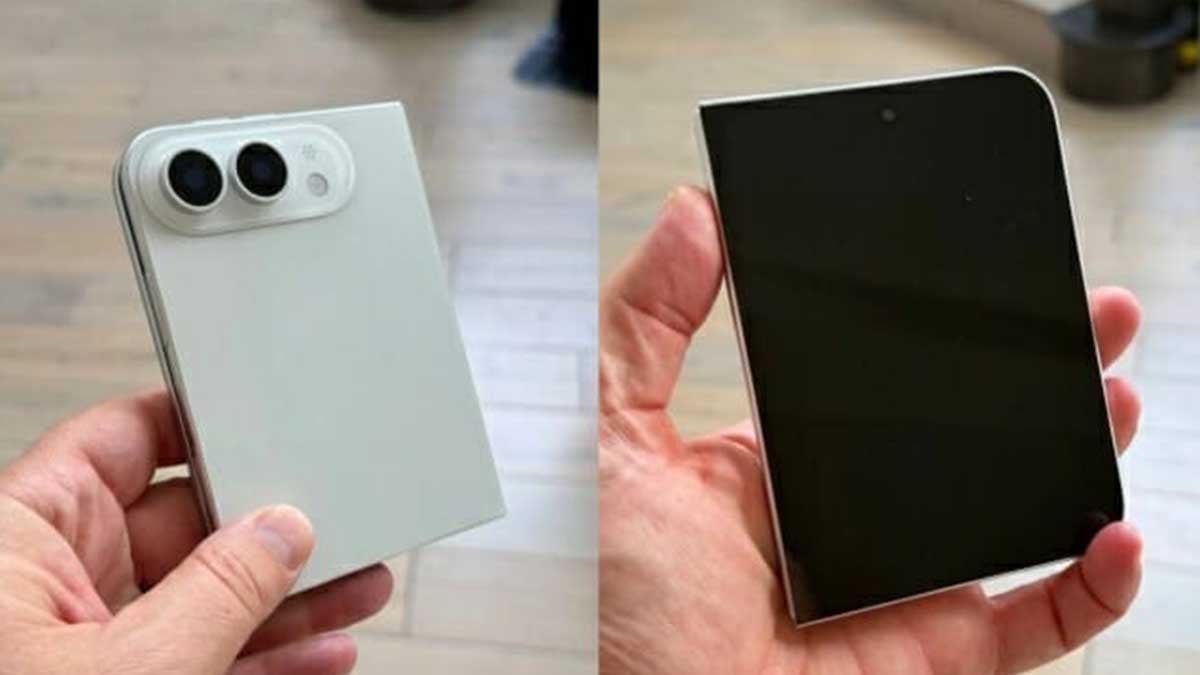
Apple’s first foldable iPhone is finally ready to enter the market, but the story behind it goes much further back than today’s launch. A new report from Bloomberg reveals that Tim Cook took Samsung and Huawei’s foldable phones seriously as early as 2020, helping push Apple toward a foldable iPhone.
Tim Cook saw Samsung and Huawei’s advantage firsthand
During a trip to Asia in 2020, Cook reportedly noticed that foldable phones were becoming increasingly common among consumers. Samsung and Huawei were already among the companies pushing the category forward, while Apple was still deciding what kind of foldable product it actually wanted to build.
Apple’s hardware teams had already been researching flexible displays, hinges and related technologies for years. However, the project reportedly lacked a clear direction. One early concept was closer to an iPad mini that could unfold into a larger tablet. Cook’s experience in Asia helped shift that thinking toward a foldable iPhone.
That makes Samsung’s role in this story particularly interesting. The Galaxy Fold arrived in 2019 and helped establish the modern book-style foldable category, giving Apple several years to observe what worked and what did not.
Apple spent years solving the foldable problems
The project eventually became known internally as V68, with the device also referred to as the iPhone Ultra during development. Apple reportedly focused heavily on reducing the display crease, improving hinge reliability, developing stronger cover glass, and solving under-display camera challenges.
The resulting design is expected to feature a 5.5-inch outer screen and a roughly 7.8-inch inner display, with a wider shape unlike Apple’s conventional iPhones.
Now, six years after Cook’s reported push, the foldable iPhone is expected to make its official debut under new CEO John Ternus. Cook, who became Apple’s executive chairman on September 1, will reportedly watch the product he championed from the audience.
You may like:
-

 One UI1 day ago
Samsung Galaxy A55 gets One UI 9 Beta and September 2026 patch
-

 One UI3 days ago
Official One UI 9.0 rollout may clash with iPhone 18 launch next week
-
 One UI2 days ago
One UI 9 makes Galaxy displays smarter with new refresh rates
-
 News2 days ago
Galaxy Z Fold 8 is reportedly convincing more iPhone users to switch