
News
Samsung gears up for Apple’s 20th anniversary iPhone display production


Samsung Display is expanding its OLED production line to align with Apple’s product roadmap, specifically the foldable model and 20th anniversary iPhone lineup.
According to TheElec (via SemiconductorsX), Samsung Display has greenlit an expansion of its 6th-generation OLED production at the A4 plant inside its Asan Campus, and this is its first fresh investment in this space in three years.
Reports suggest the 20th-anniversary iPhone will introduce four-sided bending OLED panels, curving all four edges of the display rather than just the sides, which is a meaningfully different manufacturing challenge.
There are also projections that Apple will apply four-sided bending OLEDs to its 20th-anniversary iPhone model. Four-sided bending curves all four edges of the panel to form the front design of the device, which in turn increases OLED demand.
Apple rarely commits to a design overhaul this dramatic without lining up supply well in advance, so this expansion probably isn’t speculative on Samsung’s part.

Image – Apple iPhone 20 Render | Source – Front Page Tech
It reads like a company responding to a signed order, not chasing a rumor. Detailed timelines are expected by August, with equipment orders, delivery, and installation following in sequence through 2027.
Industry reports suggest that the plan adds roughly 15,000 substrates a month to A4’s capacity. Samsung hasn’t settled on a name for the new line yet; that’s the least interesting part of this story.
Nikon is set to supply 14 units of lithography gear, while Canon Tokki will handle deposition with a single unit. Industry sources initially floated a smaller order, around 10-11 lithography units, before the number climbed to 14.


Samsung’s next-generation 2nm process improvements represent a foundational pivot away from generic foundry scaling toward architecturally localized Sovereign AI infrastructure.
Unveiled at the SAFE Forum 2026, Samsung’s strategy leverages Design Technology Co-Optimization (DTCO) to bypass the traditional cloud-routing bottlenecks that compromise regional data residency.
By custom-tailoring the notoriously rigid SRAM-to-logic layout directly to localized transformer workloads, Samsung enables domestic fabless partners to execute massive local data processing safely on-premises.
In architectural modeling of specialized architectures like Rebellions’ REBEL100, it’s observed that this tight DTCO hardware-software tuning yields a 15-20% boost in power efficiency exclusively during on-premises LLM interfacing.
From “Factory” to “Operating System”
Samsung is transforming its identity from a mere manufacturing factory into a vertically integrated platform.
By unifying Design Solution Partners (DSPs), Virtual Design Partners (VDPs), and the M.AX Alliance, Samsung mitigates the soaring complexity of sub-3nm chip development for specialized startups.
The SAFE 2nm Turnkey advantage
Virtual Design Partners (VDPs): It uses pre-flight architectural mocking to drastically cut initial layout guesswork for fabless startups.
Siemens EDA Tooling: This provides dynamic 2nm process parameter verification to ensure high manufacturing yields for massive, data-dense SRAM arrays.
Multi-Project Wafers (MPW): It offers shared physical prototyping runs on a single wafer, lowering the financial entry barrier for custom, localized silicon.
To evaluate how this functions in the wild, consider a regional logistics enterprise deploying a private supply-chain LLM under a strict sovereign data mandate.
By capturing this critical, long-tail ecosystem of specialized, sovereign, and edge-AI hardware, Samsung secures an insulated, recurring customer base that standard foundry players cannot easily compete with.


Samsung announced an ambitious investment for South Korea’s Honam region, pledging KRW 425 trillion (about $273 billion) for chip, AI, and energy expansion.
The headline piece is the accelerated timeline for the Yongin National Industrial Complex. Giheung, Hwaseong, and Pyeongtaek have carried Samsung’s chip ambitions for years.
Now Yongin is being fast-tracked to keep pace with what the company expects to be a sharp rise in global semiconductor demand, with Gwangju emerging as the leading candidate.
Samsung is reportedly drawn to the incentives on the table: power, water, workforce access, and housing conditions that could make standing up a new cluster faster and cheaper than starting from scratch elsewhere.
If it goes through, construction would begin in the second half of this year, with initial operations targeted for 2028.
The AI data center piece, dubbed Solaseado, is arguably the more forward-looking part of the plan. It’s positioned as a support hub for government AI transformation efforts spanning finance, defense, and public services.
In addition, Samsung C&T will invest in carbon-free power, nuclear-linked hydrogen production, and green hydrogen tech via SOEC advancement.
Samsung aims to establish a digital twin-based innovation hub factory and production facilities for heat pumps and HVAC systems within the Gwangju plant, and construct a global state-of-the-art logistics center in Gochang, Jeonbuk Province.
If Samsung follows through, South Korea’s semiconductor map gets a second center of gravity outside the capital region for the first time in a long while.

Samsung and KDDI have wrapped up a successful trial of Samsung’s AI-powered RAN Speed Optimizer (RSO) on KDDI’s live 5G Standalone network in Japan.
Running for several months starting in late 2025, the test covered dense urban, suburban, and rural zones around Tokyo using 100 MHz of 3.7 GHz spectrum across hundreds of cells.
During peak hours, RSO pushed 5G downlink throughput up by an average of 31 percent across the trial area, with dense urban zones seeing gains as high as 52 percent.
For end users, this means faster and more reliable connections whether they are streaming videos, browsing the web, or making calls.
Unlike older cluster-based tuning, RSO optimizes settings for each individual cell using AI-driven analysis of site data, cutting down on manual work for operators.
Building on this successful trial, Samsung and KDDI plan to continue evaluating AI-based optimization technologies for broader commercial network applications.
The tech is part of Samsung’s CognitiV Network Operations Suite. Samsung and KDDI now plan to expand AI-based optimization across broader commercial deployments, building toward fully AI native network operations.

Chinese phone makers, including Xiaomi, Oppo, and Vivo, have reportedly cut their smartphone targets for 2026. This follows the previous reduction in shipment targets as the companies face component supply challenges.
According to Nikkei Asia, Xiaomi, Oppo, and Vivo have reduced their smartphone targets once again for 2026, with the reduction hitting up to 30 percent.
Over the past couple of years, the industry witnessed back-to-back smartphone launches from Chinese phone makers. They have dominated the entry-level, budget and mid-range market through aggressive specifications.
Meanwhile, the memory crunch has made things worse, and it isn’t going to stop anytime soon. DRAM prices continue to spike as global memory manufacturers focus on High-Bandwidth Memory amid AI demand.
It’s worth noting that components other than DRAM are also difficult to secure. The component shortage is hurting Chinese vendors hard. The situation could continue to remain the same in the following year as well.
“Even planning for new product launches next year has become extremely difficult, because we have no idea how we can actually secure the components needed for those new products,” Nikkei quoted a source as saying.
Samsung has also revised its foldable smartphone strategy. However, the pace and frequency of smartphone releases hasn’t changed at scale. Galaxy phones have become expensive this year, but Samsung is handling it well.
The Korean tech giant is preparing to launch three foldables next month. The devices may see a price hike over their predecessors. Meanwhile, Samsung would offer decent preorder perks to help you deal with the cost burden.
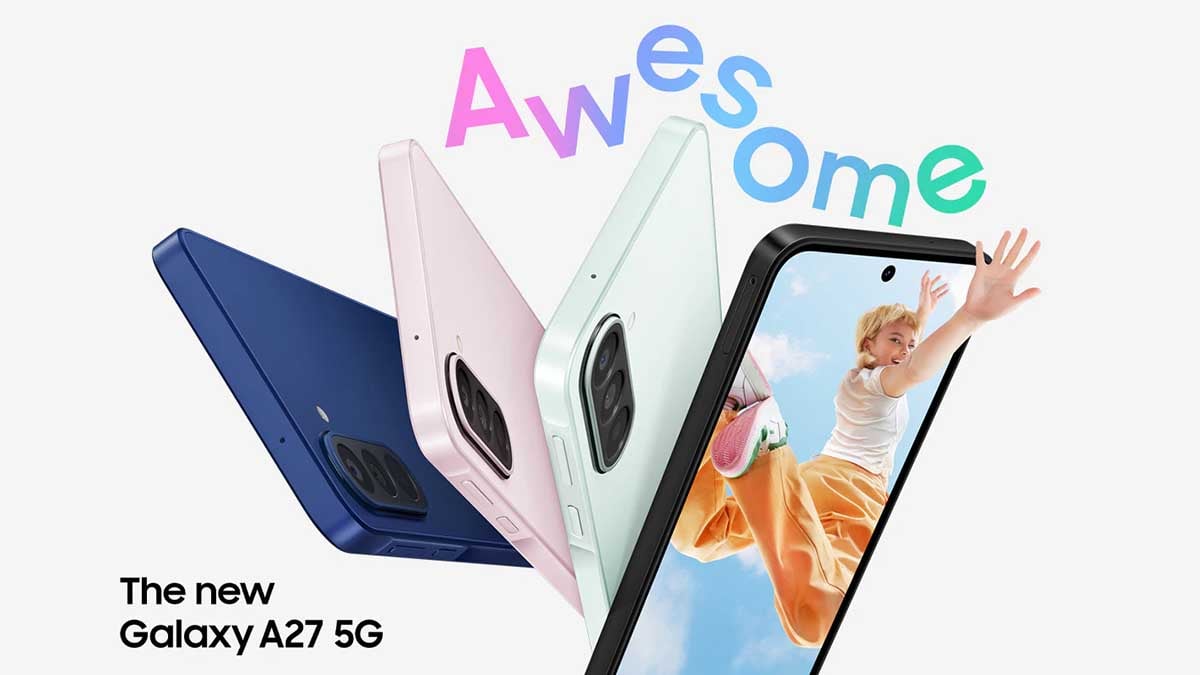
On June 25, Samsung announced the Global and US launch of the Galaxy A27 5G. The company’s new mid-range smartphone arrives with support for two AI assistants in a single Black colorway for $350 stateside.
Update: June 30, 2026 – India price reveal
Samsung has now revealed the Galaxy A27 5G pricing details for Indian consumers. The device is offered in three storage tiers: one with 6GB RAM and two with 8GB RAM options. You can score a cashback of Rs 3000 via prepaid payments.
- 6GB RAM +128GB – INR 31,999
- 8GB RAM +128GB – INR 34,999
- 8GB RAM +256GB – INR 40,499
Galaxy A27 5G comes with a 6.7-inch Super AMOLED screen with Full HD+ resolution. Samsung is bringing 120Hz refresh rate support and a modern punch-hole display, replacing the Infinity-U cutout.
Under the hood, the Galaxy A27 5G is powered by a Snapdragon 6 Gen 3 processor fabricated using a 4nm process. The new smartphone is packed with a 5,000mAh battery, measures just 7.8mm thin, and weighs 200 grams.
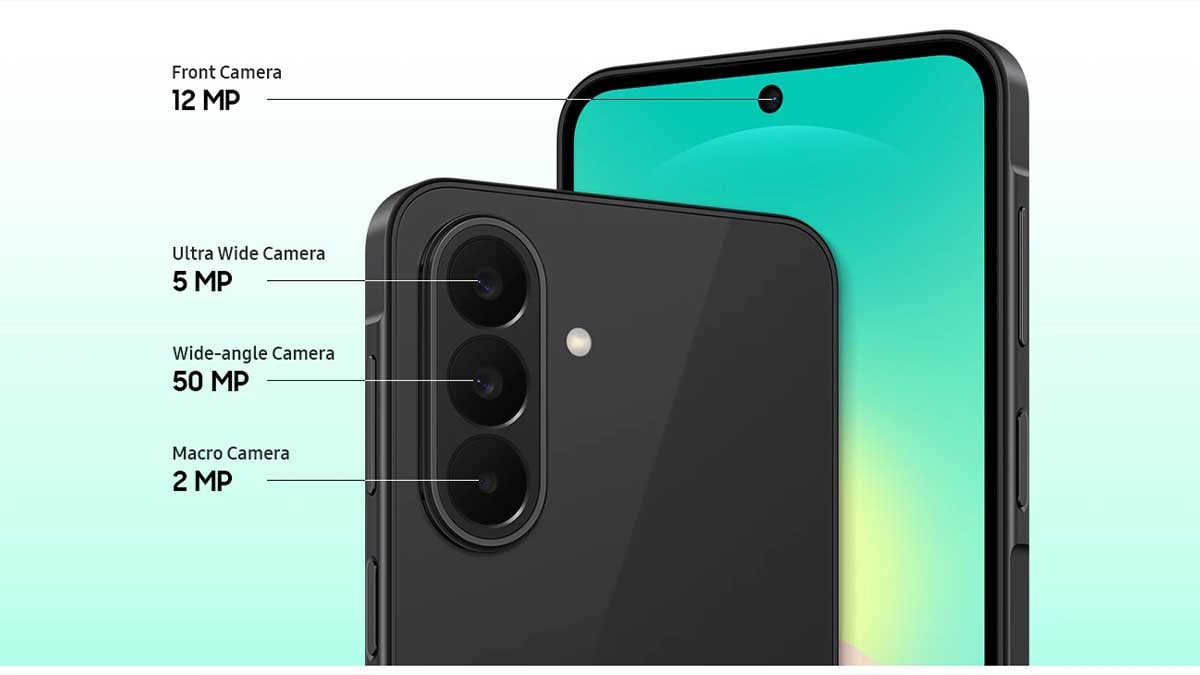
Camera setup includes:
- 5MP Ultra-Wide Camera
- 50MP OIS Wide Camera
- 2MP Macro Camera
- 12MP Front Camera
In the US, Samsung has only one memory configuration (6GB + 128GB) to offer in Black color. Meanwhile, global shoppers get three tiers: 6 + 128 GB, 8 + 128 GB, and 8 + 256 GB in Black, Blue, Light Green and Light Pink colors.
The device comes with Android 16-based One UI 8.5 software. Samsung has refined the AI feature set on its mid-range portfolio. The company is highlighting support for two AI assistants, including Gemini and Perplexity with Bixby.
Deeper integration across more native Galaxy apps, including Gallery, supports faster, more intuitive everyday interactions. Galaxy A27 5G now supports Bixby as a conversational device agent, enabling seamless control of settings and features through natural language.
Galaxy A27 5G reinforces Samsung’s commitment to long-term support with up to six generations of Android OS and One UI upgrades, as well as up to six years of security updates from the initial global launch date.
Global sales start on July 3 in select markets, while the US availability is scheduled for July 14. You can have Samsung Care+ for comprehensive coverage, including tailored benefits that protect the value of the smartphone.
You may like:
-
 Phones21 hours ago
Trusted source leaks Galaxy Z Fold 8 Wide colors, specifications
-
 One UI3 days ago
One UI 9.0 improves accessibility with 6 new features
-
 News3 days ago
Samsung Galaxy S27 lineup kicks off launch preparations
-
News16 hours ago
Samsung Galaxy A27 5G launched in the US for $350 [U: India too]