
News
Samsung proudly advertising Galaxy S26 Ultra’s Privacy Display in NCAA March Madness campaign


Samsung officially announced a multi-year deal with the NCAA, and the Galaxy S26 partnership is kicking off with a blitz of March Madness spots starring twin college basketball players Cameron and Cayden Boozer.
The spots are going live across linear TV, streaming platforms, and digital channels this week. Samsung says the twins will show off how Privacy Display works “on the court, in the classroom, and across campus.”
Privacy Display got announced with the S26 Ultra but hasn’t gotten much airtime in Samsung’s marketing until now. It’s a software toggle that narrows the viewing angle so people next to you see a dimmed or obscured screen.
Cameron and Cayden Boozer are legit college hoops prospects, and they play for Duke. Featuring twins in an ad where the main selling point is privacy feels like someone in the marketing department had a too clever idea.

The campaign is called Galaxy Upgrades, which is the kind of vague brand speak that could mean anything. Samsung’s CMO Keena Grigsby said fans are “going to see some things this tournament from Samsung they haven’t seen before.”
Drone show
Beyond the ads, Samsung is going harder than usual on experiential stunts.
There’s a drone show happening on March 20 outside The Phillies Ballpark in Philadelphia after the first round games. Another one’s planned for April 3 in Indianapolis during Men’s Final Four weekend.
Samsung is also bringing back its Super Saturday Practice sponsorship on April 4 in Phoenix before the women’s championship game.


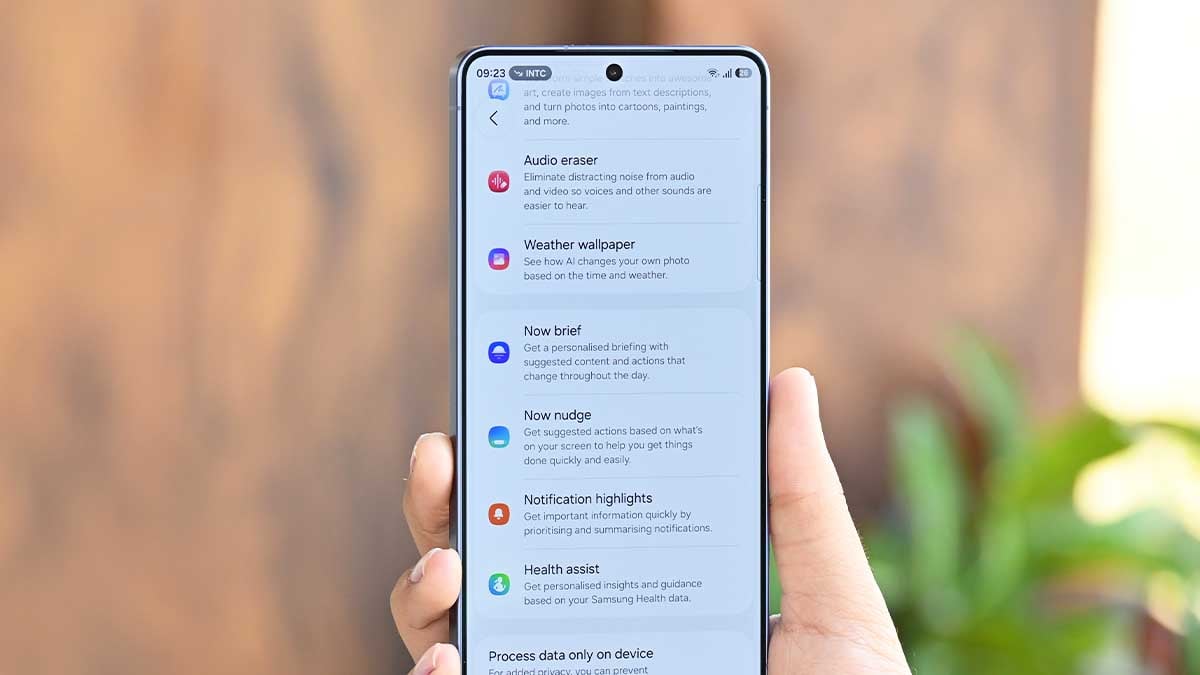
Samsung is cooking up something new for its Indian users, and this time, it’s all about making everyday life a little less stressful. The company has confirmed that its next Galaxy flagship, likely the Galaxy S27 series, will debut a fresh AI feature built specifically with Indian consumers in mind: an AI-powered bill payment reminder.
Samsung Southwest Asia CEO and President J B Park revealed that the feature was conceptualized entirely at the company’s Noida R&D centre, which has been busy studying how Indian users actually behave with their phones.
The AI will reportedly scan through emails, identify recurring bills, and nudge users before the due date hits, so no more scrambling to avoid late fees.
Speaking to Indian journalists in London, Park explained that Samsung’s broader goal is to understand user personas deeply enough to offer solutions across the board.
What’s interesting here is Samsung’s intent to differentiate. Every brand is shipping AI features these days, so Samsung wants its India-specific tools to feel genuinely useful rather than just a checkbox feature.
The bill reminder is expected to arrive with the next Galaxy device, which points squarely at the Galaxy S27 lineup expected early next year.
This announcement comes right as Samsung’s Galaxy Z Fold 8 series, including the Fold 8 Ultra, Fold 8, and Flip 8, is gearing up for its August 7 India release, with pre-orders already live.
Park also emphasized plans to scale up India’s R&D footprint further, pushing engineers toward IP-generating innovation rather than routine technical work.
If this bill reminder ships as promised, it could be one of the more genuinely practical AI additions Samsung has rolled out in a while.

SK Hynix is gearing up to roll out LPDDR6 RAM, its next-gen mobile memory, and Samsung’s own Galaxy S27 might not be the one to debut it.
According to Korea Herald, SK Hynix is set to kick off full-scale mass production of LPDDR6 in the second half of this year.
The chipmaker completed development back in March, and now it looks like Xiaomi will be the launch customer, with the new memory expected to land in Xiaomi’s upcoming flagship lineup rather than Samsung’s Galaxy S27.
Built on a 10nm-class 6th-generation (1c) process, the new chips promise better speed and power efficiency over the current LPDDR5X generation.
SK Hynix hasn’t officially confirmed the Xiaomi tie-up, but the companies go way back; this partnership started with LPDDR3 in 2013 and has continued through every generation since.
The move also sets the stage for a fiercer fight between Samsung, SK Hynix, and Micron over SOCAMM, the LPDDR-based memory module built for AI servers.
Samsung got ahead on the tech side, unveiling its LPDDR6 (1b-based) in January and picking up an Innovation Award at CES. SK Hynix moving to mass production first could tip momentum its way heading into the AI memory race.
Mobile DRAM revenue jumped 64.5 percent in Q1 alone, per TrendForce, and pricing keeps climbing as manufacturers divert capacity toward HBM and general DRAM.
With NVIDIA’s new “Vera” CPU pushing SOCAMM demand further, LPDDR6 is shaping up to be the next big growth driver after HBM, regardless of which flagship wears it first.


Samsung Electro-Mechanics is quietly laying the groundwork for one of the most important shifts in chip packaging, and its partnership with SoulBrain just got a lot more serious.
The two companies have expanded their joint development work to cover core chemical materials needed for next-generation glass substrates, a technology increasingly seen as essential for future AI chips.
The collaboration originally kicked off last year with joint research focused on etchants. Now, according to industry sources, that scope has widened to include copper plating solutions and CMP slurries as well.
Together, these three materials cover the full glass substrate manufacturing chain: etchants form the microscopic Through-Glass Vias, plating solutions fill those vias with copper to connect circuits top to bottom, and CMP slurries smooth out the surface afterward.
Samsung is still evaluating multiple vendors, and no final supplier has been locked in. That said, SoulBrain looks well positioned for etchants and CMP slurries given its existing track record, while copper plating remains a newer challenge the company is still proving out.
This all ties into Samsung Electro-Mechanics’ broader glass substrate push, including its GlaSSEM joint venture with Dongwoo Fine-Chem, targeting mass production by the second half of 2027.
As AI chip packaging leans harder into glass for its flatness and thermal stability, these early material decisions could shape supply relationships for years to come.

Samsung buying DRAM memory from a Chinese rival sounds backwards on paper, but the logic starts making sense once you look at where the company actually stands in China.
Recent reports suggest Samsung is considering sourcing DRAM from Chinese manufacturer CXMT. Those memory chips will likely be utilized in non-premium Galaxy phones sold in China, and that’s not a buying “cheap” DRAM move.
The plan is to intensively target the budget and midrange niche created by Chinese manufacturers reducing smartphone shipments due to the impact of rising component unit prices triggered by the AI data center boom.
Samsung’s smartphone share in China barely registers, sitting around a fraction of a percent while Apple has fought its way into the top tier behind Huawei.
With Chinese brands now trimming shipments because of rising DRAM costs, Samsung apparently sees a rare opening to slip into the mid-range and budget segments.
The “cheap” DRAM myth
CXMT’s chips aren’t actually the bargain they’re made out to be. Reports suggest the company is pricing DDR5 memory above what Samsung itself charges. Any deal Samsung strikes would involve comparatively small volumes, which usually means paying more per unit.
Even Apple’s interest in CXMT reportedly has nothing to do with saving money; it’s about hedging supply risk since AI demand has swallowed most of the available memory output.
If there’s one company that should get preferential treatment from a domestic (Chinese) supplier, it’s Huawei, the actual market leader in China.
Samsung’s purchase power is not so effective now
Samsung has deep pockets, sure, but nothing close to what AI-focused customers are offering. Tencent alone reportedly locked in a multi-billion-dollar arrangement with CXMT.
Against that kind of money, Samsung’s bargaining power looks thin, and the whole story may say more about narrative-shaping than actual strategy.

Samsung and SK Hynix are gearing up for another round of high-level AI diplomacy, and this time the venue is Sicily. Jay Y. Lee, Executive Chairman of Samsung Electronics, and Chey Tae-won, Chairman of SK Group, are reportedly set to attend Google Camp, the exclusive annual retreat hosted by Google co-founders Larry Page and Sergey Brin, later this month.
Google Camp brings together the world’s top tech CEOs for closed-door discussions, and details of who’s attending are famously guarded. Lee has been a regular face at the event for years, while Chey joined back in 2024.
Neither made it last year, as both were caught up in the final stretch of US-Korea tariff negotiations.
This year’s trip comes right after both chairmen wrapped up talks at the San Francisco AI Summit, where Samsung and SK Group joined Nvidia, Broadcom, and other partners in committing to roughly $950 billion worth of cooperation spanning memory chips and AI data centers.
Sicily looks like the natural next stop to build on that groundwork.
NVIDIA CEO Jensen Huang didn’t hold back in San Francisco, crediting Samsung and SK hynix’s HBM breakthroughs as essential to Nvidia’s supercomputers, calling this “truly Korea’s golden era.”
With that kind of praise on record, expect Lee and Chey to lean further into networking and dealmaking when they land in Sicily.
-
 One UI12 hours ago
One UI 9.0 (Android 17) testing on these 49 Samsung devices
-
 Updates1 day ago
Samsung’s July 2026 update rolling out to Galaxy A series phones
-
 Wearables2 days ago
Samsung Galaxy Watch Ultra 2 has four impressive upgrades
-

 One UI1 day ago
One UI 9.0 brings new Google Search to Samsung homescreen