
Technology
Samsung Galaxy devices with eSIM support (How to setup)

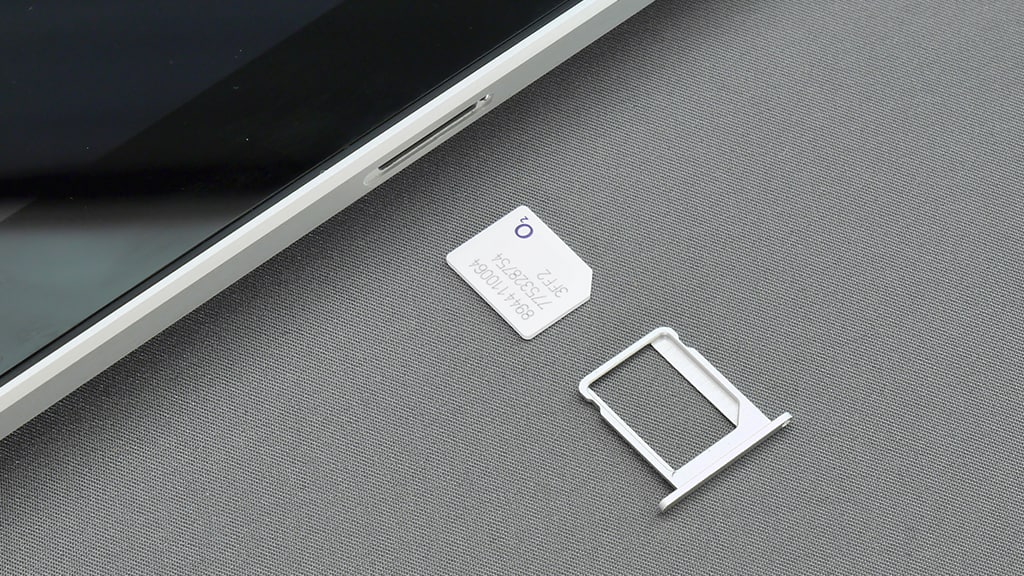
eSIM is an advanced technology that unlocks the possibility of getting network connection on your phone without inserting any kind of external thing like a SIM card. Select Samsung Galaxy smartphones also come with eSIM support, allowing users to get everything that a physical SIM card offers, virtually.
In contrast, the eSIM functionality lets you activate a mobile network plan without having a nano-SIM. In case your Samsung device supports eSIM feature, you can easily add and remove your mobile network plan. Before that, it’s important to keep in mind that the eSIM support varies by carrier and location for devices.
Follow Sammy Fans on Google News
These Samsung devices support eSIM
- Samsung Galaxy Z Fold4
- Samsung Galaxy Z Flip4
- Samsung Galaxy S22
- Samsung Galaxy S22+
- Samsung Galaxy S22 Ultra
- Samsung Galaxy Z Fold3 5G
- Samsung Galaxy Z Flip3 5G
- Samsung Galaxy S21
- Samsung Galaxy S21+ 5G
- Samsung Galaxy S21+ Ultra 5G
- Samsung Galaxy S20
- Samsung Galaxy S20+
- Samsung Galaxy S20 Ultra
- Samsung Galaxy Note 20
- Samsung Galaxy Note 20 Ultra 5G
- Samsung Galaxy Z Fold2 5G
- Samsung Galaxy Fold
- Samsung Galaxy Z Flip
Join Sammy Fans on Telegram
To add your mobile network plan on an eSIM, you can scan a QR code that your carrier provided, install a pre-assigned plan automatically, or you can enter the information manually. Before adding your plan, make sure your Galaxy smartphone is connected to WiFi or mobile data network.
Image – Unsplash
If your smartphone supports the eSIM feature and your preferred network carrier also offers the same, you can add a mobile network plan to an eSIM. To do so, your carrier may provide a QR code that you need to scan and it will install a pre-assigned plan automatically.
How to install eSIM via QR code
- Go to Settings > Connections > SIM card manager
- Tap Add mobile plan
- Tap Add using QR code
- Scan a QR code that your carrier provided
- Your mobile plan is downloaded and activated on eSIM
Instead of eSIM installation via QR code, your carrier may tell you to get it on your phone by entering the information manually. For an effortless switch (physical to eSIM) make sure your Samsung smartphone is connected to WiFi or mobile data network.
How to install eSIM via manual information
- Go to Settings > Connections > SIM card manager
- Tap Add mobile plan
- Tap Add using activation code
- Enter the information that your carrier provided
- Your mobile plan is downloaded and activated on eSIM










Samsung has unveiled the new Galaxy SmartTag 3, a small device that helps users find lost or misplaced items. It can be attached to keys, bags, luggage, bicycles and pet collars.
The SmartTag 3 is smaller and lighter than the previous model. Samsung says it is about 35% smaller and 33% lighter, making it easier to carry and use. It also comes with new accessories, including a Silicone Case and a Loop Case.
For the first time, the SmartTag series supports both Galaxy and iOS devices. Users can check and share the tag’s location through Samsung’s SmartThings Find service. The SmartTag 3 can work for up to 550 days with normal use. With Power Saving Mode, the battery can last for up to 790 days.
The device also makes finding lost items easier. Its Compass View feature can show the direction and distance of the tag from up to 60 meters away. As users get closer, UWB technology can provide more accurate directions.

Image via Samsung
If the tag is outside the phone’s Bluetooth range, Samsung’s Galaxy Find Network can help locate it. Samsung says more than 900 million Galaxy devices can help find lost tags around the world.
The SmartTag 3 also offers useful alerts. Place Notification can tell users when a tagged item moves into or out of a selected area. Location History shows where the tag has been, while Movement Detection Alert can notify users when movement is detected.
The SmartTag 3 has an IP67 rating for water and dust resistance. It will launch in Korea on October 7, 2026, followed by the US and other markets in 2027.

Samsung may soon introduce its next smart tracker, the Galaxy SmartTag 3. New leaked images have revealed what the device could look like.
According to the images shared by WinFuture, the biggest change is the design. Unlike the Galaxy SmartTag 2, which has a pill-like shape, the new model appears to have a small square shape with rounded corners. The leaked images also show two color choices, with a large Samsung logo visible on the front.
However, Samsung seems to have made one major change that some users may not like. The new SmartTag 3 does not appear to have a built-in hole for attaching it directly to a keyring, strap, or carabiner. Instead, users may have to use a separate case or accessory.

Image via WinFuture
Samsung is reportedly preparing several cases, including silicone, leather, and bumper options. There could also be an accessory designed to attach the tracker to a pet’s collar. Companies such as Spigen may offer some of these accessories. The tracker is reportedly around 30 x 30mm in size and less than 10mm thick. It will also use a replaceable coin-cell battery.
For connectivity, the SmartTag 3 is expected to support Bluetooth Low Energy and Ultra-Wideband. These features should help users locate their lost belongings more easily.
Samsung could launch the Galaxy SmartTag 3 soon. The expected price is around $30 in the US and €28 in Europe. A four-pack may cost about $100 in the US and €93 in Europe. The SmartTag 3 could be a useful option for tracking keys, bags, pets, and other valuables.
Samsung is reportedly developing its first humanoid robot and may show its prototype at CES 2027 in Las Vegas next January. CES is one of the world’s biggest technology events, where companies display new products and technologies.
The company is preparing the robot through its Robotics (RX) Business Promotion Office. The company is working on both the robot’s body and its AI software. The hardware includes parts such as the joints, hands, and other moving parts. The AI software will help the robot understand things, make decisions and perform tasks.
Jang-Hyun Yoon, Samsung’s Chief Technology Officer and President of the DX Division, is leading both the hardware and AI software teams. This means Samsung can develop the robot’s body and “brain” together, which could help speed up development.
Samsung has also been working on new robot technologies. It has patents related to hip joints, advanced robotic hands and AI systems that control robot movements.
The company is also working with its subsidiary, Rainbow Robotics. Rainbow Robotics is focusing mainly on industrial robots for factories and workplaces. Its RB-Y2 is a two-arm robot designed to carry heavy loads and work over a large area. An improved version may be shown at RoboWorld 2026.
Samsung and Rainbow Robotics are following different paths. Samsung is expected to focus on general-purpose humanoid robots, while Rainbow Robotics will focus on industrial robots. Samsung has not officially confirmed its CES 2027 plans, saying it “cannot confirm” the report.
Semiconductor
Samsung’s HBM5 with Heat Path Block (HPB) technology: A detailed technical explanation


Hey everyone, if you have been following the crazy growth in AI, you know memory isn’t just about speed anymore, it’s about keeping things from melting under insane workloads.
Samsung just dropped something pretty cool (well, it needs to be cool) at Computex 2026: the first physical mockup of its next-gen HBM5 memory, integrated with a new trick called the Heat Path Block, or HPB. I dug into the details from reliable reports, and it’s a smart move in the ongoing battle for AI dominance.
Why Heat is the New Bottleneck in AI Memory
High Bandwidth Memory (HBM) is the super-fast RAM that powers today’s AI GPUs and accelerators. It is like a skyscraper: multiple DRAM dies stacked vertically on top of a logic “base die” that talks directly to the processor. This setup gives massive bandwidth (terabytes per second), but it also generates a ton of heat, especially where the high-speed connections (called Die-to-Die or D2D interfaces) sit.
As stacks get taller and speeds climb (we are talking 14-16 Gbps now, with even more coming), that heat concentrates in the PHY area (the PHY area is basically the ‘communication zone’ on the base die where the super-fast data connections between the HBM memory and the GPU happen, and it’s also one of the hottest spots in the whole package).
Traditional cooling through the top of the stack or sides just isn’t cutting it anymore. Without better thermal management, performance throttles, systems become unstable, or you waste power on cooling.
Samsung’s rival SK hynix recently showed its iHBM (I will provide detailed information about iHBM very soon and link here) with built-in cooling elements. Samsung has an answer? HPB. It’s not copying, it’s a different but equally clever approach to the same problem.
What Exactly is Heat Path Block (HPB)?
If I want to explain “What is HPB?” easily, I will tell you to add a dedicated “chimney” right next to the memory stack. That’s basically HPB.
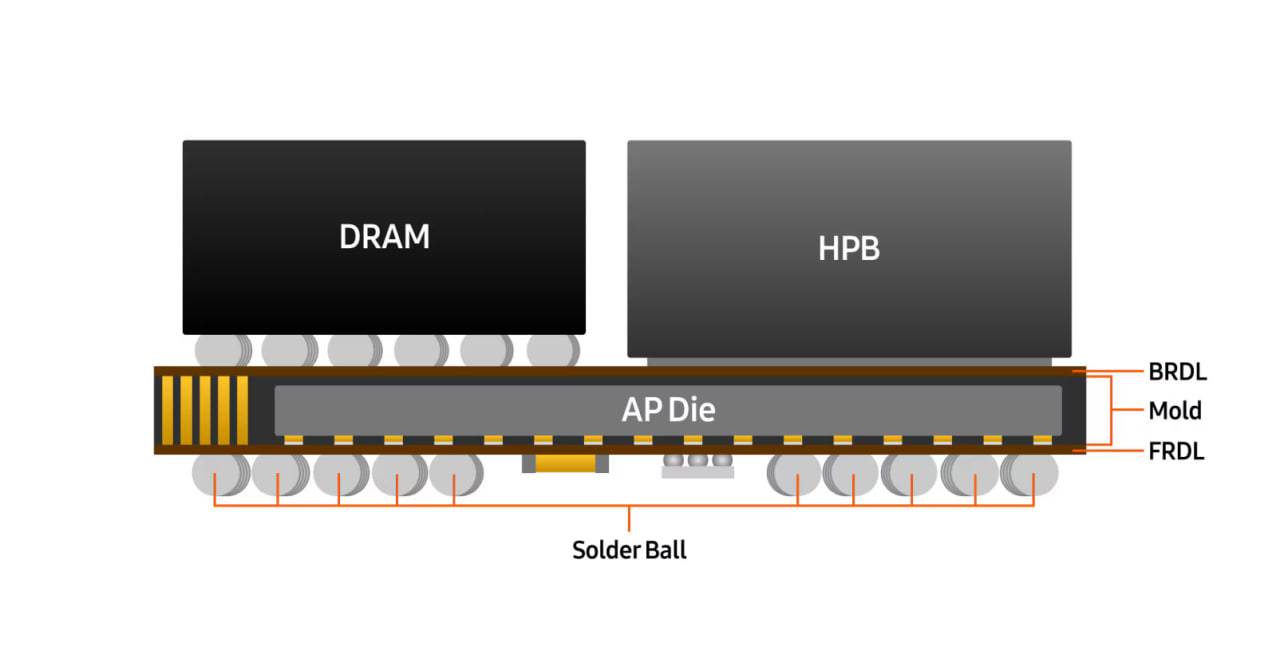 Instead of forcing all the heat to go through the DRAM dies (which aren’t great at conducting heat away quickly), HPB creates an independent thermal pathway. This structure (think thermal pillars or a block) sits on the same base die, pulls heat directly from the hot PHY region, and sends it to a heat spreader on top or the side of the package.
Samsung has already tested and verified this on its HBM4E samples (the 12-high stacks shipping now). It lowers thermal resistance, keeps temperatures more stable, and lets the memory run harder for longer without issues. Samsung first used a version of HPB in Exynos 2600 mobile processors, where it improved thermal performance noticeably, up to around 16% better resistance in some tests by optimizing the package layout.
 In the Computex HBM5 mockup, you can see the HPB structure alongside the core die stack. It’s a physical demonstration that this isn’t just a paper promise, it’s real hardware.

Via – @SemiconductorX/X
The 2nm Process Tech
The HPB isn’t the only upgrade. Samsung is going aggressive on manufacturing too. The Base Die for HBM5 will be built on Samsung’s own 2nm process node (using Gate-All-Around transistors). That’s a big jump from the 4nm used in HBM4 and HBM4E.
Why does this matter? A more advanced process means better power efficiency and higher performance in the logic part that handles all that high-speed data traffic. The core DRAM layers will use advanced 1c (6th-gen 10nm-class) technology, with potential for even denser stacks.
This is where Samsung’s unique position works. As an IDM (Integrated Device Manufacturer), the company designs both the memory and the foundry processes. Samsung’s CTO, Song Jae-hyuk, highlighted how this lets them optimize die placement and heat paths faster than competitors who might rely more on external partners. I am personally excited about this 2nm development. Good work, Sammy.
Samsung’s AI Memory Push
This HBM5 news is part of Samsung’s bigger push in AI. The company is speeding up its factory investments; for example, Samsung moved the groundbreaking for its new P5 Fab 2 in Pyeongtaek forward by 6 months to July 2026. The goal is clear: produce a lot more memory to meet the exploding demand for AI chips.
HBM5 is expected to target mass production around 2028, following samples and validation. For context, HBM4E already delivers impressive specs: up to 3.6 TB/s bandwidth per stack, 48GB capacity in higher configs, and it’s over 20% faster than previous generations in some cases. You will see HBM5 pushing those numbers further while staying cooler.
Better thermal performance lets AI systems run at full speed for longer without slowing down or using too much extra power. That’s a big deal for data centers handling huge AI training or inference jobs.
Competition and the Industry Benefits
The HBM race is really heating up. SK Hynix has been leading the market share (57-62%) for high-end HBM, but Samsung (17-22%) is fighting back strongly with new innovations. Samsung’s HPB uses a dedicated external heat path, while SK hynix’s iHBM puts cooling elements inside the package. Both solutions target the same hot spot, showing that good thermal management is now just as important as raw speed or stacking more layers.
For big customers like NVIDIA, who still rely heavily on SK hynix today but are starting to diversify. These improvements mean more reliable and power-efficient memory. Samsung is also preparing its full AI memory lineup for upcoming platforms like NVIDIA’s Vera Rubin.
Meanwhile, Micron is also competing strongly by ramping up its HBM4 with excellent power efficiency and is already sold out for 2026, while preparing its own solutions for the upcoming HBM5 generation to challenge Samsung and SK Hynix.
From a business side, stronger HBM products could help Samsung win back ground in this high-profit AI memory market. Memory prices go up and down, but the strong demand from AI continues to be a big advantage.
Challenges and Opportunities
Of course, nothing is guaranteed. Samsung still has to successfully scale up its 2nm production, maintain good yields on these complex stacked packages, and keep costs under control. But its vertical integration, controlling both memory and chip manufacturing, gives it some unique advantages that others don’t have (you are winning here, Sammy).
For chip enthusiasts and semiconductor professionals, this is really exciting. It shows how innovation in packaging and thermal management is keeping up with smaller chip processes. As AI models keep getting bigger, the hardware underneath needs to evolve too, not just faster, but also smarter about power and heat.
If you are into chips, keep watching HBM developments closely. What started as a special memory for graphics cards has now become a key part of the AI revolution.
Samsung’s HBM5 with HPB feels like a strong step toward making those giant GPU clusters more efficient and reliable.

Samsung’s new Exynos 2600 processor is gaining attention because of its advanced cooling system, Heat Pass Block (HPB). This new technology helps the chip stay cooler and work faster for a longer time, mainly during gaming and heavy tasks.
Today’s smartphones become hot quickly because powerful processors create a lot of heat. Most premium phones use vapor chambers to control temperature, but Samsung has added something extra. The company placed a copper cooling layer directly on top of the processor to move heat away more efficiently.
Most smartphone companies, including Apple, use a design where memory is placed on top of the processor to save space inside the phone. While this makes phones thinner, it also traps heat. As a result, processors slow down after some time to avoid overheating. This problem is thermal throttling.
According to tests by YouTuber Geekerwan, the Exynos 2600 performed better than Qualcomm’s Snapdragon 8 Elite Gen 5, even when the Snapdragon chip was cooled using liquid nitrogen. Surprisingly, the Snapdragon processor still could not maintain stable performance for long periods.
The Exynos 2600 is not completely free from heating issues. The Galaxy S26+ still showed some throttling during long gaming sessions because its cooling system is smaller than that of the Galaxy S26 Ultra. However, adding a small clip-on fan to the back of the phone helped improve cooling and performance.
Samsung’s new HPB cooling system could become very important for future smartphones. Other companies like Qualcomm, Apple, and MediaTek may also adopt similar cooling methods in upcoming processors.
-
 Updates2 days ago
Galaxy S26 getting October 2026 update on One UI 9.0 in Europe, India
-

 Updates3 days ago
Samsung Galaxy S24 series gets ready for One UI 9 with September 2026 patch
-

 One UI2 days ago
Samsung Galaxy A15 5G is now getting One UI 9 Beta 2
-
 One UI3 days ago
Samsung expands on-device AI Scam Detection with One UI 9 stable update