
News
Download LineageOS 19 for Samsung Galaxy S10 [Android 12]

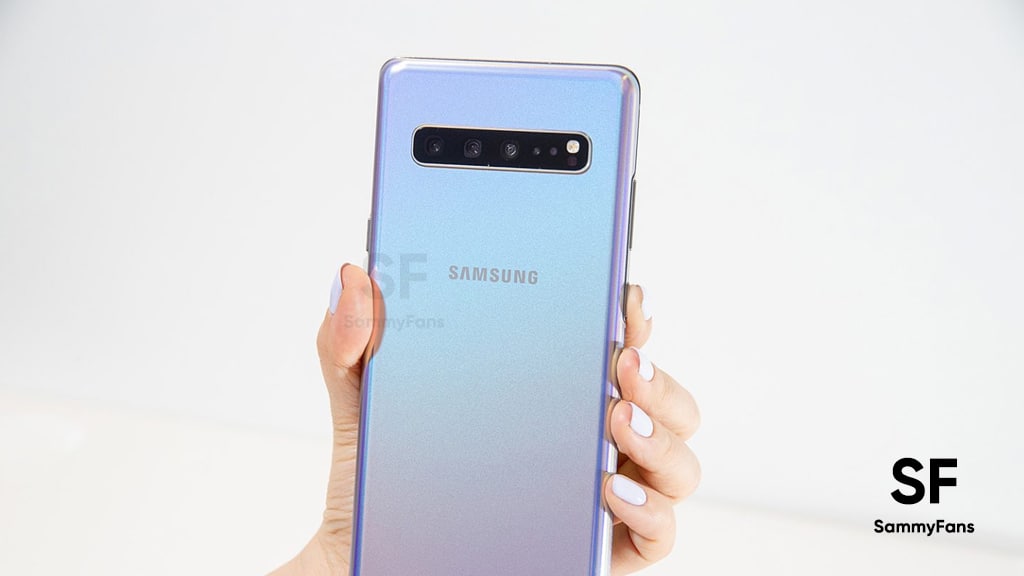
Launched back in early 2019, the Galaxy S10 is one of the most sold smartphone lineups by Samsung. Due to their flagship segment belonging, the company delivered three major OS upgrades to the Galaxy S10 series phones including the Android 10, Android 11, and Android 12.
Samsung already provided the Android 12-based One UI 4.0 and One UI 4.1 updates to the Galaxy S10e, S10, S10+, and S10 5G smartphones. Meanwhile, Android 12-based LineageOS 19 has now added support for these older flagship models that you can download from the links below.
DOWNLOAD SAMMY FANS APP
As soon as you download the official LineageOS 19 ROM for your Samsung Galaxy S10e, S10, S10+, or S10 5G, you have to follow the installation guide which is available in the table. It redirects you to your specific smartphone’s LineageOS wiki page.
Join SammyFans on Telegram
LineageOS is based on the stable Android 12L codebase, which comes with improvements and several new features for compatible devices. FYI, LineageOS 19 introduces improved backup features, revised Camera and Gallery apps, a dedicated launcher for Android TV builds, and revamped iconography for stock apps.
Download LineageOS 19 for Samsung Galaxy S10
| Device Name | Model No. | ROM Link | Installation |
|---|---|---|---|
| Galaxy S10e | SM-G970F/DS | DOWNLOAD | beyond0lte |
| Galaxy S10 | SM-G970F/DS | DOWNLOAD | beyond1lte |
| Galaxy S10+ | SM-G973F/DS | DOWNLOAD | beyond2lte |
| Galaxy S10 5G | SM-G976B/DS | DOWNLOAD | beyondx |
| Tab S6 Lite WiFi | SM-P610 | DOWNLOAD | gta4xlwifi |

| Via – XDA |


Samsung Galaxy S26 Ultra is down to around $949 in the US for Black Friday, but some lucky shoppers have scored the device for just $125. Amazon’s Japanese subsidiary then actually shipped the devices, honoring the orders.
It has come to light that Amazon is shipping Galaxy S26 Ultra to some shoppers who ordered the device for $125 in Japan. The e-commerce giant had a technical glitch, which caused the pricing error, but there were already some orders.
Amazon could have canceled the orders, citing technical bugs. However, the company didn’t cancel orders, but actually shipping devices to those who have ordered the Galaxy S26 Ultra at 92 percent discounted price.
The attached screenshot shows that the Galaxy S26 Ultra went down briefly to 20,185 yen in Japan, which translates to around $125 in direct currency conversion.
The pricing glitch was limited to the Sky Blue variant of the Galaxy S26 Ultra. Other colors, including Black, White, and Cobalt Violet, remained at their usual prices.
Some shoppers reported that Amazon delivered their orders as well. That made it the deal of the decade, as it was literally unexpected and impossible at the time, when memory prices keep climbing.

Deals like this don’t come frequently, as they are highly driven by technical glitches. Also, it’s not always possible for the platform to ship the orders placed amid MRP issue. Meanwhile, you can look at the Black Friday deals for your purchase.
Galaxy Z Fold 8 is also trending, with Black Friday promotions taking the price down to around $1,500 in the US. If you no longer feel slab-type phones are iconic, you can give Samsung’s latest foldable a chance to be your daily driver.

Apple’s expected to stay ahead of Samsung in 2026 and even 2027 in the global smartphone market, but the US market witnessed a notable turnaround when it comes to the presence of Android- and iOS-powered devices in Q3 2026.
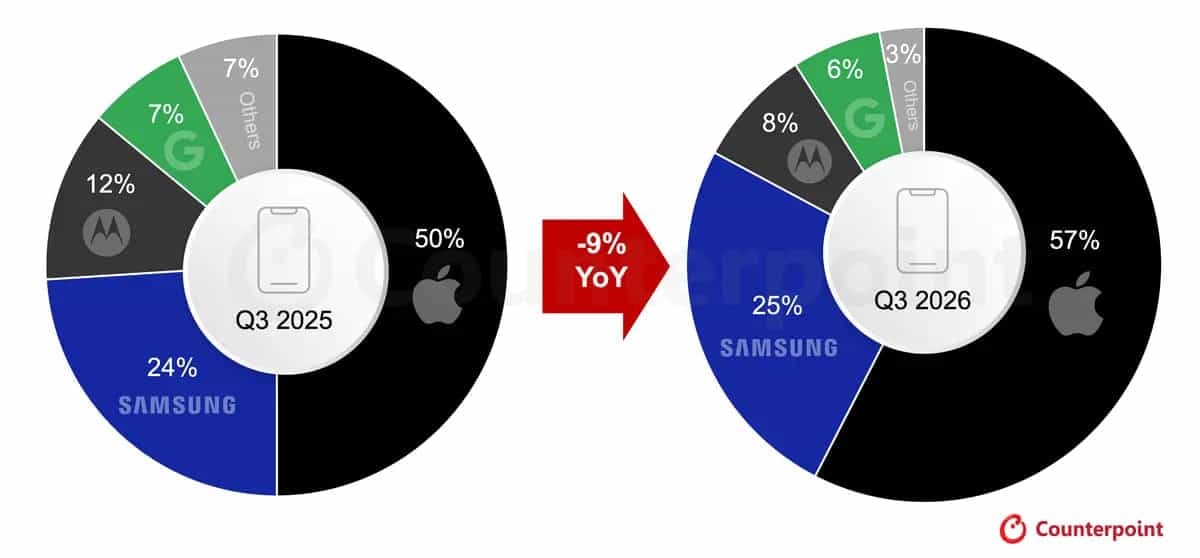
Counterpoint Research pointed out that the US smartphone market declined 9 percent year-on-year in Q3 2026. Apple led the US smartphone market with a huge 57 percent market share, leaving Samsung behind with a 25 percent share.
Apple’s share was 50 percent during the same period last year, which increased to 57 percent this year. Samsung, meanwhile, improved its footprint, grabbing 25 percent market share, up from 24 percent in Q3 2025. Motorola, Google and others declined sharply, surrendering their share to Apple and Samsung.
US smartphone shipments declined 9% YoY in Q3 2026, according to Counterpoint Research’s latest US Market Monitor data. Rising memory costs put pressure on Android OEMs, particularly in the low-end segment where margins are thinnest, while Apple’s relative resilience pushed its share of the market to 57%.
That said, Samsung alone is saving Android’s presence nationwide amid Apple’s rally. The Cupertino company is gaining market share in the US, driven by the increasing sales of premium phones that better absorb the memory crunch.
Google, which owns Android, declined from 7 percent in Q3 2025 to 6 percent in Q3 2026. Motorola was in good position at 12 percent share last year, but it declined to just 8 percent in the same period this year.
Samsung has reportedly decided on two major changes for its smartphone segment. On one hand, the company is trimming the shipment target for its Galaxy A series, while several devices could go costlier by up to 19 percent.
You may like: Android dominance slide and Samsung’s one move could make it worse
Based on these shifts, industry insiders believe that Apple would keep beating Samsung in the 2026 worldwide smartphone market. Samsung’s runner-up position may continue in 2027, even though the Galaxy S27 Pro is coming early next year.

Samsung is wasting no time resetting its smartphone business after global mobile chief TM Roh stepped down last week. In Gurugram, Samsung just replaced its India mobile head amid an uncomfortable pile-up of unsold Galaxy phones across retail stores.
Just days after Samsung Electronics replaced longtime mobile chief TM Roh with former COO Won-Joon Choi in Seoul on November 20, its Indian subsidiary has pulled the trigger on its own executive overhaul.
Soon Choi has stepped down as head of Samsung India’s Mobile Experience (MX) division to take up a role outside the country, handing the reins to Yong Chan Oh. His exit comes less than two years after he took the Gurugram post in January 2024, following a stint leading Southwest Asia regional product management in 2023.
According to Moneycontrol and industry sources, Soon Choi pushed for a transfer out of India after struggling to adapt to the local business and cultural environment.
Samsung India’s new command structure: MX, TV and Appliances
This latest move marks Samsung India’s second major leadership shake-up of 2026. Back in May, longtime veteran Raju Pullan exited the company, prompting Samsung to hand smartphone business operations to Aditya Babbar and elevate Hiren Rathod to oversee national sales across offline, online, and general trade channels.
Alongside the mobile change, Samsung India is also consolidating power at the top of its consumer electronics business. Visual Display (VD) head Mike Chu will now oversee both the TV and Domestic Appliances (DA) units, though both divisions will continue running independently on a day-to-day basis.


Global smartphone market is facing a difficult time. Smartphone sales dropped 16% year-on-year in Q3 2026, mainly due to the ongoing RAM shortage. This shortage has affected budget phones the most, while higher memory costs have also increased prices of premium smartphones.
Android held 74% of the global smartphone market in Q3 2026, down 5% from the same quarter last year. This was its lowest-ever share for a third quarter. Android’s presence across different price ranges has made it more affected by the market slowdown.
However, new phones from OPPO, vivo, Xiaomi, and Samsung helped reduce the decline. But Samsung’s latest plan could make things worse for Android.
Samsung is reportedly planning to cut Galaxy A series production in Q4 2026. The cut could equal around 10 million phones annually. Samsung is reportedly focusing more on its expensive Galaxy S and Z series because they bring higher profits during the RAM shortage.

Image via Counterpoint
This is a big concern because the Galaxy A series has historically made up more than 70% of Samsung’s smartphone shipments. Producing fewer Galaxy A phones could affect Samsung’s overall sales and global market position.
Samsung may also increase prices of several Galaxy A models by up to 19%. Higher prices could make these phones less attractive to budget buyers.
Meanwhile, Apple and Huawei are gaining ground. Apple’s iOS reached a record 21% market share, while iPhone sales grew 2%. In China, Huawei’s HarmonyOS reached 22% market share as Huawei sales increased 12%.
With Apple and Huawei growing, Samsung’s production cuts and price hikes could put even more pressure on Android’s market share.
Samsung Electronics and SK Hynix are set to pay a total of 44 trillion Korean won in dividends to their shareholders over the next month. The large payments have raised hopes of bringing investors back to South Korea’s struggling semiconductor market.
The company will pay a record 30 trillion won in dividends on the 27th. This is the biggest dividend payment ever made by a South Korean company. Shareholders will receive 4,601 won per share, 12.3 times more than the previous quarter.
Individual investors in South Korea are expected to receive more than 5 trillion won. After tax, an investor holding 100 shares will get around 389,200 won, while someone holding 1,000 shares will receive approximately 3.89 million won.
Meanwhile, SK Hynix plans to distribute 14 trillion won in dividends on the 29th of next month. Together, the two companies will pay shareholders 44 trillion won.
Despite these large dividend payments, both companies have seen a sharp fall in their share prices. Samsung shares have dropped 54.3% from their June peak, while SK Hynix shares have fallen 64.7%.
Investors are worried about whether spending on artificial intelligence (AI) will continue to grow. They are also concerned that future oversupply of memory chips could affect prices and company profits.
However, market experts believe some investors may use their dividend money to buy semiconductor shares at lower prices. This could increase demand for the stocks and improve investor confidence.
-
 One UI3 days ago
One UI 9.5 Eligible Devices: These Samsung devices could receive the next major update
-
 Wearables2 days ago
Samsung confirms Galaxy Watch 9 features for older models, including Watch 4!
-

 News2 days ago
Galaxy S25 could be banned in the US as Samsung loses camera patent case
-
 One UI2 days ago
Samsung Galaxy S23 FE gets a new update but that’s not One UI 9