
Tips
How to customize One UI 4.1-based Samsung Keyboard on your Galaxy phone?


Whether you want to send a text message, type with voice, or send emojis, files, GIFs, audio, video, etc, your Galaxy phone’s Samsung Keyboard is well designed and customized to allow you to enjoy its features with ease.
The keyboard is an important part of any smartphone. Samsung knows this and has supercharged its built-in keyboard with lots of customization options. You can change the language, layout, themes, size, feedback, and even add custom symbols with a few taps.
Join SammyFans on Telegram
The Samsung Keyboard can also help you out with Smart typing options like text and emoji suggestions. For example, emojis and stickers will appear in the toolbar as you type, so you can quickly add them to your messages without searching for them.
DOWNLOAD SAMMY FANS APP
Back in February, Samsung released the One UI 4.1 custom software skin for its eligible smartphones. Along with various new features and other improvements, the new OS also installs Grammarly to Samsung Keyboard to ensure that you will not make any silly typing mistakes.
Let’s see how to customize the One UI 4.1 Samsung keyboard with various features and customization options.
One UI 4.1 Samsung Keyboard
Use the toolbar on the keyboard:
You can send funny GIFs and stickers to your friends and family, no matter what phone they use. Your phone will automatically convert them into a multimedia message.
- Launch the Messages app.
- Tap the new conversation.
- Enter or choose a recipient.
- Tap the Enter message field to pull up the keyboard.
- The toolbar will automatically appear.
- From here, you can select from Emoji, Stickers, GIF, Voice Input, and Settings.
- Tap Expand toolbar (the three horizontal dots) to see more options available on your phone.
If you do not like the toolbar or do not use it often, you can disable it.
- With the keyboard open, tap the Settings icon that appears in the toolbar.
- Tap the switch next to the Keyboard toolbar to make the toolbar disappear.
If you ever want to turn it back on:
- Navigate to Settings.
- Search for and select Samsung Keyboard.
- Tap the switch again.

Keyboard Settings:
- Open the Settings of your phone.
- Search and select Samsung Keyboard.
- Adjust your desired keyboard settings.
- You can also access this page by tapping the Settings icon in the keyboard’s toolbar.

Type with your Voice:
There are two built-in voice-to-text apps on your phone: Samsung voice input and Google voice typing.
- To turn on these features, navigate to and open Settings.
- Tap General management.
- Tap Keyboard list and default.
- Tap the switch next to Samsung voice input.
- Ensure only one voice assistant is activated on your phone.
- You are now ready to type a message using your voice! Open the Messages app, and start a new conversation.
- Touch and hold the Microphone icon on the keyboard’s toolbar.
- Simply talk when the Microphone icon is active and your voice will be translated into words.
- Release the Microphone icon when you are done.
- If it’s your first time using Samsung voice input, you may need to agree to the terms or allow some permissions.


Change keyboard mode:
- Navigate to Settings.
- Tap General management.
- Tap Samsung Keyboard settings.
- Tap Mode. You can choose from the following keyboard modes:
- Standard keyboard: This is the normal keyboard view, with your phone’s on-screen keyboard stretched to fill the main screen.
- One-handed keyboard: This mode shifts the keyboard to the right side of the screen. To shift the keyboard to the left, tap the Left arrow icon.
- Floating keyboard: This mode turns the keyboard into a small floating popup in the center of the screen.

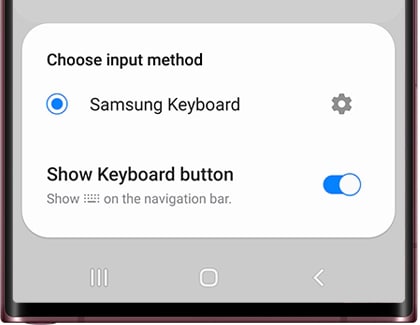
Change default keyboard:
Typing is about to get a whole lot more exciting. If you want a new keyboard, you can download one that fits your style from the Play Store and Galaxy Store.
- Once downloaded, open the Settings on your phone.
- Go to General management.
- Tap Keyboard list and default.
- Tap the Default keyboard.
- From there, select your desired keyboard.
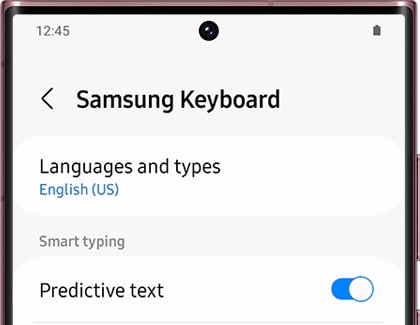
Use Smart typing options:
- Go to the Settings of your phone.
- Tap General management.
- Tap Samsung Keyboard.
- From there, tap the switch(es) next to the following options under Smart typing:
- Predictive text: The keyboard will suggest words for you as you are typing. Just select the word to add it to your message.
- Suggest emojis: The keyboard will suggest emojis that match what you are typing.
- Suggest stickers while typing: The keyboard will suggest stickers that match what you are typing.
- Auto replace: The keyboard will replace words for you while you are typing. You can tap the space bar or Enter key to use the new word.
- Suggest text corrections: The keyboard will automatically correct grammar and phrases for you. Suggestions will be marked with green underlines. You can also tap Manage apps to choose which apps will receive text corrections.
- You can tap Text shortcuts to add your own shortcuts for frequently used phrases as well. Or, tap More typing options to adjust additional preferences like Auto capitalize and Auto spacing.
Get notified –
Aside from SammyFans’ official Twitter and Facebook page, you can also join our Telegram channel, follow us on Instagram and subscribe to our YouTube channel to get notified of every latest development in Samsung and the One UI ecosystem. Also, you can follow us on Google News for regular updates.


Samsung has started rolling out One UI 9.0 update and Galaxy users should look at optimizing their phone’s power settings to extend battery life.
Android 17-based One UI 9.0 update brings a refined interface and smoother animations, but learning how to manage the system’s power consumption is the key to getting through a heavy day without reaching for a charger.
Whether you want to stretch your daily screen-on time or protect the physical health of the battery over the next few years, the new settings menu has you covered.
Here are the top three battery settings you need to tweak right after updating to One UI 9.0:
1. Configure the New Battery Protection Modes
One UI 9 gives you much more granular control over your phone’s long-term battery health. Instead of a simple on/off toggle that limits charging to 85%, Samsung now offers three distinct tiers to prevent battery degradation over time.
Where to find it: Go to Settings > Battery > Battery protection
Choose between Basic (stops at 100% and waits until it drops to 95% to resume), Adaptive (pauses at 80% while you sleep and finishes charging right before you wake up), or Maximum (hard caps the charge at 80%).
Samsung Battery Protection (Source – Sammyfans)
2. Switch to the “Light” Performance Profile
Standard Power Saving mode is great for emergencies, but it disables your 120Hz refresh rate and limits background data. If you want to save battery without making your phone feel sluggish, the Light Performance Profile should be your pick.
Where to find it: Go to Settings > Device Care > Performance profile | Switch the profile from Standard to Light

3. Aggressively manage background usage limits
One UI 9 is excellent at managing background power usage, but manually moving unused apps into “Deep Sleep” guarantees they won’t sip power when you aren’t looking.
Where to find it: Go to Settings > Battery > Background usage limits
Tap on Deep sleeping apps, hit the + icon, and add any apps that you rarely use or don’t need real-time notifications from (like airline apps, fast food apps, or older games).
Keep visiting SammyFans for such tips!


Samsung’s One UI 9 introduces a simple way to make Galaxy phone screens more dynamic with Motion Photo wallpapers. The feature lets users turn compatible Motion Photos from Samsung Gallery into moving wallpapers for the lock screen and/or home screen.
Here’s how to use the new feature on supported Galaxy devices. Just need to follow a few easy steps.
- Start by opening the Samsung Gallery app on your Galaxy smartphone. Browse through your photos and select an image that was captured with Motion Photo enabled. Only compatible Motion Photos will show the new wallpaper option.
- Open the Motion Photo you want to use. Make sure it contains the motion captured when the picture was taken. You can use your preferred Motion Photo rather than having to capture a new image.
- From the selected image, choose the option to set the picture as your wallpaper. Samsung will take you to the wallpaper customization screen, where additional options are available.
- On the wallpaper setup screen, look for the “Motion photo” option. Turn it on to use the image as an animated wallpaper. If you prefer a normal static wallpaper, you can leave the option disabled.
- Choose where you want to use the Motion Photo wallpaper and apply the changes. It’s done

The feature is currently available on Samsung’s latest foldables, including the Galaxy Z Flip 8, Galaxy Z Fold 8, and Galaxy Z Fold 8 Ultra, running official One UI 9 software. It is reportedly missing from the Galaxy S26 beta for now, but Samsung is expected to expand the feature with the wider One UI 9 rollout.


Samsung Good Lock unlocks many possibilities to customize the One UI software experience, but there’s an in-built feature that could help you remove the swipe gestures and enable a tap button instead.
Swipe gestures are part of the Android ecosystem, it helps users navigate through the system. You can swipe up or down to scroll through the content, gallery, menu, or any of the large screen space. These gestures expand beyond scrolling, such as answering or denying a call.
However, Samsung also gives an option for its phone users to switch off gestures for certain features. I’ve been using tap only for quite some time, and here’s my experience with it.
It makes a lot of difference when answering a phone call. You just need to tap on the answer button, and that’s it. Sometimes, my fingers get greasy, which fails to register a swipe across the display to pick up calls. This shortcut made it a lot easier.
Gestures are a nice way to interact with the phone, and I use them all of the time, especially the back gestures. However, it may not suit every situation. Most One UI versions support replacing swipe gestures with the tap button for calls, alerts, and alarms. Here’s how you can activate it.
- Open Settings
- Search “Replace swipe with single tap”
- Tap on the slider to activate
Alternatively, go to Settings > scroll down and enter Accessibility > Interaction and dexterity > Replace swipe with a single tap > tap on the toggle to activate.

Samsung has mainstreamed this feature in the One UI 9.0 settings, while previous versions required an extra tap on the screen.

Samsung Messages app has been discontinued in the US, and Google Messages is the officially preferred switch. Google Messages offers all the great features you need for everyday messaging, along with support for Rich Communication Services (RCS). Still, if you want to rely on the Samsung Messages app, there’s a workaround that keeps it alive for now.
Back in April 2026, Samsung announced that its native Messages app would be discontinued. The app started to notify users in early July, with the deployment happening on July 6, disconnecting the app from the connection.
Samsung recommends Galaxy users get Google Messages from the Play Store and make it the default messaging app. Once done, you will retain all your chats in Google’s app and continue further messaging through it.
Notably, Samsung has started shipping recent flagships without the Samsung Messages app in the US. It includes the Galaxy S25 series and Galaxy S26 series, as well as the Z Fold 6, Z Flip 6, Z Fold 7, and Z Flip 7 foldable phones.
Well, it’s not impossible to keep Samsung Messages alive; here’s how:
Samsung Messages app is just disconnected, not banned or revoked. Users can get the app working again on their Galaxy device despite the official discontinuation. However, you will have to use its factory version, which it was shipped with.
Open your phone Settings > Apps > Messages > More Options (three dots) and tap Uninstall Updates.
Once done, open the Galaxy Store > Menu > Updates > Samsung Messages, and uncheck Enable auto-update.
These tweaks will roll back updates you’ve installed over the past time. Unchecking “auto-update” will ensure the Galaxy Store or Play Store won’t trigger an automatic update and stop the functionality of the app again.
The workaround is working as of July 2026, but no guarantee for the future. Also, we recommend that users comply with the official guidelines.
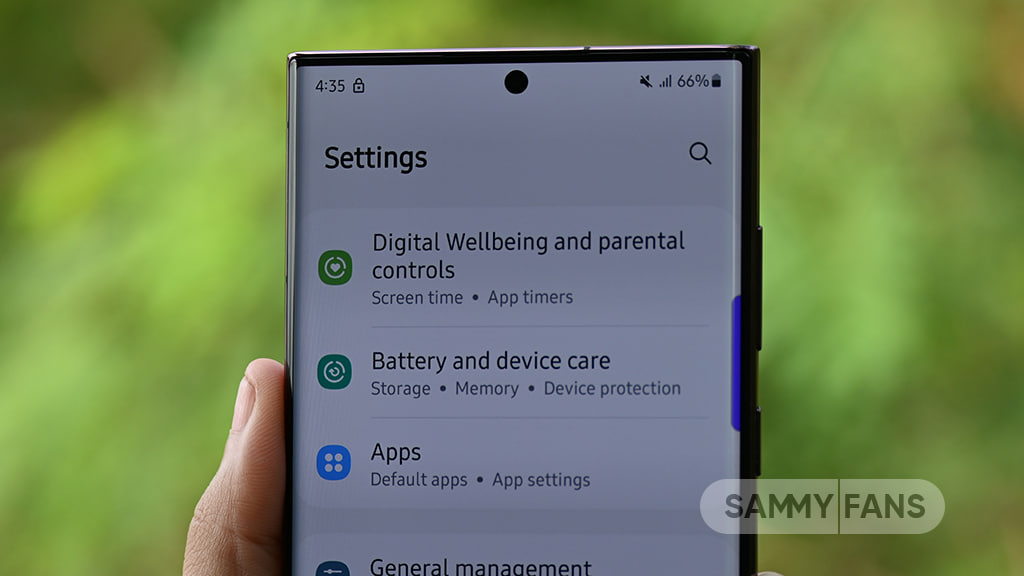
Samsung has added a new feature that helps stop annoying apps from sending too many advertising notifications. If an app keeps sending promotional alerts, Samsung can automatically block it from bothering you with the “Block apps with excessive ads” feature.
This new tool helps stop apps from sending too many ad notifications. The feature does not block ads inside apps. It only works with notifications and helps reduce unwanted notifications from apps that send too many ads.
When Samsung detects an app sending lots of advertising notifications, it can place that app into Deep Sleep. Apps in Deep Sleep cannot run in the background, which helps stop those annoying alerts.
Notably, it offers two blocking options:
Basic Blocking
This option is turned on by default. Samsung uses its own data to find apps that are known for sending too many ad notifications and blocks them automatically.
Intelligent Blocking
It gives extra protection. It checks notifications in real time and can find new apps that are sending too many ads. It then blocks those apps automatically.
How to enable this feature:
- Open the Settings app on your Samsung Galaxy phone.
- Scroll down and tap Device Care.
- Tap the three dots in the top-right corner.
- Select Settings.
- Tap Block apps with excessive ads.
- Check that Basic Blocking is turned on and turn on Intelligent Blocking for stronger protection.

Once the feature is enabled, your phone will watch for apps that send too many ad notifications and automatically reduce them.
Aside from this, you can also check which apps were blocked. For that, open Settings >> Device Care >> Care Report >> Excessive Alerts. You can see here the apps that Samsung has moved to Deep Sleep because they were sending too many promotional notifications.
This new feature is a simple way to keep your Galaxy phone cleaner and quieter. By turning it on, you can enjoy fewer annoying ads and a better smartphone experience.
-
 Wearables3 days ago
Samsung confirms Galaxy Watch 9 features for older models, including Watch 4!
-

 One UI22 hours ago
You no longer need to clear app caches one by one on Samsung Galaxy Phones
-

 News3 days ago
Galaxy S25 could be banned in the US as Samsung loses camera patent case
-

 Samsung1 day ago
Samsung’s new page transition effects make One UI feel surprisingly playful