
Business
Samsung remained second-largest global smartphone brand in Q4 2021: IDC

According to the latest International Data Corporation (IDC) report, worldwide smartphone shipments declined year-on-year in the fourth quarter of 2021 (4Q21), marking the second consecutive quarter of negative growth. Despite the second half of the year being challenging, full-year shipments still rebounded, thanks to a strong first half.
As per the report, smartphone sellers shipped a total of 362.4 million phones during the holiday quarter (4Q21), down 3.2% year-on-year, slightly better than the IDC forecast. In 2021, the market grew 5.7 percent year on year and shipped 1.35 billion smartphones.
Despite a slight decline in shipments year on year, Apple impressed the Holiday Quarters, once again topping the charts over Samsung. Its strength in the supply chain is demonstrated to be higher in 4Q21 than ever before. The iPhone 13 SKUs were an influential component of the holiday quarter volume, leading to a strong increase in the average selling price of the entire iPhone.
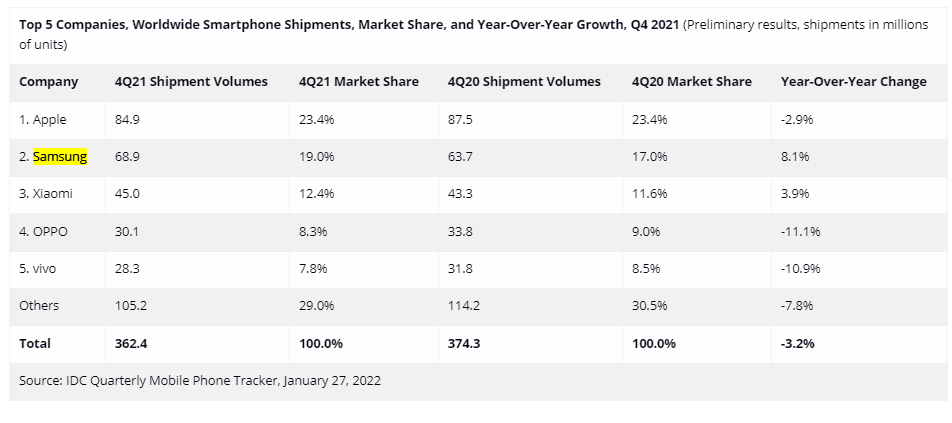
Samsung and Xiaomi followed in second and third place and were the only vendors in the top 5 to increase shipments per year on the 4Q21 – Oppo and Vivo are in the top 5. For the full year, a total of five sellers increased inventory for the year, with four out of five achieving double-digit growth.
Xiaomi’s annual growth has reached almost 30%, while Samsung’s slowest growth in 2021 is just 6.0%. This distinction clearly shows which vendor has benefited the most from Huawei’s sharp decline this year. For the reasons already mentioned, Apple achieved a healthy annual growth rate of 15.9% in 2021, as well as an impressive 40% growth in China in 2021.
Get notified –
Aside from SammyFans’ official Twitter and Facebook page, you can also join our Telegram channel, follow us on Instagram and subscribe to our YouTube channel to get notified of every latest development in Samsung and One UI ecosystem. Also, you can follow us on Google News for regular updates.





Samsung Electronics is facing another challenge in its TV business as Chinese display manufacturers tighten their grip on the LCD panel market and push prices higher.
Korea’s Chosun reports that Chinese vendors, including BOE and TCL CSOT, are strengthening their pricing power at a time when Samsung has limited alternatives for sourcing large-screen display panels, putting additional pressure on its TV business.
Samsung is estimated to buy around 4.4 million LCD panels from BOE in 2026, double the previous year’s volume. BOE is expected to represent 12.3% of its panel purchases, while TCL CSOT accounts for approximately 20.4%.
Rising panel prices add to an already difficult cost environment. Display panels account for roughly 40% to 50% of TV manufacturing costs. Samsung is responding by prioritizing premium televisions and managing supplier relationships.
The timing leaves Samsung with limited room to maneuver. Global TV shipments are forecast to decline 0.6% this year to 194.81 million units, making it harder for manufacturers to pass higher production costs directly to consumers.
Omdia reported that BOE, CSOT, and HKC now control an estimated 70% to 85% of the global supply of 65-, 75-, and 85-inch LCD TV panels. Their dominance is even greater in ultra-large screen categories. Samsung Display ended its LCD production in 2022, leaving Samsung Electronics increasingly dependent on external suppliers.

Image via Samsung

Apple and Samsung accounted for 69% of global smartphone revenue in Q3 2026, highlighting how the industry’s financial strength is becoming increasingly concentrated among its biggest players. The combined share came despite a 19% year-over-year decline in global shipments, as higher device prices pushed quarterly smartphone revenue to $114 billion.
According to Counterpoint Research, global smartphone average selling prices (ASPs) increased 27% annually to a record $442. Premiumisation, changes in product mix, and rising memory costs contributed to the increase. Revenue grew 3%, showing how higher prices are compensating for weaker demand.
Apple vs Samsung: Revenue share and Shipments
Apple led the market with a 50% revenue share, recording 17% growth and its highest-ever third-quarter revenue. Samsung followed with 19% of global revenue, up 14% annually. Interestingly, it retained shipment leadership with a 22% share.
Apple vs Samsung: Smartphone average selling price
Apple’s ASP increased 19%, supported by iPhone 17 demand and early sales of the iPhone 18 Pro series. Meanwhile, Samsung’s ASP climbed 21% to $367, reflecting higher Galaxy A-series prices and stronger contributions from the Galaxy S26 Ultra and Galaxy Z Fold 8.

Xiaomi maintained flat revenue despite declining shipments, while OPPO and vivo suffered revenue declines of 26% and 22%, respectively.
The performance of Chinese smartphone manufacturers highlights the difficulty of maintaining revenue when consumers become more price-sensitive.
Counterpoint expects smartphone revenue to contract in Q4 2026 as shipment declines outpace ASP growth. Elevated memory costs are also expected to keep pressuring manufacturers through 2027, potentially extending price increases.

A new report from Omdia reiterates the Q3 2026 global smartphone market crash, with Apple and Samsung managing to avoid the worst of the memory crunch era.
Last month, market research firm Omdia reported preliminary stats of the Global smartphone market in Q3. Worldwide shipments fell 20 percent year-on-year, making the period the worst in terms of sales in 10 years.
Third-quarter shipments this year fell 20% year-on-year, marking the lowest Q3 level since 2013. While Samsung and Apple held up relatively well, Chinese vendors including Xiaomi, Oppo, and Vivo posted high double-digit declines.
“Emerging markets, once the backbone of global smartphone volume growth, are now facing the greatest pressure from rising prices,” said Sanyam Chaurasia, Principal Analyst at Omdia.
Global smartphone shipments in Q3 reached 254.7 million units. Higher smartphone prices reduced consumer purchasing power, particularly in emerging markets, while distributors also took a cautious approach to securing inventory.
Samsung shipped 57.8 million units in Q3, down 5% year-on-year, but retained the top spot in shipments.
While competing Android manufacturers were affected by memory supply constraints and price hikes, Samsung’s budget and mid-range Galaxy A series helped expand its market share.
Additionally, the Galaxy Z8 series foldables, which were released in September, also supported sales in the premium segment with the help of trade-in and upgrade programs.
Apple placed second, shipping 56.50 million units and keeping sales roughly flat compared to the same period last year.
Continued demand for the iPhone 17 and preemptive inventory stockpiling by retail channels expecting price increases contributed to the result. Strong demand in China and North America offset weakness in emerging markets.

Xiaomi maintained third place with 30.7 million units, but its shipments plunged 29% year-on-year. Shipments to China and India dropped by 20% and 28%, respectively. As Xiaomi raised product prices to cope with rising component costs, sales fell sharply in price-sensitive emerging markets.
Oppo (including Realme and OnePlus) ranked fourth with 23.4 million units, down 39% year-on-year. Vivo also saw a 33% decline, shipping 19.3 million units.

Samsung Electronics reported a record-breaking third quarter, posting KRW 107.4 trillion ($80.04 billion) in operating profit, 783.11% year on year from 107.44 trillion won on consolidated revenue of KRW 195.3 trillion.
The South Korean tech giant became the first company globally to surpass KRW 100 trillion in quarterly operating profit, driven almost entirely by the ongoing generative AI infrastructure expansion.
While smartphone hardware margins face persistent input cost pressure, its silicon manufacturing footprint is reaping unprecedented gains from the global AI buildout.
Profit jumped 8x on AI chip boom
Samsung’s incredible Q3 performance was led by the Device Solutions division, which posted KRW 106.5 trillion in operating profit amid tight industry-wide DRAM and HBM supply.
Scaling shipments of next-generation HBM4 and server-grade QLC SSDs allowed the semiconductor business to capture maximum pricing power.
The results echo similar bullish signals from cross-town rival SK Hynix, validating that high-density memory demand remains structurally undersupplied.
Mobile business flagged another deficit
Conversely, consumer-facing sectors faced headwinds; the Mobile eXperience and Networks divisions recorded an operating loss of KRW 0.6 trillion as elevated memory component prices inflated handset manufacturing costs.
Samsung warned that supply constraints will intensify through 2027 as hyperscale cloud providers increase capital expenditures for AI deployments. To support this trajectory, the company allocated KRW 27.2 trillion of its KRW 29 trillion quarterly capex specifically to semiconductor infrastructure.
KRW 30 trillion third-quarter dividend
Samsung confirmed a KRW 30 trillion third-quarter dividend alongside planned share buyback programs.
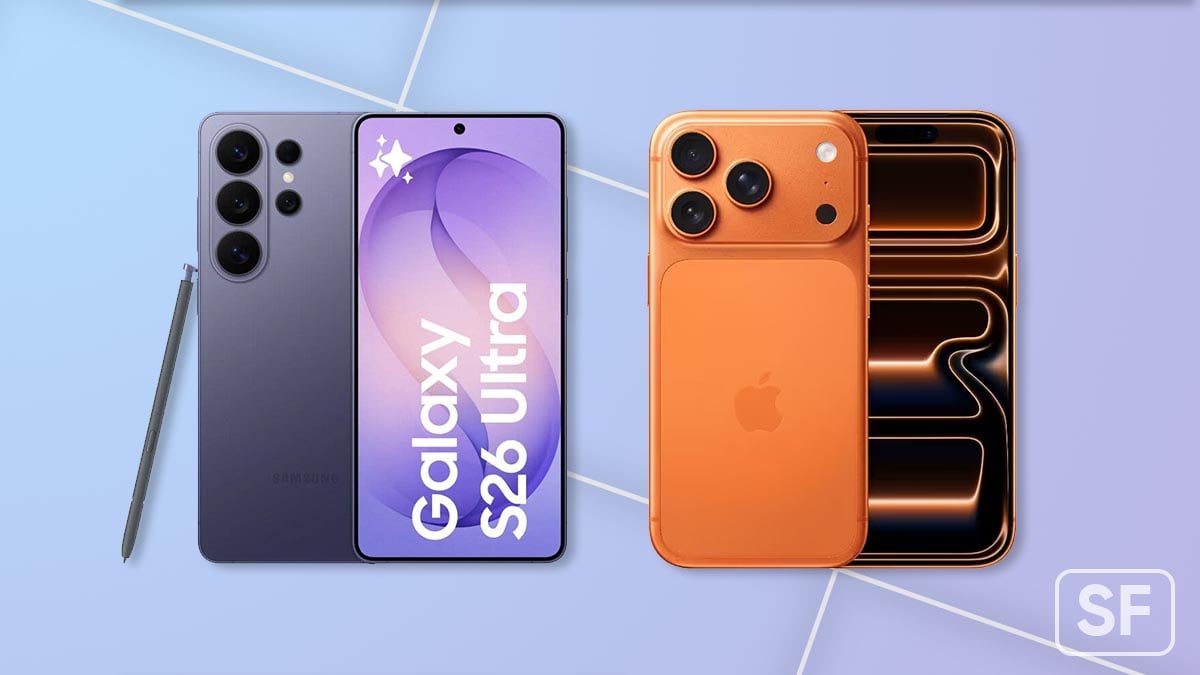
The global smartphone market shipments have crashed by 20 percent due to the ongoing memory and component supply shortage. Meanwhile, Samsung retained its leadership in Q3 2026, while Apple remained the runner-up, as per Omdia.
Market research agency Omdia revealed its preliminary estimates this week, confirming the Q3 2026 smartphone market crash of 20% YoY. It was a much bigger slump than the 6% decline recorded in the second quarter of the year.
Q3 welcomed new flagship launches from Samsung and Apple, and their impact has started to show as well. Galaxy Z Fold 8 is selling strongly, while the influence of the iPhone 18 Pro line would be seen in the fourth quarter of the year.
Samsung beats Apple in Q3 2026, Omdia says
Samsung remained the global smartphone market leader in shipments in Q3 2026. The company seized the biggest slice of 23 percent volume. In the same period last year, Samsung’s smartphone presence was 19 percent.
Samsung’s broad product portfolio and established global channel presence helped cushion the impact of the market downturn, while the August launch of the Z Fold 8 and Flip 8 supported its premium positioning.
Apple retained its second spot in the third quarter of the year with 22% market share. The company’s share improved significantly year-on-year, as it was 18 percent in Q3 2025.
Continued demand for the iPhone 17 family, alongside the September introduction of the iPhone 18 Pro and Pro Max, helped maintain its momentum.
Xiaomi, Oppo, and Vivo faced a decline in their Q3 2026 smartphone shipments. Xiaomi now has 12 percent, Oppo has 9 percent, and Vivo has 8 percent market share.

The decline of Chinese smartphone makers was the biggest, due to weakening sales of low-cost devices. The slump in their shipments (share) moved Samsung and Apple up in terms of market share in the third quarter of the year.
Looking ahead to the fourth quarter, new flagship launches, promotions and festive demand are unlikely to fully offset persistent supply-side pressures.
-
 One UI12 hours ago
One UI 9.0 official update now rolling out to these Samsung phones
-

 One UI2 days ago
Fresh One UI 9.5 leaks reveal AI Rambler, Telegram and WhatsApp call recording, new widgets and UI tweaks
-
 AI2 days ago
Gmail gets new Gemini AI tools for writing and email summaries
-
 Updates2 days ago
Flagship Galaxy S26 lineup now getting November 2026 update globally