
Semiconductor
TSMC reportedly targets Elon Musk’s Terafab amid Intel setback


TSMC is reportedly exploring a role in Elon Musk’s Terafab semiconductor project in Texas, potentially helping operate the massive facility and making it an anchor customer for a future TSMC campus in the state.
Intel joined the project in April, promising its expertise in chip design, fabrication, and packaging, while Musk later said Terafab planned to use Intel’s 14A process technology.
Culpium (via Jukan) now reports that TSMC is looking at ways to support Terafab’s manufacturing ambitions. One possibility is for Terafab to become an anchor customer for a new TSMC semiconductor campus in Texas.
Additionally, TSMC is considering a second major US manufacturing hub, potentially in the Dallas area, alongside its enormous Arizona expansion.
Terafab is far more ambitious than a conventional chip factory. SpaceX says the planned facility in Grimes County will eventually combine logic, memory, packaging, and testing, with the first phase backed by more than $16.8 billion.
If Intel talks have genuinely stalled, bringing TSMC closer to the project would represent a significant change in strategy.
TSMC has the manufacturing experience Musk’s companies lack, although integrating another foundry’s technology into Terafab would still be a complicated undertaking.


Samsung is expected to introduce the Exynos 2700 next year, and the first performance numbers are already giving us an early idea of what the company may have achieved with its next-generation silicon.
According to an early performance report shared by X user @kro_roe, the Exynos 2700 is consistently reaching around 3,900 in Geekbench 6 single-core testing.
Geekbench 6 results suggest Exynos 2700 could deliver a substantial CPU performance increase over the Exynos 2600. The chip reaches around 3,900 points in single-core testing, compared with roughly 3,100 to 3,450 for its predecessor.
That would put it noticeably ahead of the Exynos 2600, which has reportedly recorded scores between 3,100 and 3,450.
The Exynos 2700 is still under development, and Samsung has plenty of room to tune its silicon and software before commercial devices arrive.
Samsung is reportedly moving toward a dual-prime-core CPU configuration using C2 Ultra cores, alongside eight C2 Pro cores. LPDDR6 memory support and an Xclipse 970 GPU have also been tipped.
Meanwhile, supporting newer memory does not necessarily mean Samsung will use it across every Exynos 2700-powered device, particularly if memory costs remain elevated.
If these specifications hold up, Samsung appears to be targeting both higher peak CPU performance and a stronger overall platform.
The final Exynos 2700 will be judged less by its headline Geekbench score and more by sustained performance, efficiency and thermal behavior.
For now, the 3,900-point result is best viewed as a promising early indicator, not a guarantee of what the Exynos 2700 will deliver in the Galaxy S27 series flagships.

Samsung is preparing multiple cooling technologies for HBM4E as AI semiconductor packages grow larger and generate more heat.
The company is working on solutions including Hybrid Copper Bonding (HCB), Heat Pass Block (HPB), and package- and system-level cooling with equipment and backend partners. HBM4E is expected to enter mass production in 2027.
Samsung’s next HBM generation is facing a problem that cannot be solved simply by pushing DRAM processes further. As AI accelerators pack more compute and memory into a single package, heat is becoming a serious limitation.
The interposer connecting GPUs, chiplets and HBM is already several times larger than the maximum exposure area of an EUV lithography tool.
Industry estimates suggest these interposers could grow dramatically as AI workloads demand more compute and memory bandwidth. That creates a bigger thermal challenge around the HBM stacks sitting alongside the processor.
Samsung appears to be treating HBM4E as an important opportunity to address that problem early. The company shipped 12-high HBM4E samples in May, using 10nm-class sixth-generation DRAM alongside a 4nm foundry process.
One of its key approaches is HCB, which removes conventional micro-bumps between stacked DRAM layers and directly connects copper interconnects. The tighter structure can reduce the distance heat needs to travel out of the stack. Samsung also has HPB, another approach designed to improve thermal performance without requiring hybrid bonding.
The interesting part is that Samsung is looking beyond the memory stack itself. The company is reportedly working with equipment manufacturers and backend partners on cooling at the package and server-system levels.

Samsung Electronics is reportedly seeking more than three times the price of its current HBM3E for next-generation HBM4.
According to Korean media (via SemiconductorsX), Samsung proposed a mid-to-high $4 price per gigabit during negotiations with major customers, compared with roughly $1.5 per gigabit for HBM3E.
The South Korean semiconductor giant has already entered annual supply negotiations with key customers, with most of next year’s major HBM volumes understood to be largely negotiated.
HBM supply differs from conventional DRAM because manufacturers and customers typically agree on volumes and pricing well ahead of production. That makes these negotiations particularly important for Samsung.
The proposed pricing also reflects Samsung’s push to monetize HBM4’s performance improvements. If customers accept prices above $4 per Gb, the jump from HBM3E would represent a major increase in revenue potential per unit.
My read is that Samsung is betting on performance and the broader HBM4 transition to support the premium.
Whether customers accept the full increase will depend heavily on qualification results, supply availability and how competing HBM4 products are priced. The negotiations are reportedly approaching their final stage this month.

Samsung Electronics led the global DRAM market in Q2 2026 with a 38% revenue share, while SK Hynix held 25% and Micron reached 24%, according to Counterpoint Research.
Samsung’s lead remains significant, but the more interesting development is happening immediately behind it. Micron has rapidly closed the gap with SK Hynix as demand for memory in AI data centers continues to surge.
Micron’s fiscal 2026 fourth-quarter results underline that momentum. The company generated a record $54.23 billion in quarterly revenue, up sharply year over year, while data center revenue reached $18 billion.
Its gross margin also climbed to 86.8%, showing that stronger AI-related demand is translating into substantial profitability.
Micron’s DRAM revenue share jumped to 24%, compared with SK Hynix’s 25%. A fivefold year-over-year increase in Micron’s Q2 DRAM revenue helped bring the companies within touching distance.
Samsung, meanwhile, still commands a sizeable lead at 38%. The company’s position gives it considerable scale as manufacturers and data-center operators continue securing high-performance memory for AI workloads.
The competitive picture could become even tighter. Micron expects memory supply and demand conditions to become more constrained during 2027 and 2028, with more than 75% of its 2027 production already covered by sales contracts.
For Samsung, maintaining its lead may increasingly depend on how effectively it expands high-value AI memory production. For SK Hynix and Micron, the battle for second place could become one of the most closely watched shifts in the DRAM market.

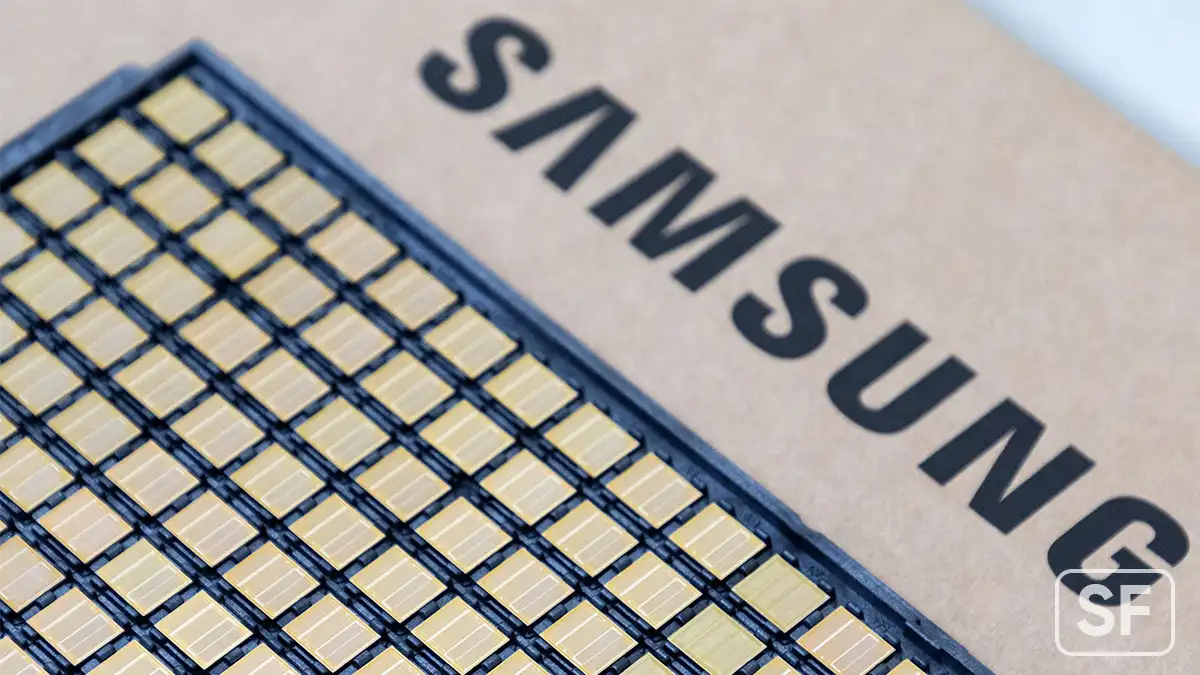
Samsung could see a sharp increase in its HBM selling prices next year as AI infrastructure demand continues to absorb a growing share of DRAM production capacity.
KB Securities now expects Samsung’s HBM prices to rise by more than 100% in 2027.
According to KB Securities research head Kim Dong-won, HBM4 is expected to account for around 80% of Samsung’s HBM sales next year, compared with 40% in 2026.
On October 1, KB Securities forecasted regarding Samsung Electronics that “next year’s High Bandwidth Memory (HBM) selling prices will rise by more than 100%.”
Additionally, KB Securities estimates that even with 30% of DRAM wafer input directed toward HBM, its share of total DRAM supply by storage capacity would remain around 13%.
The trend is already visible across the industry. TrendForce separately expects blended HBM prices to increase 121% in 2027, reflecting stronger HBM4 adoption and persistent supply constraints.
The combination of higher HBM pricing and constrained conventional DRAM supply could substantially improve Samsung’s profitability. KB Securities expects Samsung’s profit to reach 368 trillion won in 2026 and 555 trillion won in 2027.
If AI data-center investment remains strong, HBM4 and its successors could therefore become an increasingly important driver of Samsung’s memory business through 2027 and beyond.

-
 One UI2 days ago
Samsung drops first One UI 9.5 appearance with new app update
-
 Updates2 days ago
One UI 9.0 vs One UI 8.0: Samsung update size comparison
-
 One UI2 days ago
Verizon brings One UI 9.0 update with these great features in the US
-

 One UI2 days ago
Top 3 battery settings to change after One UI 9.0 update