
News
Samsung is now free from all Galaxy performance court cases


Samsung has reached the end of a four-year court case surrounding the Galaxy performance throttling, specifically the Game Optimizing Service (GOS) controversy, with the final consumer lawsuit now closed.
According to Newsis, Samsung is now free from the last remaining court case linked to the Galaxy performance throttling controversy. The last remaining case, a class-action lawsuit filed in Israel, ended after the plaintiffs voluntarily withdrew it.
The Jerusalem District Court approved the withdrawal on September 9, bringing all eight GOS-related consumer lawsuits filed across South Korea, the US, and Israel to a close. None resulted in a ruling that held Samsung liable for damages.
How the GOS controversy started
The dispute dates back to early 2022, when Galaxy S22 users discovered that GOS could limit CPU and GPU performance during demanding workloads.
Samsung defended GOS as a mechanism designed to control temperature and power consumption. Following the backlash, the company introduced a software update that gave users greater control over game performance.
The controversy eventually moved into courtrooms. Three cases were filed in South Korea, four in the US, and one in Israel. The US cases ended through voluntary withdrawals around 2023, while the Korean cases were withdrawn earlier this year.
Gaming on Galaxy S24 Ultra (Credit: Sammyfans)
The legal closure does not erase the 2022 controversy, but it removes the remaining consumer litigation from Samsung’s GOS history.
For Samsung, the episode also became a reminder that performance claims, thermal management, and user control can become closely connected in flagship smartphones.
Today, GOS remains part of Samsung’s broader approach to balancing sustained gaming performance with heat and battery management.



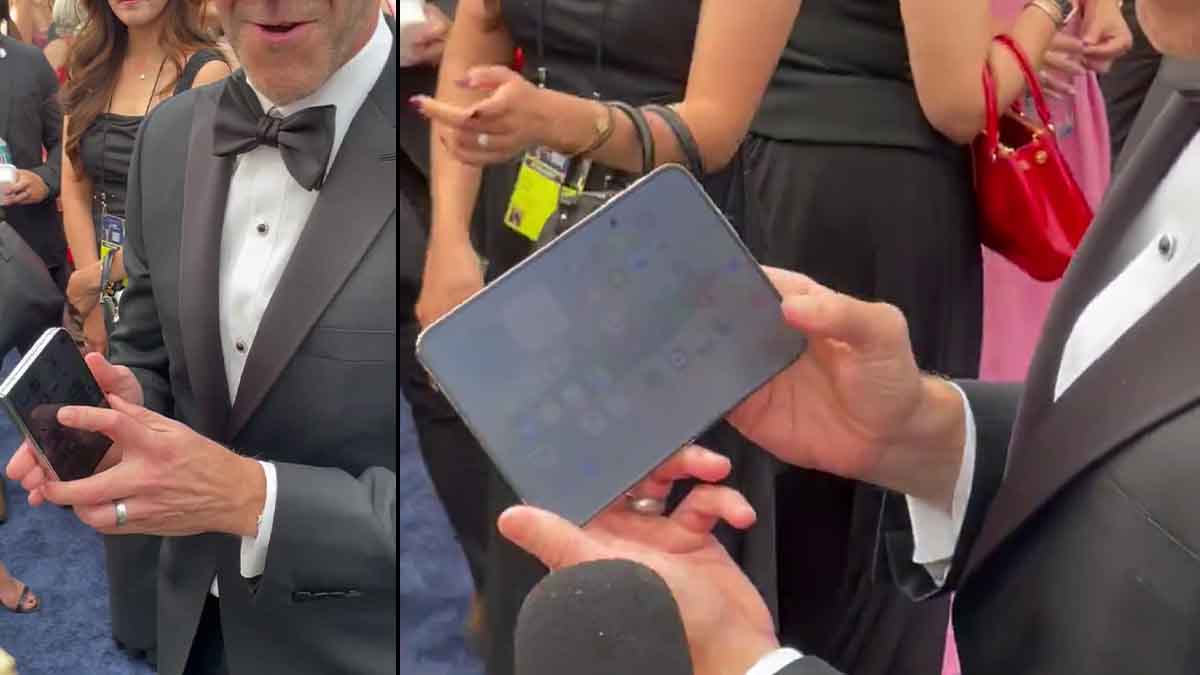
Apple iPhone Duo foldable phone has already found itself under scrutiny, and this time the concern is not about its hinge or crease, but the screen, which appears dark in bright light.
The iPhone Duo’s inner screen appeared unusually dim and washed out during a public appearance, raising questions about how its matte display finish performs under harsh lighting.
Apple iPhone Duo dark screen draws attention at Emmys
Apple CEO John Ternus briefly showed the iPhone Duo while attending the 78th Emmy Awards. Video from the event quickly circulated online, with the unfolded display looking difficult to read under the bright lighting at the venue.
The reaction is particularly interesting because Apple has made the inner display’s nano-texture finish one of the iPhone Duo’s notable design features.
The 7.6-inch flexible screen uses the textured surface to scatter reflections, making the display easier to view in normal conditions while also helping make the central fold less obvious.
Apple CEO John Ternus shows the new iPhone Duo | #Emmys pic.twitter.com/7a6Rp1yMSS
— Deadline (@DEADLINE) September 14, 2026
Is nano-texture responsible?
A nano-textured surface can reduce reflections, but its matte appearance can also make an OLED panel look less punchy when strong ambient light hits the screen. The effect can reduce perceived contrast and make the display appear more grey under intense lighting.
The Emmy footage (via AplWire) therefore raises a legitimate question about the balance Apple has chosen. The company appears to have prioritized reducing reflections and making the crease less noticeable, but that does not automatically mean the display has sacrificed brightness.
There is another important detail: the iPhone Duo’s external screen also appeared relatively dark in the same footage, despite not using the inner display’s nano-texture treatment.
That makes it difficult to blame the matte finish alone. Display brightness, viewing angle, camera exposure and the extremely bright red-carpet lighting could all have contributed.
Real-world testing will tell the story
The controversy is arriving well before the iPhone Duo reaches customers. Apple has scheduled pre-orders for October 16, with sales beginning October 23.
The more interesting question is whether Apple’s unusual approach can deliver the promised low-reflection experience without making the display look dull when the lighting gets difficult.

Samsung Display is planning to invest about 300 billion won to start mass production of 12-inch RGB OLEDoS displays. The company is expected to confirm the investment this month
The planned production line will have a capacity of about 3,000 wafers per month. Samsung Display is likely to build the line at its A2 plant, which already has a 12-inch WOLEDoS line. Around 150 billion won of the investment will be spent on deposition equipment. Samsung Display has selected South Korean company Sunik Systems to supply this equipment after comparing it with Japan’s Canon Tokki.
RGB OLEDoS requires very accurate production because red, green and blue materials must be placed directly on very small pixels. The equipment must also control the position of the wafer and mask very carefully. This makes the equipment more expensive than normal OLEDoS equipment.
Samsung Display is expected to order the equipment in the fourth quarter. Equipment installation could begin in 2027, while mass production is planned for 2028. The company will need time to install and test the equipment and improve the production process.
RGB OLEDoS has an advantage because it does not need a color filter. This can provide higher brightness, better power efficiency, and better color quality. However, production is difficult. Imagine, a US microdisplay company acquired by Samsung Display in 2023 is known to have achieved a yield of around 20% on 8-inch wafers.
Moving to 12-inch wafers could make production harder because maintaining even deposition and accurate alignment becomes more difficult. An industry official said that 12-inch RGB OLEDoS mass production has not yet been proven. Improving the yield will be main to deciding when Samsung Display can begin commercial production.
Rajiv Aggarwal, who has been handling government relations for Samsung India, is leaving the company after almost four years. He is currently in his final week at Samsung, according to Reuters.
Rajiv Aggarwal, 57, was Samsung India’s head of public affairs and ESG. His work included managing the company’s communication and relationship with the Indian government.
The reason behind his decision to leave has not been made public. Aggarwal, who earlier worked as a government official, has also held public policy positions at Uber and Meta. He did not give any comment about his departure. Samsung Electronics has also not responded to questions.
His exit comes when Samsung is dealing with several important issues in India. The government recently asked smartphone companies, including Samsung and Apple, to install government apps on their devices. The companies have expressed concerns about user privacy.
Samsung is also facing a legal issue over rules related to electronic waste. The company has challenged a government policy that requires businesses to pay more money to electronic-waste recyclers.
India is an important market for Samsung. The company currently has about 16.2% of the country’s smartphone market. It has the same share as Oppo and is behind Vivo. Samsung was the biggest smartphone brand in India in 2023.
Aggarwal’s departure means Samsung will now need to find a new person to manage its government and public policy work at a time when technology companies are facing more rules in India.

Samsung officially launched a new budget phone, the Galaxy A08, in Bosnia and Herzegovina. The company didn’t make an announcement nor published a press release on its Newsroom, with the phone going directly on sale.
Galaxy A08 specifications
Samsung’s Galaxy A08 comes with a sleek and lightweight design, weighing 197 grams. The phone sports a 6.7-inch PLS LCD screen with HD+ resolution.
Under the hood, it is powered by MediaTek’s Helio G99 chipset, paired with 4GB RAM (LPDDR5X), 128GB of internal storage, 6000mAh battery, and 25W fast charging.
In terms of optics, the Galaxy A08 has a dual camera setup, featuring a 50MP main camera with an F1.8 aperture and a 2MP secondary camera with an F2.4 aperture, plus the selfie camera has 8-megapixel resolution.
Samsung will ship the budget phone with the latest software. The official listing reveals that the device will come with Android 17-based One UI 9 software, while supporting six years of updates.
Additionally, Samsung’s Galaxy A08 introduces GPS, 4G LTE, a dual-SIM card slot, Wi-Fi 5, Bluetooth 5.3, a USB 2.0 Type-C port, and a 3.5mm headphone jack. Available colors include Dark Blue, Green, and Silver.
Samsung hasn’t shared pricing details for now.


Samsung is strengthening its position in the foldable display supply chain even as the overall market faces a slowdown.
According to Counterpoint Research (via Semiconductor Insider), global foldable smartphone panel shipments fell 13% year-over-year during the first half of 2026.
Samsung Display increased its second-quarter panel shipments by 6% compared to the same period last year. Its market share jumped 13.5 percentage points to 66%, with the company also recording 10% shipment growth for the first half.
The Korean display maker’s market share rose 13.5% to 66%, widening its lead over China’s BOE, whose shipments fell 41% and share dropped to 22%.
The decline in the wider market is largely tied to Flip phone screens, which dropped 62%. Meanwhile, book-style panels grew 35%, pushing their share to 78%. This shift favors Samsung’s Galaxy Z Fold lineup and other larger-screen foldables.
Counterpoint expects the foldable panel market to rebound strongly in the second half, with full-year shipments forecast to grow 23%.
Global foldable smartphone panel shipments in the first half of 2026 decreased by 13% year-on-year. Samsung Display saw its shipments rise by 10%, leading to an increase in market share.
According to Counterpoint Research, Samsung Display's foldable panel shipments in the second… pic.twitter.com/bEV1w6fyVg
— Semiconductor Insider (@SemiconductorsX) September 15, 2026
-
 One UI3 days ago
One UI 9.0 Beta and Stable testing on these Samsung devices
-
 Comparison3 days ago
Top 7 camera differences between iPhone 18 Pro Max and Galaxy S26 Ultra
-
 News2 days ago
Samsung Galaxy S26 refurbished phones arrive in Korea
-

 One UI2 days ago
Samsung Galaxy S24 grabs 4 great AI features with One UI 9 Beta 2