
News
Samsung closes 2025 with record revenue, AI chips outperform phones and TVs


Samsung ended 2025 with its biggest quarter ever: KRW 93.8 trillion in revenue and operating profit at KRW 20.1 trillion ($13.98 billion). For the full year, Samsung posted KRW 333.6 trillion in revenue and KRW 43.6 trillion in operating profit.
Key takeaways from the 2025 Annual Report:
- Total Revenue: KRW 333.6 trillion (Annual) / KRW 93.8 trillion (Q4)
- Operating Profit: KRW 43.6 trillion (Annual) / KRW 20.1 trillion (Q4)
- DS (Semiconductor) Division saw a 33% revenue jump in Q4.
- DX (Mobile/TV) Division revenue slipped 8% sequentially.
- Record R&D investment of KRW 37.7 trillion for the year.
The AI boom rose memory demand, which helped Samsung make more money than from phones and TVs. The Device Solutions Division was the engine, with sales jumping 33 percent quarter-on-quarter.
Samsung leaned hard into high-value products like server DDR5, enterprise SSDs, and AI-focused memory stacks. The company is already lining up HBM4 shipments in Q1 2026, including parts rated at an industry-leading 11.7Gbps.
System LSI earnings dipped due to seasonal softness and customer schedule changes, yet image sensor revenue climbed on new 200MP and 50MP big-pixel sensors.
Foundry revenue rose on strong demand and the start of first-generation 2nm mass production, even if provisional costs capped profits. Second-generation 2nm ramps later this year remain the real test.
Phones and TVs
Revenue slipped 8 percent sequentially as smartphone launch effects faded and competition intensified across devices. The MX business still delivered double-digit annual profit in 2025, supported by flagships, tablets, and wearables.
On mobile, the Galaxy S26 series is set to push Agentic AI as the headline feature.
If HBM4 ramps as planned and Agentic AI lands cleanly on Galaxy S26, Samsung enters 2026 not just as a market leader, but as the company setting the rules for the AI era.





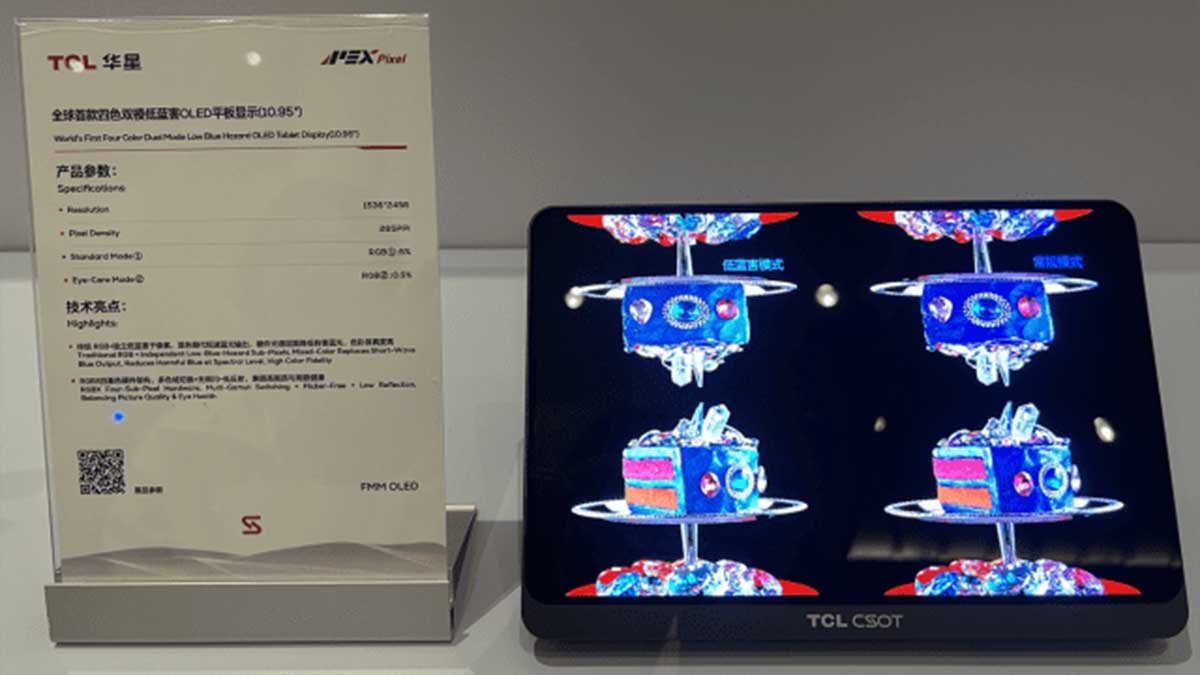
China’s display manufacturer TCL CSOT showcased three types of 4-subpixel dual-mode OLED display technologies at its Global Display Tech-Ecosystem Conference in Wuhan, China. CSOT’s new OLED solutions claim to reduce power consumption without compromising color.
The new CSOT OLED panels utilize technologies, such as Blue phosphorescent emitters, thanks to a 4-subpixel dual-mode solution. The Chinese panel maker touts power saving without affecting the color production of the displays.
Korea’s ZDNet reports that CSOT’s 4-subpixel dual-mode OLED adds one specific-colored subpixel to the existing small- and medium-sized RGB OLED structure that deposits organic materials using a fine metal mask (FMM).
The new display structure switches the combination of driven subpixels depending on the mode. Based on the color of the added subpixel, it is categorized into RGBB, RRGB, and so on.
How CSOT’s new OLED is different
Legacy OLED panels make Red and Green subpixels use phosphorescent emitters with an internal quantum efficiency of 100%, whereas blue OLED subpixels use fluorescent emitters with an internal quantum efficiency of 25%.
TCL CSOT worked on replacing the Blue fluorescent emitters with phosphorescent or thermally activated delayed fluorescence (TADF) emitters, but the RGBB OLED solutions have not yet been commercialized due to lifespan issues.
CSOT official stated, “Compared to the standard mode that uses the blue fluorescent emitter, the low-power mode applying the blue phosphorescent emitter can save 20% in power consumption.”
RGBB OLED
CSOT showcased another RGBB OLED, which has both blue (B) emitters as fluorescent. The product specifications are the same as those of the RGBB OLED applying the blue phosphorescent emitter.
A CSOT official explained, “We applied a fluorescent emitter with reduced blue light emission to one of the two blue subpixels.”
RRGB OLED
TCL’s CSOT also showcased an RRGB OLED with an added red (R) OLED subpixel. A deep red (RD) subpixel was added to the existing RGB structure. It can be used by switching between standard mode (RGB) and wide color gamut mode (RDGB).
BT.2020 color gamut coverage:
- 89% in standard mode
- 95% in wide color gamut mode
RGBN OLED
CSOT exhibited an RGBN product that adds a white (W) color filter to the RGB color filter of LCD products. The company expressed the W color filter as N (natural), with specs supporting 4K resolution, a 120Hz refresh rate and over 95% of the BT.2020 color gamut.
The CSOT official stated, “The RGBN product increased light transmittance from the previous upper 6% range to 9%.” Higher light transmittance allows for savings in backlight unit (BLU) power consumption.

Samsung’s $898 million patent licensing agreement with US semiconductor company Netlist is facing fresh scrutiny after a US appeals court upheld the invalidation of three memory-related patents involved in a long-running legal dispute with Micron.
On November 13, the US Court of Appeals for the Federal Circuit affirmed the Patent Trial and Appeal Board’s (PTAB) decisions invalidating three Netlist patents.
The patents include technologies covering memory rank multiplication and data buffering modules. They were also central to a $445 million damages verdict previously secured by Netlist against Micron.
The ruling is particularly relevant to Samsung because the company had already agreed to a five-year global patent licensing arrangement with Netlist before the appeals concluded. Although Samsung withdrew from the appellate proceedings after settling, the court continued reviewing the patent disputes and ultimately upheld the invalidations, as per Bloomberg.
The outcome creates an important distinction between Netlist’s ability to defend its patents and its contractual rights under existing licensing agreements.
Samsung signed its five-year patent cross-license agreement with Netlist on August 4, 2026, effective July 1. The agreement covers Netlist’s broader global patent portfolio, rather than just the three patents involved in these appeals.
Additionally, Micron settled its patent disputes with Netlist on October 5, 2026, agreeing to a five-year license worth $600 million, payable in quarterly installments of $30 million.

Samsung has become Indonesia’s top smartphone brand, with a 33% market share in the third quarter of 2026. The company achieved this position even as the country’s smartphone market faced a major decline.
According to research firm Counterpoint Research, smartphone shipments in Indonesia fell by 43% compared to the same quarter last year. The findings were shared at the Indonesia Gadget Awards 2026 on November 12.
Samsung’s market share increased from 21% last year to 33% this year. Its smartphone shipments fell by only 5%, showing better performance than its competitors.
Xiaomi ranked second with a 21% market share, followed by Oppo with 16%, Infinix with 11%, and Vivo with 8%. Other brands faced bigger drops in shipments. Vivo saw the largest decline at 67%, followed by Oppo at 64%, Infinix at 51% and Xiaomi at 33%.
The main reason for the market decline is the global shortage of memory chips. Higher demand for memory from AI data centers has pushed up the prices of RAM and storage.
This has also made affordable smartphones more expensive. The market share of phones priced below $150 dropped from 55% to 24%. Meanwhile, phones priced between $150 and $249 increased their share from 22% to 33%.
Due to rising costs, smartphone companies are now focusing more on midrange and premium phones. Samsung’s smaller shipment decline helped it take the top position in Indonesia. However, the country’s overall smartphone market continues to face challenges.
News
Samsung shows off massive new OLED factory as BOE and TCL CSOT ramp up pressure for Apple’s business


Samsung Display just gave the industry a rare look at its mega A7 OLED production line in Asan, South Korea, according to a report by Korean outlet iNews24. Unveiled via video during an adjacent campus ceremony on November 12, the steel-framed facility is slated for mass production in the second half of 2029.
Just six days prior, China’s TCL CSOT announced core equipment move-ins for its CNY 29.5 billion t8 line in Guangzhou, targeting Q4 2027 production.
Meanwhile, BOE’s massive CNY 63 billion B16 line in Chengdu already beat Samsung’s existing A6 line to mass production by three weeks back in June, supplying 14-inch panels to Lenovo.
Samsung Display currently holds a lucrative monopoly as the sole panel supplier for Apple’s newly launched OLED MacBook Pro, a direct payoff from its KRW 4.1 trillion bet on the 8.6-generation A6 line.

TrendForce projects OLED MacBook Pro shipments to hit up to 1.5 million units in 2027, fueling a broader 40% surge in OLED laptop demand. That momentum already helped Samsung Display post KRW 1.1 trillion in Q3 operating profit.
Yet, holding onto Cupertino’s business won’t be easy. TrendForce notes that BOE, TCL CSOT, and LG Display are aggressively vying for the upcoming OLED MacBook Air expected in 2029.
CSOT is even gambling on inkjet printing tech at its t8 plant to slash material costs. Samsung’s public flex with A7 signals it won’t cede its IT panel leads without a massive capital fight, though winning Apple’s next contract will ultimately boil down to tandem OLED yields rather than sheer factory floor space.

Apple may have avoided the launch of base iPhone 18 and shipped it alongside the iPhone 18 Pro lineup if Samsung had caught up on camera sensors and ramped up its advanced semiconductor factory in Texas, the US.
A new report makes us blame Samsung for the delay in iPhone 18 launch. Earlier, it was only the memory supply shortage, but fresh reporting suggests that Apple is waiting for Samsung to catch up on camera chip demand.
Samsung is making advanced camera chips for Apple’s iPhone in the US. The two companies announced this mega collaboration last year. The transition from Sony’s monopoly to a Samsung-and-Sony duopoly is slated to start with iPhone 18.
Semiconportal reports that Apple found it difficult to source camera sensors for the iPhone 18 series in 2026 alone. Since Samsung is set to join the supply chain with iPhone 18, the base iPhone 18’s launch timeline has been postponed.
Samsung is expected to begin mass producing image sensors for Apple in Fall 2026. With the Korean tech giant beginning manufacturing, Apple would be able to source enough camera sensors for its iPhone 18 model in early 2027.
Apple and Samsung are making the former’s camera sensors with “innovative new technology for chip manufacturing” at the latter’s semiconductor plant in Austin, Texas. Apple would buy 48MP or 200MP sensors from Samsung under the agreement.
You may like: When will Apple and Samsung launch 200MP telephoto camera phones?
At present, Sony dominates the iPhone camera supply chain. Bringing Samsung in the camera supply will push Apple’s US manufacturing ambitions further, while reducing complete reliance on one supplier for a key component.

Post date: July 3, 2026
-
 One UI21 hours ago
One UI 9.0 official update now rolling out to these Samsung phones
-
 One UI12 hours ago
One UI 9.5 Eligible Devices: These Samsung devices could receive the next major update
-

 One UI3 days ago
Fresh One UI 9.5 leaks reveal AI Rambler, Telegram and WhatsApp call recording, new widgets and UI tweaks
-
 AI3 days ago
Gmail gets new Gemini AI tools for writing and email summaries