
News
Your Galaxy S25 has the real Snapdragon 8 Elite, not Qualcomm’s


Samsung’s Galaxy S25 series has become Qualcomm’s growth engine with the Snapdragon 8 Elite for Galaxy chip. If your smartphone has the Snapdragon 8 Elite processor, high chance it would be a Galaxy S25 from Samsung.
This year, the Galaxy S25 series boosted Snapdragon 8 Elite sales, benefiting Qualcomm. The Galaxy S25 flagships use a custom Snapdragon that is different from what Qualcomm ships to non-Samsung Android OEMs.
Samsung insider Phoneart shared sales data of the Galaxy S25 series, as of June 2025. As the flagships exceeded 20 million sales, the same volume of the Snapdragon 8 Elite for Galaxy processor is also commercialized worldwide.
Snapdragon 8 Elite, Qualcomm’s standard version, has sold even less than 20 million collectively from all OEMs, including Xiaomi, OnePlus, Oppo, RedMagic, and Asus.
So practically, the Snapdragon 8 Elite for Galaxy is the real “elite” chip, not the one Qualcomm launched. Samsung’s custom Snapdragon has the same CPU as standard but features faster prime cores clocked at 4.47GHz.
On the other hand, Snapdragon 8 Elite has a 4.32GHz CPU frequency. The CPU performance is difficult to differentiate in general usage. However, the custom version alone sold more than the standard one globally.
Well, it may not be the same case in 2026 if Samsung launches Exynos 2600. This chip will then take half the share of total sales by powering the Galaxy S26 Pro and Edge in key markets in Asian and European regions.
The Galaxy S26 Ultra will be equipped with a 2nd-gen Snapdragon 8 Elite chip. It will feature an even faster CPU at 4.74GHz on two prime cores. The standard version is highly likely to feature a little underclocked CPU.


If you’re planning to wait another year before buying a foldable phone in hopes of getting a better deal, that strategy may no longer work. Foldable phone prices will climb further, and 2026 is set to see an 18 percent jump alone.
The overall foldable market is rapidly shifting toward ultra-premium devices priced above $1,600. Delaying your purchase could actually mean paying more for the type of foldable that manufacturers increasingly prioritize.
A new Counterpoint report indicates that devices above the $1,600 price bracket could account for roughly 60 percent of all foldable shipments in 2026, fundamentally changing the category’s average selling price.
Apple’s arrival changes the pricing equation
Industry estimates suggest Apple’s first foldable, widely rumored as the iPhone Ultra, could capture nearly 28 percent of the global foldable market in its first year.
Unlike many Android manufacturers that compete across multiple price tiers, Apple is expected to launch directly into the premium book-style segment.
That single move dramatically raises the industry’s weighted Average Selling Price (ASP). Ironically, it also hides the fact that lower-priced foldables continue getting cheaper underneath the surface.
The real story isn’t hardware, but AI
The smartphone industry has reached a practical limit. Traditional slab phones maximize portability but struggle with multitasking. Flip phones prioritize compactness, yet sacrifice usable workspace.
Book-style foldables solve a completely different problem: they create a pocket-sized workspace capable of supporting simultaneous AI workflows. We found that multitasking is becoming the strongest justification for expensive foldables.
For years, consumers expected smartphones to become cheaper with time. Foldables are beginning to follow a different path, where the devices delivering the most productivity gains also command the industry’s highest premiums.
You may like:


July 1, 2026 | Samsung may expand its premium tablet portfolio in the next few months. The company’s upcoming Galaxy Tab S12+ and Galaxy Tab S12 Ultra might be unveiled in September 2026, as per @fireuniverse.
Original story…
Samsung isn’t reportedly bumping the battery capacity on its Galaxy Tab S12 Ultra. New information coming out from the supply chain suggests a battery mAh stagnation on the company’s biggest tablet this year.
GalaxyClub revealed the possible battery capacity of the Galaxy Tab S12 Ultra. Samsung’s upcoming tablet reportedly retains an 11,600 mAh battery (11,374 mAh rated).
This is the same size battery the Korean tech giant installed inside the Galaxy Tab S11 Ultra. Charging speed could also remain unchanged at 45W, letting users charge their tablets faster.
While the battery size is staying same, Samsung may still bring battery life improvements. This would be powered by the utilization of a new chipset that’s coming from MediaTek.
Galaxy Tab S12 series could rely on MediaTek’s Dimensity 9500 processor. This 3nm chipset is fabricated using TSMC’s 3nm 3NP process, offering performance and efficiency improvements.
- You may like – Exynos 2600 vs Snapdragon 8 Elite Gen 5 vs Dimensity 9500 – Which is the fastest mobile chip?
The Dimensity 9500 uses three CPU clusters based on a fast ARM C1-Ultra core with up to 4.2 GHz, three C1-Premium cores at up to 3.5 GHz, and four smaller C1-Pro cores at up to 2.7 GHz.
In Geekbench 6, the Dimensity 9500 scores 3,177 in single-core and 9,701 in multi-core. The 9400+ pushes single-core slightly higher than the base 9400 thanks to its boosted 3.73 GHz prime core, but it still uses the same ARMv9.2 architecture.
MediaTek’s Dimensity 9500 is up to 42% more efficient for graphics, powered by the new Mali-G1 Ultra. In terms of AI, it delivers 100% faster 3-billion-parameter LLM output, 128K token long-text processing, and 4K ultra-high-definition image generation on-device.
Samsung could launch the Galaxy Tab S12 Ultra alongside the Tab S12 Plus sometime in September this year.

Samsung initiated July 2026 with the first wave of Unpacked teasers, but what followed next has revealed the launch date of the upcoming Galaxy Z Fold 8 foldable phone and Galaxy Watch 9 smartwatch.
In Malaysia, Samsung is giving away free shopping vouchers through the Members app. Galaxy users are seeing a newly published advertisement inside. The voucher is valued at RM 700, which translates to roughly $170.
Well, that’s not the entire story.
The Samsung ad published in the Members app also accidentally revealed the launch date of the Galaxy Z Fold 8 and Watch 9. The vouchers apply to “next foldable” or “next wearable” and qualify purchases starting July 22, 2026.
Once grabbed, Samsung users will be able to redeem the vouchers until October 4 on the Samsung Online store, and from August 11 to October 4 when shopping in-store.

Korean media had been reporting for months that July 22 is the strongest contender for the Galaxy Unpacked event. The in-person event could be organized in London, rather than a city in the United States or South Korea.
Samsung has a wide range of gadgets in the pipeline for its Summer Unpacked. Three foldable phones and two Wear OS smartwatches are coming. The company may also reveal progress on its intelligent eyewear (glasses).
New Fold teasers
Earlier today, Samsung released five teasers linked to the Galaxy Z Fold 8. The company has used a variety of stuff to build hype for the wide foldable model. An image also teased some of the color shades alongside the official wallpaper.
Read more here:

Researchers discovered 6 security flaws in Android Quick Share and Apple AirDrop. The research exposed how these sharing platforms work under pressure. Five billion devices are reportedly affected, but the fix is rolling out.
Researchers Arash Ale Ebrahim and Nils Ole Tippenhauer from the CISPA Helmholtz Center dug into how AirDrop and Quick Share actually work behind the scenes, as per HelpNetSecurity.
What they found is worth paying attention to: three bugs turned up in AirDrop, and all three can crash the system. The worst one hits sharingd, the background service on macOS and iOS that handles plenty of services.
Quick Share had its own issues, but they showed up in a different way. Researchers found two ways to slip past the point where the app is supposed to check who you are, before any real security kicks in.
It’s worth noting that a comment left in the code by Samsung’s own developers years ago basically predicted this exact problem, and the fix at the time didn’t fully solve it.
Apple and Google built these two systems completely separately, with different code and different teams. Yet they both ran into the same kind of mistake: checking security in bits and pieces instead of one solid gate that nothing gets past.
Ale Ebrahim pointed out that this isn’t really an Apple problem or a Google problem.
Apple already patched one of the three AirDrop bugs, though the public details aren’t out yet. Google fixed the Windows issue too, while a couple of the Quick Share bugs are still being looked into.

Samsung is aiming to make the first chip based on its 1.4nm process in 2029. The company has recently confirmed that technology development is progressing smoothly and an enhanced version is being developed for 2030.
In a recent development, supply chain inputs revealed that Samsung has shared its 1.4nm plans with foundry partners. The move signalled that the company hasn’t dumped the next leap just to mature the 2nm process.
Now, TheElec reports that Shin Jong-shin, a senior executive at Samsung, shared juicy information about the chip process. The development of the 1.4nm chip is proceeding smoothly, and Samsung plans mass production in 2029.
Samsung’s 1.4nm process is based on SF1.4, and the company also has an enhanced iteration, SF1.4+, planned for 2030 mass production.
“SF” stands for Samsung Foundry process, while the number following it indicates the process node. The plus sign (+) denotes an enhanced version.
“The ‘Plus’ node improves yield and PPA (Power, Performance, and Area) by optimizing Design-Technology Co-Optimization (DTCO) and adding new features, all while maintaining the existing intellectual property (IP) infrastructure.”
In particular, Intel is leading the 1.4nm chip manufacturing. The US tech giant is expected to produce the first 1.4nm-class A14 products in 2028; however, the mass production would begin at scale in the year 2029.
Samsung’s expansive 2nm roadmap
Samsung also revealed its roadmap for the next-gen 2nm process. It will evolve in the sequence of SF2, SF2P, SF2P+, and SF2X, with mass production for SF2P+ targeted for 2027-2028, and subsequently introduce SF2X.
The 2nm semiconductor process will continue to dominate the foundry market until 2029. The Korean tech giant may ship its first Galaxy devices with the 1.4nm chipset in early 2030, if it stays consistent with the usual strategy.
-
 Phones2 days ago
Trusted source leaks Galaxy Z Fold 8 Wide colors, specifications
-
 One UI17 hours ago
Android 17-based One UI 9.0 testing on these 27 Samsung devices
-

 Samsung12 hours ago
Samsung Galaxy Z Fold 8 (Wide): Complete phone specifications
-
 News2 days ago
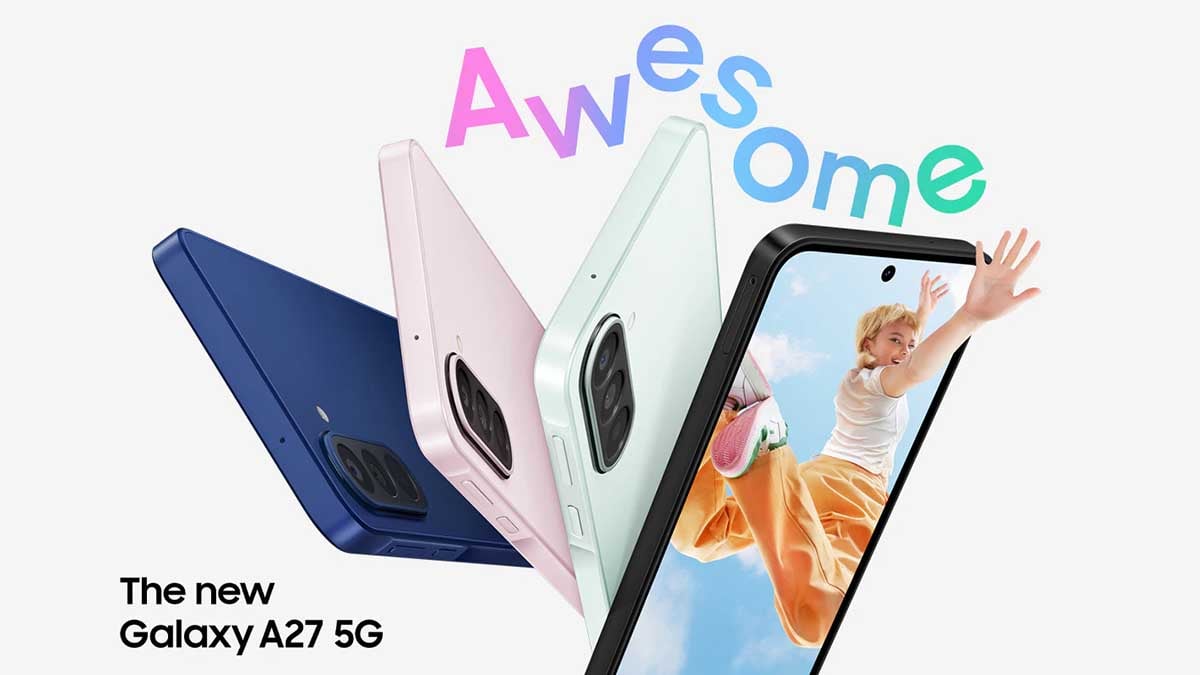
Samsung Galaxy A27 5G launched in the US for $350 [U: India too]