
Samsung
Samsung’s Executives meet with U.S. tech giants to discuss future chips


Samsung’s top executives, including Vice Chairman Jun Young-hyun and President Han Jin-man, are visiting Silicon Valley this week. They’re meeting with major U.S. tech companies like Apple, NVIDIA, and Broadcom to talk about improving Samsung’s semiconductor business.
The main topic of the meeting is Samsung’s memory chips, especially the DRAM used in mobile devices. Samsung is also working with Apple on a new type of memory for a future launch in 2028.
The Korean tech giant wants to keep Apple as a customer and stop it from switching to other companies like Micron. This is important because Apple plans to buy a huge amount of chips this year. Samsung lost its top spot in global DRAM sales in the first quarter to SK Hynix, so keeping Apple’s business is critical.
Samsung is also in talks with NVIDIA about its new memory technology, HBM4, which they hope to use in NVIDIA’s next AI chip, “Vera Rubin.” Samsung plans to start mass-producing HBM4 later this year and expects to earn revenue from it in 2024.

With big companies like Google and Meta investing in AI and cloud services, Samsung is also hoping to get more orders for server memory chips and NAND flash.
Samsung’s Foundry business, which makes chips for other companies, is in focus. The company has faced challenges with poor chip yields, but it plans to start producing 2nm chips by the end of this year to attract candidate customers like Qualcomm and Tesla.
Overall, Samsung is also worried about potential tariffs on semiconductor products in the U.S. These tariffs could affect global supply chains to make it even more important for Samsung to meet with U.S. companies face-to-face to discuss the future.

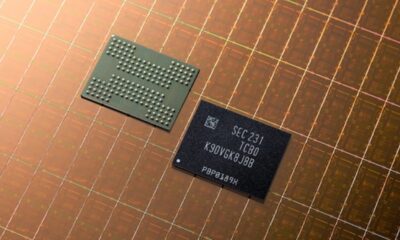






At Future of Memory and Storage (FMS) 2026 in Santa Clara, Samsung showcased a fresh batch of AI memory innovations, including zHBM and zNAND-O.
The company has once again reminded the industry why it sits at the top of the memory game. The showcase included two concept models, zHBM and zNAND-O, along with the industry-first V10 BV-NAND, a NAND architecture that pushes past 400 layers.
Samsung zHMB AI memory
The standout reveal was zHBM, a concept that flips the traditional HBM layout on its head.
Instead of placing HBM beside the AI accelerator, Samsung’s new architecture stacks it directly on top. It reduces the physical distance data has to travel, offering faster processing and better power efficiency for AI training and inference workloads.
Samsung claims a next-gen interface built around zHBM could hit roughly eight times the performance of HBM5, while memory density climbs past 10 times thanks to new wafer bonding tech. Energy efficiency reportedly triples too, and thermal resistance drops by more than half.
Samsung zNAND-O AI memory
Alongside zHBM, Samsung introduced zNAND-O, a NAND solution aimed squarely at edge AI. Built on the company’s existing V-NAND foundation, it’s being developed in four- and eight-layer configurations, focusing on space efficiency, quicker I/O, and low latency.
Samsung V10 BV-NAND
Then there’s V10 BV-NAND, which arrives 13 years after Samsung first introduced V-NAND back in 2013. This new generation uses Bonding V-NAND architecture and packs in more than 400 layers.
Wafer bonding technology plays a key role here too, letting Samsung stack cells more efficiently while also improving read, write, and I/O performance.
Additionally, Samsung used the event to lay out a broader roadmap covering everything from HBM and LPDDR to enterprise storage, all built around the idea of keeping AI infrastructure fast, efficient, and ready to scale.


Samsung revised its One UI software rollout roadmap and made it public along with the August 2026 security patch details. This is an important update for Galaxy users that lets them verify their device’s software lifespan.
Interestingly, Samsung has made no significant changes to its August 2026 software rollout roadmap. Nearly all devices that were listed in the July 2026 chart are carried over to the August 2026 chart.
Samsung classifies its roadmap in two parts: Monthly and Quarterly. Flagship phones receive the latest patches every month, while others get them once a quarter.
Based on device eligibility and age, the company places them in the appropriate category, then moves them once before permanently dropping them from software updates.
Here’s the latest update frequency schedule released on August 4, 2026.
Samsung Monthly Devices
This is the top tier of Samsung Galaxy updates. All the flagship phones enter the “Monthly” category for up to 6 years. The last year of their software lifecycle spends on a “Quarterly” rollout plan.
Galaxy Foldable Series
- Galaxy Z TriFold
- Galaxy Z Fold4, Galaxy Z Fold5, Galaxy Z Fold6, Galaxy Z Fold7, Galaxy Z Fold Special Edition, Galaxy Z Fold8, Galaxy Z Fold8 Ultra
- Galaxy Z Flip4, Galaxy Z Flip5, Galaxy Z Flip6, Galaxy Z Flip7, Galaxy Z Flip7 FE, Galaxy Z Flip8
- W23, W23 Flip, W24, W24 Flip, W25, W25 Flip, W26
Galaxy S Series
- Galaxy S26, Galaxy S26+, Galaxy S26 Ultra
- Galaxy S25, Galaxy S25+, Galaxy S25 Ultra, Galaxy S25 Edge, Galaxy S25 FE
- Galaxy S24, Galaxy S24+, Galaxy S24 Ultra, Galaxy S24 FE
- Galaxy S23, Galaxy S23+, Galaxy S23 Ultra, Galaxy S23 FE
Enterprise Models
- Galaxy A54 5G, Galaxy A55 5G, Galaxy A56 5G, Galaxy A57 5G
- Galaxy Tab Active5 Pro
- Galaxy XCover7, Galaxy XCover7 Pro
Samsung Quarterly Devices
All non-flagship Samsung phones and tablets receive “Quarterly” updates. They get listed in this expansive batch right after their debut. Flagship phones you see in this section are transferred from Monthly frequency.
Galaxy Foldable Series
- Galaxy Z Fold3 5G
- Galaxy Z Flip3 5G
Galaxy S Series
- Galaxy S22, Galaxy S22+, Galaxy S22 Ultra
- Galaxy S21 FE 5G
Galaxy A Series
- Galaxy A04, Galaxy A04s, Galaxy A04e, Galaxy A05, Galaxy A05s, Galaxy A06, Galaxy A06 5G, Galaxy A07, Galaxy A07 5G
- Galaxy A14, Galaxy A14 5G, Galaxy A15, Galaxy A15 5G, Galaxy A16, Galaxy A16 5G, Galaxy A17, Galaxy A17 5G
- Galaxy A23 5G, Galaxy A24, Galaxy A25 5G, Galaxy A26 5G, Galaxy A27 5G
- Galaxy A33 5G, Galaxy A34 5G, Galaxy A35 5G, Galaxy A36 5G, Galaxy A37 5G
- Galaxy A73 5G
Galaxy C Series
- Galaxy C55 5G
Galaxy M Series
- Galaxy M04, Galaxy M05, Galaxy M06 5G, Galaxy M07
- Galaxy M13 5G, Galaxy M14, Galaxy M14 5G, Galaxy M15 5G, Galaxy M16 5G,
- Galaxy M17 5G, Galaxy M17e 5G
- Galaxy M34 5G, Galaxy M35 5G, Galaxy M36 5G
- Galaxy M44 5G, Galaxy M47 5G
- Galaxy M54 5G, Galaxy M55 5G, Galaxy M55s 5G, Galaxy M56 5G
Galaxy F Series
- Galaxy F04, Galaxy F05, Galaxy F06 5G, Galaxy F07, Galaxy F70e 5G
- Galaxy F13, Galaxy F14, Galaxy F14 5G, Galaxy F15 5G, Galaxy F16 5G, Galaxy F17 5G
- Galaxy F34 5G, Galaxy F36 5G
- Galaxy F54 5G, Galaxy F55 5G, Galaxy F56 5G
Galaxy Tab S Series
- Galaxy Tab S11, Galaxy Tab S11 Ultra
- Galaxy Tab S10+, Galaxy Tab S10 Ultra, Galaxy Tab S10 FE, Galaxy Tab S10 FE+, Galaxy Tab S10 Lite
- Galaxy Tab S9, Galaxy Tab S9+, Galaxy Tab S9 Ultra, Galaxy Tab S9 FE, Galaxy Tab S9 FE+
- Galaxy Tab S8, Galaxy Tab S8+, Galaxy Tab S8 Ultra
- Galaxy Tab S6 Lite (2024)
Galaxy Tab A Series
- Galaxy Tab A11, Galaxy Tab A11+
- Galaxy Tab A9, Galaxy Tab A9+, Galaxy Tab A9+(2025)
Enterprise Models
- Galaxy A53 5G
- Galaxy Tab Active4 Pro, Galaxy Tab Active5
- Galaxy XCover5, Galaxy XCover6 Pro

Samsung has launched its first credit card, the Samsung Galaxy Card, in the US. It is made for people who want to earn cash rewards while shopping, especially when buying Samsung products. The card also gives rewards for everyday spending.
New cardholders can get a special welcome bonus. If you spend $2,000 within the first 90 days after opening your account, you will receive $200 in bonus cash rewards.
Samsung Galaxy Card offers different reward rates depending on where you shop. You earn 5% cash rewards when you buy directly from Samsung. This includes phones, tablets, TVs, accessories, and even preorders for new Samsung devices.
If you use the card through Samsung Wallet with Samsung Pay, you earn 3% cash rewards on your purchases. You also earn 2% cash rewards when paying for eligible streaming services like Netflix, Disney+, and Spotify. All other purchases earn 1% cash rewards, so you can still earn rewards on your everyday spending.
The card also comes with extra benefits. Cardholders get 20% off Samsung VIP Advantage memberships. You can also earn 5% cash rewards when you buy or renew a Samsung VIP Advantage membership.
The card works with Samsung Wallet, and Samsung Knox helps protect your personal and payment information with strong encryption. After your application is approved, you can start using the digital card in Samsung Wallet right away.
Samsung Galaxy Card is available for qualifying adults who are 18 years or older and live in the United States. The card is issued by Barclays US Consumer Bank and runs on the Visa network.

Samsung’s camera engineers clearly aren’t slowing down, and the next year’s flagship phone is shaping up to be another proof point. Galaxy S27 Ultra camera may retain Samsung’s advanced inkjet lens process technology.
According to industry sources, Samsung Electronics and Samsung Electro-Mechanics are extending the inkjet lens printing process, first rolled out on the Galaxy S26 Ultra, to next year’s Galaxy S27 Ultra camera as well.
Recently, an industry report revealed the camera specifications of the 2027 flagships.
Samsung’s upcoming Galaxy S27 Pro and S27 Ultra will feature 200MP main, 50MP ultrawide, and 16MP selfie cameras, whereas the Pro gets 12MP 3x telephoto and the Ultra adopts a single 50MP 5x telephoto sensor.
Samsung’s advanced inkjet lens technology
Inkjet lens process replaces anti-reflective film with matte ink applied via inkjet printing. Film has handled this job, but it has a thickness problem; matte ink applied through inkjet printing does the same job while taking up less space.
Samsung plans to bring this process to three rear camera modules on the S27 Ultra, mirroring what it did with the S26 Ultra this year. The lenses in question are reportedly the L3 Tele, L3 Wide, and L6 Wide. As before, only one lens layer per module gets the ink treatment, while the rest continue using conventional film.

The Ultra model continues to dominate Samsung’s Galaxy S lineup, accounting for roughly 40 to 50 percent of total shipments. It’s a clear signal of where Samsung’s priorities, and its most advanced camera tech, will keep landing first.
You may like: Industry report says Galaxy S27 Ultra loses 3x telephoto, S27 Pro adopts a new 12MP camera

Galaxy S27 Ultra could impress Samsung fans if the silicon-carbon battery rumor turns out to be accurate. The company used the new battery solution in its foldable phones, and an expansion is reportedly planned for the flagship models.
Battery capacity has always remained the aspect Samsung has never gone aggressive on. While rivals aggressively adopted higher battery capacities, Samsung restrained and kept the size unchanged over the years.
Galaxy S27 Ultra to get silicon-carbon battery upgrade
A highly credible media outlet reported this week the potential battery capacities of the Galaxy S27 Pro and Galaxy S27 Ultra. The former is reportedly getting a 5,200mAh battery, while the latter is getting a 5,700mAh battery.
Samsung’s Galaxy S27 Pro could come compact, with the display reportedly measuring under 6.5 inches. Galaxy S27 Ultra may retain the size, and thickness could be improved further, yet a 5,700mAh battery is rumored.
Such upgrades can’t be made easily. That’s what indicates that the Korean tech giant may have decided to bring a silicon-carbon battery upgrade to next year’s Galaxy S27 Pro and Galaxy S27 Ultra flagship phones.
700mAh will be a big boost to Samsung’s top-tier flagship phone. If true, it’s going to be the first change in seven generations, starting with the Galaxy S20 Ultra. Seems like it took Samsung seven years to ramp up the battery by 700mAh.
Samsung’s silicon carbon battery has no durability concerns
Durability and long-term reliability have always been the primary concern with silicon-carbon battery solutions. The difference in internal architecture and elements renders the new battery tech less reliable than lithium-ion cells.
That said, Samsung took a different approach to eliminate that concern. Rather than just swapping in silicon, engineers redesigned the cathode, electrolyte, and separator alongside the new anode to keep that expansion in check.

-
 Updates2 days ago
New July 2026 GPSU rolling out to Samsung Galaxy devices
-

 Good Lock2 days ago
Samsung teases big Good Lock announcement a day before One UI 9 official rollout
-

 Apps2 days ago
Galaxy Store learns the new design language of One UI 9
-
 One UI1 day ago
One UI 9 Watch is here but what about older Samsung Galaxy Watch users?